
















500 GSM vs 600 GSM Hotel Towels
A 600 GSM towel is denser by specification; a 500 GSM towel is lighter per equal area. Construction, size and process determine which works better.
Published by Gencer Textiles

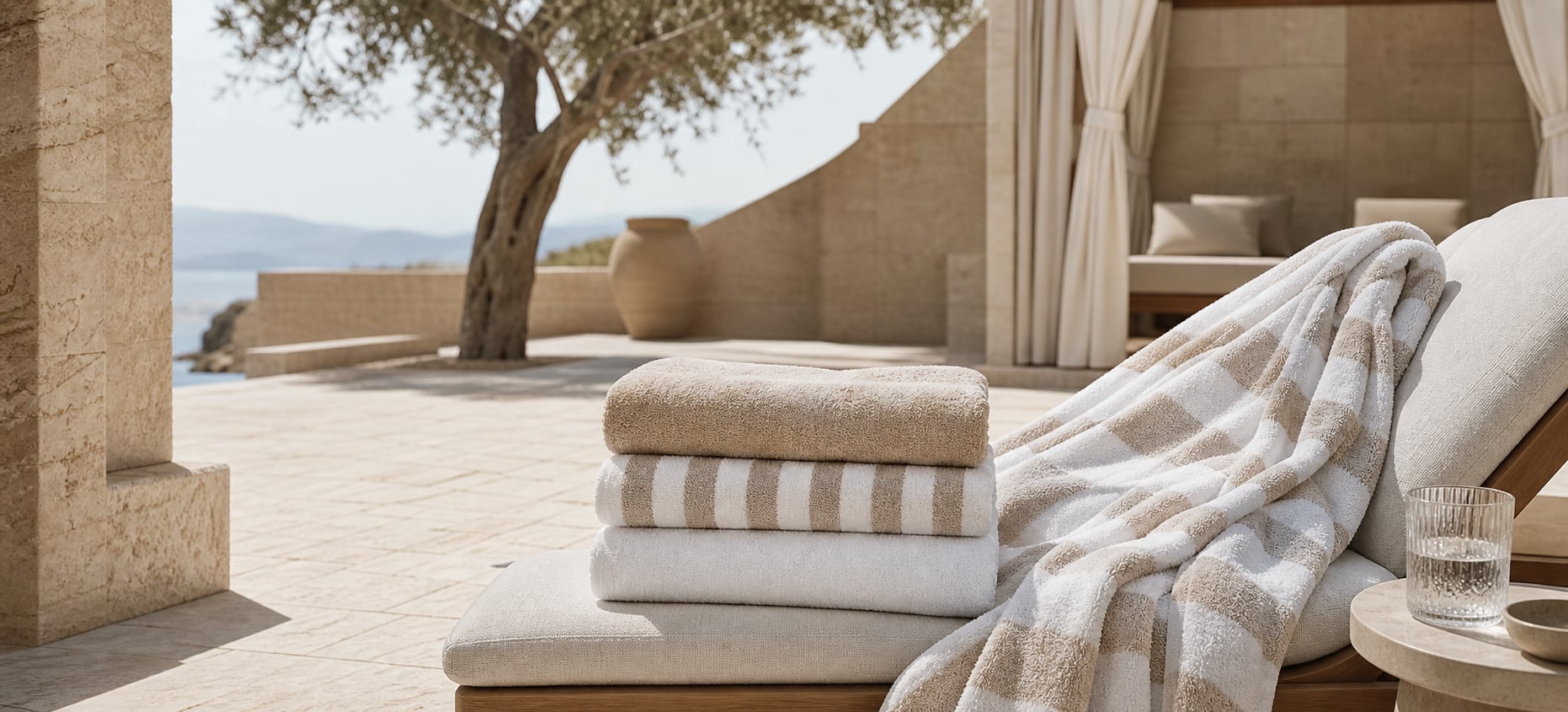
At equal finished dimensions, a 600 GSM towel contains more mass than a 500 GSM towel. It may feel denser and offer more absorbent material, while the 500 GSM option may be lighter to dry, fold, store and handle. Neither weight is automatically better for a hotel because pile, yarn, ground, finish, size and laundry can change the result.
The comparison is valid only when dimensions and other construction variables are known. A larger 500 GSM bath towel can weigh more as a complete piece than a smaller 600 GSM towel. Procurement should compare both GSM and conditioned piece weight, then test full-size samples after the intended care process.
Calculate the piece-weight difference at the approved size
For a rectangular towel, area in square metres equals finished width in metres multiplied by finished length in metres. Multiply that area by GSM to estimate nominal dry mass. At the same area, 600 GSM carries 20% more mass than 500 GSM because 600 is 1.2 times 500. Actual conditioned piece weight and tolerance should still be measured.
Do not turn that mathematical difference into a 20% claim about absorbency, drying time, durability, price or quality. Those outcomes are influenced by construction and process. The calculation shows only mass per equal area.
| Decision | 500 GSM starting tendency | 600 GSM starting tendency |
|---|---|---|
| Dry mass at equal size | Lower | 20% higher by nominal GSM ratio |
| Initial hand | Often lighter and less dense | Often fuller and denser |
| Wet handling | Potentially lighter complete piece | Potentially heavier complete piece |
| Drying and storage | May reduce demand and volume | May require more capacity |
| Guest positioning | Can suit efficient, crisp programmes | Can suit a fuller tactile brief |
| Required evidence | Processed full-size trial | Processed full-size trial |
Construction can narrow or widen the felt difference
A 500 GSM towel with a bulky, low-twist pile can initially feel fuller than expected; a compact 600 GSM construction can feel firm. Ground weight, loop height, density, yarn preparation and finishing affect loft and surface. Compare declared construction and do not assume GSM tells where the mass sits.
After laundering, applied softness and pile orientation may change. Inspect hand, surface, lint, loops, borders and dimensions after several representative cycles. The hotel should approve the processed state rather than the delivery impression.
Compare absorbency with a consistent method
The additional mass in a 600 GSM towel can contribute capacity, but fibre accessibility, twist and finish affect wetting and water uptake. Test rate and capacity consistently if those metrics matter, and also assess how the towel dries the skin in use.
A towel holding more water becomes heavier and transfers more moisture to the laundry. The desired guest experience should be balanced with extraction and drying rather than pursuing the largest capacity without consequence.
Measure the laundry and handling effect
Create representative loads with the same format and piece count or compare equal total load weight, clearly stating which method is used. Record extraction, drying endpoint, cycle or energy data where reliable, lint, folding and final hand. Do not publish a universal time saving from the GSM difference.
Test bundles on carts and shelves and ask staff to move wet and dry pieces. The effect depends on towel size, pieces per room, trolley capacity and route. A modest difference per piece becomes material when multiplied by the hotel’s daily volume.
Use the process in choosing hotel towels for commercial laundry and the dimensional method in the hotel towel size guide.
Choose by operating scenario, not category labels
A 500 GSM towel can be appropriate where fast room turnover, limited drying capacity, compact storage or a lighter hand is preferred. A 600 GSM towel can be appropriate where a fuller hand and denser presentation justify the measured processing and storage demand. Both can serve many hotel positions when well constructed.
If suites receive 600 GSM and standard rooms 500 GSM, define the guest purpose and manage labels, sorting and replenishment. Similar-looking weights can be mixed easily. The complexity should be justified rather than used as an assumed status hierarchy.
Run the comparison on equal terms
- Confirm equal finished dimensions, composition and intended format.
- Record GSM tolerance, conditioned piece weight, pile, yarn, ground and finish.
- Retain controls and process several marked towels per option.
- Compare hand, wetting, capacity, lint, loops, borders and dimensional change.
- Measure drying, folding, bundle weight and storage with stated conditions.
- Review the full-size pieces in the intended bathrooms.
- Approve a processed sample and document any room-specific allocation.
The choice between 500 and 600 GSM is therefore a balance of density and operations. The 600 GSM option is heavier at equal area; whether that added mass creates enough value depends on the complete towel and the hotel’s measured process.
Use the results when reviewing the hotel bath-towels family and the wider Stay collection.
Product catalogue
Request the Stay catalogue
Share your business email and, if useful, your company or property name. We will carry these details into the secure catalogue-request form with the relevant category already selected.
Journal
Continue reading
What GSM Is Best for Hotel Towels?
How to interpret grams per square metre without treating towel weight as a standalone quality score.
Read What GSM Is Best for Hotel Towels?How to Choose Hotel Towels for Commercial Laundry
A process-led towel specification covering wash, extraction, drying, lint, borders, folding and guest-room results.
Read How to Choose Hotel Towels for Commercial LaundryHotel Towel Size Guide: Bath, Hand, Face and Bath Mat
A focused guide to choosing finished towel dimensions by function rather than copying universal size labels.
Read Hotel Towel Size Guide: Bath, Hand, Face and Bath Mat