






















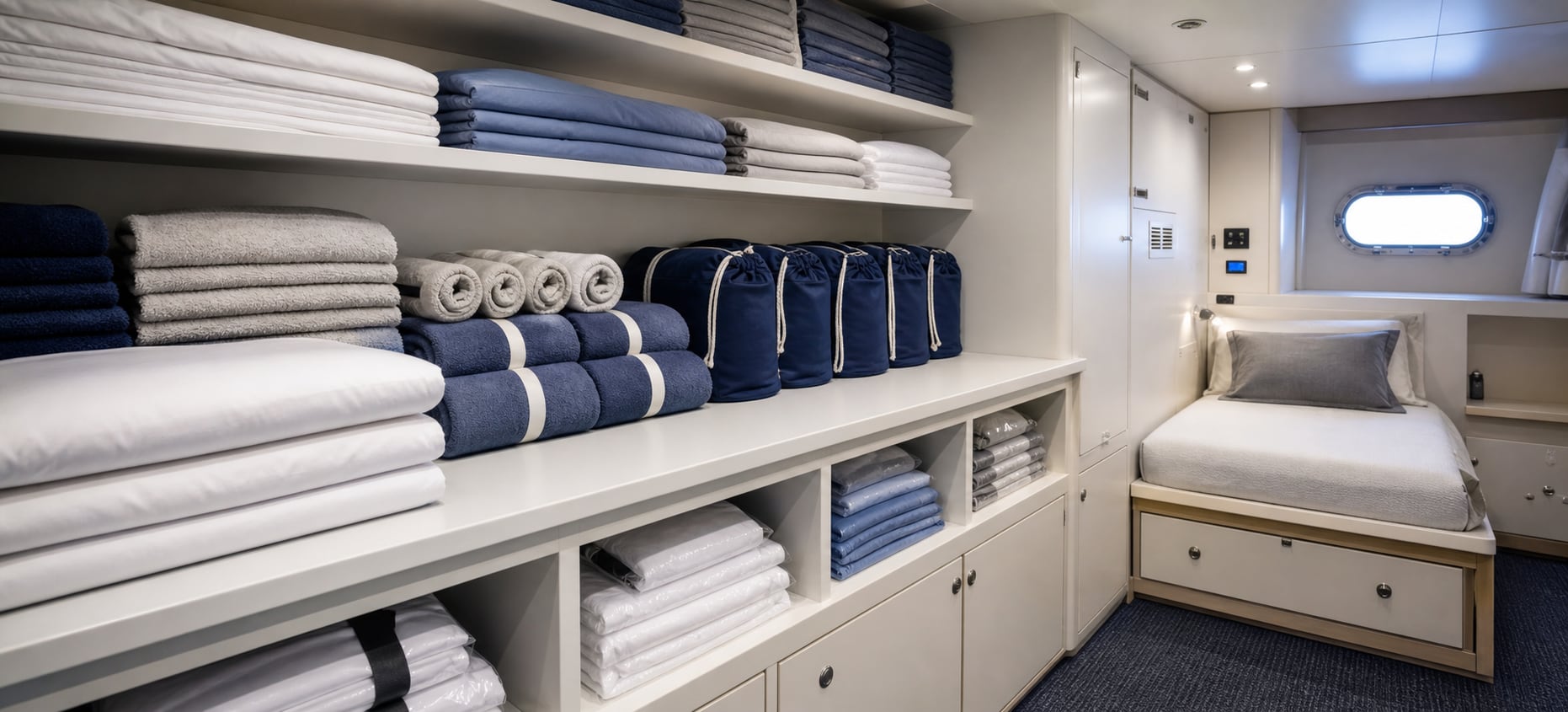



Independent Hospitality

Stay
Bed, bath and in-room textiles developed around your dimensions, quality standards and identity, with a clear specification from first sample to repeat order.
Stay Collection
Built for Hospitality
The right textile program depends on the scale, identity and operating rhythm of the property. We shape the approach around those requirements rather than forcing every property into the same standard.
Independent Hospitality

Multi-Property Hospitality

Destination Hospitality

Extended-Stay Hospitality
Working with Gencer
We take Stay textiles from initial requirements through sampling, approval and delivery, then keep the approved specification as the reference for future orders.
We begin with the products, where they will be used and the standard the property wants to achieve. From there, we define the important details such as material, construction, dimensions, weight, colour and finishing.
Where sampling is useful, we prepare the material, product or custom detail that needs to be reviewed before production so the decisions that matter are clear.
Approved dimensions, materials, colours, construction, finishing and custom details are recorded as the reference for the order and future requirements.
Once the specification and commercial details are confirmed, production and delivery proceed against the approved reference and agreed project requirements.
For repeat or replacement requirements, we return to the approved specification and previous order context instead of defining the product again.
One clear specification, carried from first approval into future requirements.
Gencer Studio
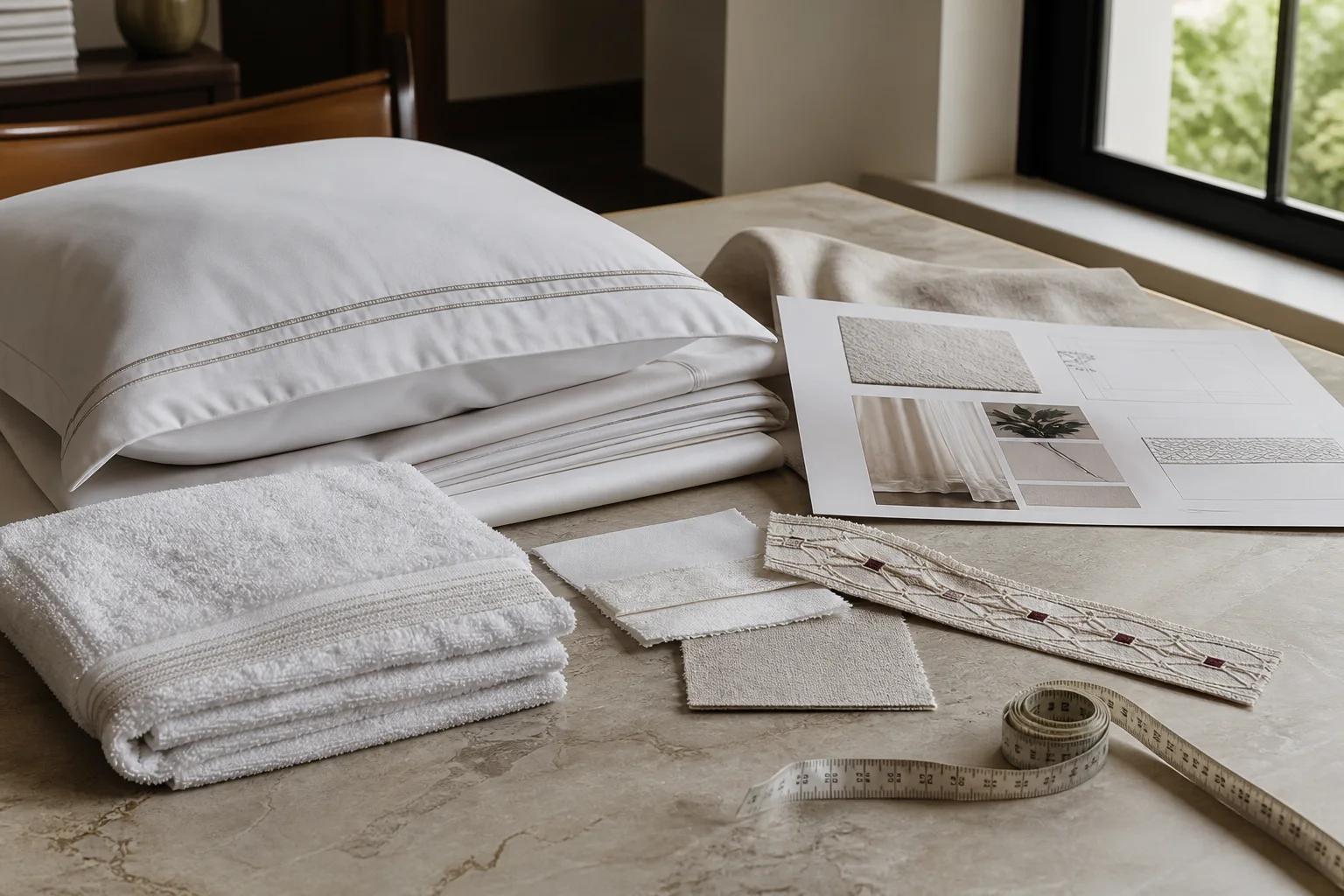
Gencer Studio helps shape the textile around the property, how it feels, how it fits, and how the property's identity appears in the finished details.
Fabric & construction Thread count & towel weight
Choose the material, construction and weight around the guest experience and daily use.
Bed & pillow dimensions Towel & bath sizing
Adapt dimensions to the room, bed, bathroom and product rather than relying only on standard formats.
Colour & embroidery Finishing, labels & packaging
Carry the property's character through colour, monograms, borders, labels and presentation.
Beyond the First Order
Once a product is approved, we keep the important details connected to the property so repeat requirements can start from an established reference instead of from zero.
The Reference
Material, dimensions, weight, colour, finishing and property-specific details remain recorded as the reference for future requirements.
The Next Requirement
When replacements or repeat quantities are needed, the conversation can begin from the established specification instead of defining the product again.
The Relationship
Specifications, orders, documents and replenishment requests remain connected to the property through the ongoing Gencer relationship.
Stay Guidance
Practical answers on hotel textiles, customisation, sampling, orders, operations, repeat requirements and working with Gencer.
A typical room program covers bed sheets, pillowcases, duvet covers, pillows and duvets, together with mattress protection. Bathrooms usually need bath, hand and face towels, a bath mat and often bathrobes or slippers. Decorative pieces may be added by room type. The final list should follow the property concept, housekeeping method and guest experience rather than a generic checklist.
There is no single thread count that suits every hotel. Thread count should be assessed with fibre quality, yarn, weave, finishing, wash performance and the hand feel the property wants. A well-made lower-count sheet can outperform a poorly constructed higher-count one. Compare complete specifications and test how the fabric behaves after laundering, not the number in isolation.
Percale usually feels crisp, light and cool, with a matte appearance. Sateen generally feels smoother and softer, with a subtle sheen. Neither is universally better: climate, room positioning, laundry process, desired presentation and guest preference all matter. The practical choice is the weave that delivers the intended feel while remaining manageable through repeated hotel laundering.
GSM describes fabric weight, not overall quality. A higher-GSM towel can feel fuller and absorb more water, but it also retains more moisture and may require longer washing and drying cycles. A lighter towel can be easier to turn around operationally. Select GSM alongside fibre, construction, size, laundry capacity, storage and the experience expected by guests.
A useful specification identifies the product, composition, construction, dimensions, weight or thread count where relevant, colour, finishing and care requirements. It should also record branding, labels, packaging, room or property allocation and the approved reference. Clear specifications allow different teams to discuss the same product and give repeat orders a reliable starting point.
Cotton and cotton-rich blends are common because they offer familiar comfort and established laundry performance. The right choice depends on fibre and yarn quality, weave, desired softness, durability, drying and ironing requirements, climate and budget. Material names alone do not describe performance; construction and finishing need to be reviewed with the intended commercial laundry process.
No. Very high figures can be achieved in ways that do not necessarily improve comfort or service life. Fibre length, yarn consistency, weave density, finishing and laundering often matter more than a headline number. Buyers should compare physical samples, full construction details and wash behaviour. Thread count is useful when it is one clearly defined part of a complete bed-linen specification.
No. Extra weight can create a plush first impression, but it may also increase drying time, energy use, storage volume and handling effort. Absorbency and durability depend on fibre, yarn and construction as well as GSM. The better towel is the one that balances guest feel with the property’s laundry capacity, turnaround time and replacement plan.
Many properties combine a bath towel with hand and face towels, plus a bath mat. Some add a larger bath sheet, pool towel or separate spa towel. Dimensions should fit the bathroom layout, guest positioning and housekeeping process. Define every size explicitly; labels such as “standard bath towel” can mean different things to different teams or markets.
A bath sheet provides more coverage and can support a more generous guest experience, but it occupies more laundry, drying and storage capacity. A bath towel is more compact and may suit faster operational turnover. Some properties use both by room category. Compare dimensions, weight per piece and circulation needs before deciding, not the product name alone.
Hospitality pillows and duvets should be selected around comfort level, filling, support, warmth, allergy considerations, care method and replacement cycle. Room temperature and climate also affect duvet weight. Properties may offer more than one pillow type. Covers, protectors and accurate finished dimensions should be considered with the insert so the complete bed works as intended.
A mattress topper changes the comfort layer of the bed by adding cushioning or support. A mattress protector creates a removable protective layer over the mattress. Bedding protection is the broader group that may also include pillow or duvet protection. Each serves a different purpose, so dimensions, breathability, fastening, laundering and the required level of protection should be specified separately.
Yes. Suites, standard rooms, connecting rooms and accessible rooms may require different dimensions, comfort levels, presentation or branding details. The important point is to record those differences clearly rather than relying on informal room names. A shared design language can remain consistent while product references and quantities stay specific to each room category.
Compare like with like: composition, construction, dimensions, weight or thread count, finishing and care requirements. Handle samples, check seams and details, and review performance after the intended wash process where appropriate. Consider cost per useful cycle, not only unit price. The best comparison also includes how consistently the specification can be documented, approved and ordered again.
Provide mattress and duvet dimensions, sheet style, pillow sizes, required products, composition or quality direction, weave, colour, finishing and estimated quantities. Include room categories, laundering conditions, branding and target timing where relevant. Existing samples or technical references are useful. Clear inputs make the quotation comparable and help identify where further specification work is needed.
Property-specific dimensions can be developed where the product, quantity, material and production method allow. Measure mattress width, length and depth, including any topper, and define the required sheet style and allowance. Gencer Studio uses those details to shape a clear specification before sampling or quotation rather than treating “custom size” as a single generic option.
Embroidery, monograms and selected identity details can be reviewed according to the product, artwork, placement, scale, colour, quantities and laundering conditions. The detail should support the textile rather than compromise comfort or care. Artwork and physical execution may need approval before production, and exact commercial implications are confirmed against the project.
An existing towel, sheet or finished product can provide a useful starting reference for dimensions, hand feel, weight, construction and finishing. It may not always be possible to reproduce every element identically, particularly when original materials are unknown or unavailable. Gencer can review the reference, define measurable requirements and present an appropriate development direction for approval.
Colour development may be possible depending on fibre, construction, dyeing method, quantity and required tolerance. A physical colour reference is more reliable than a screen image. Sampling and approval may be required, and normal material or production variation should be understood. Exact quantities, pricing and timing are confirmed once the product and colour requirement are reviewed.
Gencer Studio develops the textile through material, proportion and identity. The team reviews how the product should feel and perform, defines dimensions and construction around the property, then refines colour, embroidery, labels and finishing where relevant. The outcome is an understandable specification and approval reference that can support both the first order and future requirements.
Depending on the product, development can address material, construction, weight, dimensions, colour, borders, embroidery, monograms, labels, finishing, packaging and room-set presentation. Not every option suits every textile or quantity. The useful approach is to begin with the property need and shape only the details that improve fit, identity, performance or operation.
Yes, where production requirements allow. Finished pillow or duvet dimensions, closure style, internal allowance, flange or border details and expected shrinkage should be defined. Existing inserts can be measured, but the measurement method must be clear. Recording the approved finished dimensions prevents room teams and future orders from relying on ambiguous labels such as king or standard.
Embroidery can be developed around artwork, thread colour, finished dimensions and placement, subject to product suitability and quantity. Scale should work with the textile and remain practical through laundering. A placement measurement and approved visual or physical sample are more useful than a general instruction such as “logo in the corner.”
Border proportions, weave details and selected design elements can be developed for suitable towel constructions. The border must be considered with absorbency, shrinkage, handle and laundering because a decorative decision can affect performance. Feasibility, quantity, sampling and timing depend on the chosen construction and are confirmed during specification development.
Labels may identify the property, product, size, room group or care information where suitable. The label material, position and wording should remain comfortable, durable and legible after laundering. Identification can also help housekeeping separate similar specifications. Requirements are reviewed with applicable product, quantity and production constraints.
Packaging, grouping and presentation can be considered around receiving, storage, room distribution and opening requirements. Products might be grouped by room, size or department where the project scope supports it. The right solution is operational rather than decorative alone, and feasibility depends on quantities, product mix and delivery requirements.
A coordinated program can connect bed, bath and decorative textiles through colour, proportion, borders, embroidery or labels without making every item identical. Materials react differently, so an exact colour may not appear the same on every construction. Gencer Studio can define a shared direction and approve each product in its own appropriate form.
Yes. A group can retain shared material or performance standards while giving each property its own embroidery, colour, label, size or presentation details. Those variations should be recorded by property and product reference. Clear separation protects the common program from accidental changes and supports more accurate repeat requirements.
Share the product and intended use, dimensions, estimated quantity, desired material or performance, colour and identity details, property location, laundering conditions and timing. Drawings, artwork, photographs or an existing sample can help. State which details are fixed and where Gencer should recommend a direction; that makes the first review more useful.
Property-specific development can introduce material minimums, additional setup, sampling and longer approval stages. The effect varies by product, construction and level of change, so there is no universal uplift or fixed minimum. Gencer confirms applicable quantities, quotation and timing after reviewing the exact requirement and current production conditions.
Sampling can be arranged where appropriate to the product and requirement. The useful format may be an existing quality sample, material swatch, embroidery trial, development sample or pre-production reference. Availability, cost and timing depend on the project. The purpose is to confirm important decisions before production, not to promise a sample for every initial enquiry.
Check dimensions, composition, construction, weight, colour, hand feel, seams, finishing, branding and care information against the intended specification. Consider the sample after the relevant wash process where appropriate. Record comments precisely and involve operations or housekeeping when their experience matters. Approval should identify what is accepted, not simply say that the sample “looks good.”
An existing product can help communicate size, construction, weight, feel and finishing. Gencer can assess it as a reference, although unknown materials or discontinued constructions may prevent an exact reproduction. The review should translate the physical item into a measurable specification and identify any alternatives that need approval before proceeding.
Approval may use physical colour references, lab dips, thread references, artwork, embroidery trials or finished samples depending on the product. Record colour, scale, placement and tolerance clearly. Digital images are useful for communication but may not show colour accurately. Production should proceed from the agreed reference and written specification.
The approved decisions are incorporated into the final production specification, together with quantity, packaging and delivery details. Gencer then confirms the next commercial and production steps for the order. If an approval includes comments or conditions, those should be recorded explicitly. The approved reference remains useful later when the property needs a repeat or replacement requirement.
Sampling is especially useful for new constructions, custom dimensions, colours, embroidery, unfamiliar materials or products that strongly affect guest feel and operations. A standard, previously approved product may need a different level of review. The appropriate route depends on risk, quantity, timing and how much of the specification is already established.
Not necessarily. An established product may be reviewed through an available quality sample or documented specification, while a property-specific product may need material, size, colour or branding development. The sampling plan should match the decisions that still need approval. Gencer confirms what is appropriate once the product and requirement are understood.
Where suitable options are available, comparing more than one direction can clarify trade-offs in feel, appearance, durability, laundering and cost. Keep the comparison focused: too many unrelated samples can make approval harder. Use the same evaluation criteria for each option and document why the selected specification best fits the property.
A sample review can lead to specific changes in dimensions, construction, colour, embroidery or finishing where technically feasible. Each revision may affect timing, quantity or cost, so comments should be consolidated before another stage begins. Once the final reference is approved, later changes need to be treated as specification changes rather than informal adjustments.
Not always. Products sharing the same material or detail may allow some decisions to be approved together, while dimensions, constructions or high-visibility elements may require individual review. The sampling plan should cover meaningful risk without duplicating work. Gencer can help identify which products or details need their own reference.
An embroidery trial can be useful for approving artwork, thread colour, density, scale and placement before applying it to a complete product. The base fabric still affects the final appearance, so the trial should use a representative material where possible. Final approval should connect the embroidery reference to the correct textile specification.
Measure the sample using an agreed method and compare it with the specified finished dimensions. Clarify whether measurements are before or after laundering and how expected shrinkage is handled. For fitted products, test against the actual mattress, insert or equipment where practical. Record tolerances and any approved adjustment rather than relying on a visual impression.
Approved specifications and key approval information can be retained as the reference for future requirements. A physical sample may also be useful where appropriate, but the written specification is essential because samples can age, be misplaced or show only one production point. The reference should identify material, construction, dimensions, weight, colour, finishing and branding.
Record the product reference, sample version, date, approver and any conditions or comments. Photographs can help, but they should not replace the physical or written reference for colour and construction. Procurement, design and operations should agree who has final authority. A clear record prevents different teams from approving conflicting versions.
A development sample explores a possible direction and may still change. An approved reference records what the client has accepted visually or physically. The final production specification translates that approval into complete instructions, including material, construction, dimensions, colour, finishing, branding, quantity and tolerances. Production and future repeats should refer to the final agreed specification.
Useful inputs include required products, dimensions, target specification, quantities, property and delivery location, timing, laundering context and any colour, branding, packaging or sampling needs. Existing references can help. If some details are undecided, identify them clearly so Gencer can separate specification questions from commercial assumptions.
Minimum quantities depend on the product, material, construction, dimensions and level of customisation. A standard item and a newly developed colour or weave may have different production requirements. Gencer confirms the applicable quantity when the requirement is reviewed and quoted; no single minimum can accurately cover the full Stay range.
Pricing can be affected by composition, yarn and construction, size, weight or thread count, finishing, quantity, customisation, sampling, packaging and delivery requirements. Compare quotations against the same written specification. A lower unit price may represent a different product or service scope, so unclear assumptions should be resolved before an order decision.
A boutique property can discuss a property-specific program, but feasibility depends on the selected product, construction, material and quantity. Some details may work at a smaller scale while others require production minimums. Gencer reviews the requirement and can clarify where an established quality, adapted dimension or different development route is more practical.
There is no reliable universal number. Planning should account for occupied rooms, laundry turnaround, items in use, items being washed, housekeeping reserve, damage and replacement stock. Different products may need different par levels. A property with outsourced laundry or seasonal peaks may plan differently from one with an on-site laundry and stable occupancy.
Yes, a quotation can review a coordinated mix of bed, bath and in-room textiles. Each line should still have its own size, specification and quantity so the commercial comparison remains clear. Grouping products can help plan the complete property requirement without hiding important differences between constructions or approval stages.
Different sizes can be reviewed within one requirement, subject to product and production conditions. List each finished dimension and quantity separately and connect it to the correct room category or property. This avoids using broad labels that may be interpreted differently and helps packaging, receiving and future replenishment.
Multi-property requirements can be reviewed together while preserving property-specific products, branding, quantities and destinations. Whether they can be combined commercially or operationally depends on specification alignment, timing and delivery scope. Clear property allocation is essential even when the broader program is coordinated as one group requirement.
They can affect material usage, production setup, sampling, artwork preparation and minimum quantities. A dimension change may be simple for one product and significant for another; colour development can require its own production conditions. Gencer confirms the commercial effect against the exact specification rather than applying a generic customisation surcharge.
A program can be phased, for example beginning with core bed and bath products before adding decorative or other room textiles. Define the first phase carefully and record the shared material or identity direction. Later additions can then start from that reference, subject to current availability and any new quantities or development needs.
The specification, quantities, commercial scope, approvals, packaging and delivery information need final confirmation before the order proceeds. Any outstanding sample or artwork decisions should be closed. Gencer then confirms the applicable production steps and timing. Acceptance should relate to a clearly identified quotation version so both sides work from the same scope.
Revisions can be reviewed before confirmation, but they may change pricing, minimums, sampling or timing. Send changes in one clear record and identify the affected product lines. Once an order is confirmed or production has begun, changes may no longer be possible or may require a separate commercial review.
Prepare a room and product list, finished dimensions, estimated quantities, quality direction, laundering context, property location, target timing and required identity details. Separate essential requirements from preferences. If a budget framework or existing product is relevant, share it. Better inputs allow Gencer to quote the intended product rather than fill gaps with assumptions.
Start with room inventory by category, the items used in each room and a realistic laundry circulation plan. Add opening setup, housekeeping reserve, expected damage and early replacement needs. Consider occupancy ramp-up and supplier timing without assuming every product needs the same reserve. Operations, housekeeping and procurement should validate the final calculation together.
Separate commercial views can be prepared where the project requires them. Provide a clear allocation of product, specification, quantity and destination for each property or room type. The structure of the quotation depends on the scope, but the underlying references should remain consistent so totals and differences can be understood.
There is no fixed lead time for every order. Timing depends on specification complexity, sampling and approval, quantity, customisation, material availability, production scheduling, packaging and destination. Gencer confirms an applicable timeline after the requirement is defined. Hotels should allow decision time as well as production and transport when planning an opening or refurbishment.
International delivery can be reviewed according to the destination, product origin, shipment size, documentation and agreed commercial scope. Requirements differ by project, so coverage, timing and delivery terms are confirmed during quotation rather than assumed. Share the complete destination and any receiving constraints early in the process.
Translate GSM into operational impact by considering weight per piece, daily volume, washer and dryer capacity, drying time, storage and staff handling. A fuller towel may suit the guest proposition but slow circulation. Testing representative options through the intended laundry process can reveal a better balance than selecting on GSM alone.
Circulation should cover linen on the bed, linen in the laundry process, clean stock ready for use and a practical reserve. The right level depends on collection frequency, wash and return time, occupancy, room changes, storage and replacement risk. Model the actual operating cycle rather than applying one standard number to every property.
Build a room and area schedule, assign products and specifications, confirm dimensions, estimate quantities and reserves, then work backwards from the operational date. Include sampling, internal approval, production, delivery and room setup. Refurbishments also need a plan for phased rooms and existing stock so old and new standards are not mixed unintentionally.
Material availability, construction, quantity, custom dimensions, colour or embroidery, sample revisions, approval speed, production scheduling, packaging, documentation and destination all influence timing. Delays often arise when decisions remain open. A complete specification and named approval process help Gencer provide a more meaningful schedule.
Bed, bath and other room textiles can be planned as one opening program while retaining separate specifications and approval needs. Coordination helps align delivery and room setup, but every product may not share the same production path. Priorities, critical dates and acceptable phased delivery should be discussed early.
Multiple destinations can be reviewed where the commercial and logistics scope supports them. Quantities, labels, packaging, receiving contacts and timing should be allocated by destination before confirmation. Additional handling or documentation may affect pricing and schedule, so the requirement should be included at quotation stage rather than added informally later.
Yes. Build the quantity plan from the room inventory and approved textile specification for each category. A suite may use different sizes, pillow quantities or decorative pieces from a standard room. Keeping those references separate supports more accurate ordering, room setup and later replenishment.
Share wash temperature, chemicals, drying method, ironing or finishing process, turnaround and whether laundry is on-site or outsourced. These conditions influence fibre, construction, colour, weight and expected shrinkage. The guest-facing textile and the care process must work together; selecting either in isolation can shorten useful life or slow operations.
Heavier or larger towels hold more water, occupy more drum and shelf space and take more effort to move. High guest turnover may favour a construction that dries and circulates efficiently. Storage limits also affect par levels. Compare guest feel with the complete daily movement of towels from room to laundry and back.
Not automatically. The heaviest option may feel substantial but can increase drying time, energy use, handling and stock volume. A well-constructed mid-weight towel may provide the desired softness and absorbency with better circulation. The choice should reflect hotel positioning and the real laundry system, not an assumption that more GSM always means more quality.
Shrinkage varies by fibre, construction, finishing and care process. Define whether quoted dimensions refer to new or laundered condition, review supplier guidance and test where necessary. For fitted sheets, duvet covers and other size-sensitive products, expected change must be considered with the mattress or insert so the product remains usable after laundering.
Track loss, damage, stains, wear and room additions by product rather than guessing one reserve percentage for everything. Combine that history with laundry turnaround, occupancy peaks and replenishment timing. Keep approved references and stock counts accessible to procurement and housekeeping so replacements do not gradually introduce unrecorded sizes or qualities.
Useful context includes room inventory, guest positioning, occupancy pattern, laundry setup, wash and drying process, storage, housekeeping turnaround, existing product issues, reserve policy, delivery access and target dates. These details help distinguish a textile that looks appropriate from one that will also work in daily service.
A repeat requirement starts from the previously approved product reference rather than a blank brief. Confirm the property, product, reference, quantity, destination and any requested change. Gencer then reviews current material and production availability and confirms the applicable commercial and timing details before the repeat order proceeds.
Approved specification information can remain connected to the property and product as a future reference. This can include material, construction, dimensions, weight, colour, finishing, branding and approval details. It provides a strong starting point, while each new order remains subject to current availability and production conditions.
The previous specification and approval record are used to review the new requirement. Product references reduce reliance on memory or informal descriptions, and requested changes can be separated from the established standard. Consistency is managed against that documented reference; it is not a promise of mathematically identical results across separate material or production runs.
Yes, a replenishment requirement can focus on selected approved products rather than repeating the entire original program. Identify the property, product reference and required quantity. Minimums, availability and timing are reviewed for the requested lines, which may differ from the conditions of the first order.
Describe the requested change and why it is needed. Gencer can review its effect on performance, sampling, quantity, pricing and timing. The revised version should receive a new clear approval record rather than silently replacing the old details, especially when some rooms or properties will continue using the original standard.
The useful reference may include product name and code, material, construction, dimensions, weight or thread count, colour, finishing, embroidery, labels, packaging, property allocation, approval date and previous order information. The exact record depends on the product. Together these details explain what was approved more reliably than a photograph alone.
They can be, but the commercial and production implications may change. A smaller replenishment quantity may face different minimums or setup conditions from the opening order. Gencer reviews the required quantity against the approved specification, current materials and production route before confirming feasibility and quotation.
New sizes can be developed while using the existing material, construction and identity reference where appropriate. Provide exact dimensions and room allocation, and confirm whether inserts or mattresses have changed. The added size should be documented and approved as its own product reference so future orders remain clear.
A new property can use the group’s established direction as a starting point while defining its own dimensions, room mix, branding, quantities and delivery needs. Existing standards should not be copied blindly if the operating context differs. Property-specific references keep the shared program organised without erasing necessary differences.
Textile fibres, dyeing and production can show normal variation between runs. The approved colour reference helps manage consistency, but zero variation should not be promised. Where appearance is critical, the current production reference can be reviewed before proceeding, and hotels may plan replenishment quantities to avoid unnecessary mixing within one visible setting.
Requested updates can be reviewed, but they create a revised specification rather than a pure repeat. Artwork, placement, dimensions or finishing may need fresh sampling or approval and can affect quantity, cost and timing. Record the new version clearly so the property can distinguish it from the previous approved reference.
Monitor usable stock, discard rates, occupancy, laundry circulation, planned room changes and the confirmed timing for the relevant product. Set a reorder point that allows review and production before reserve stock becomes critical. Different items wear at different rates, so towels, sheets, protectors and decorative products should not share one automatic schedule.
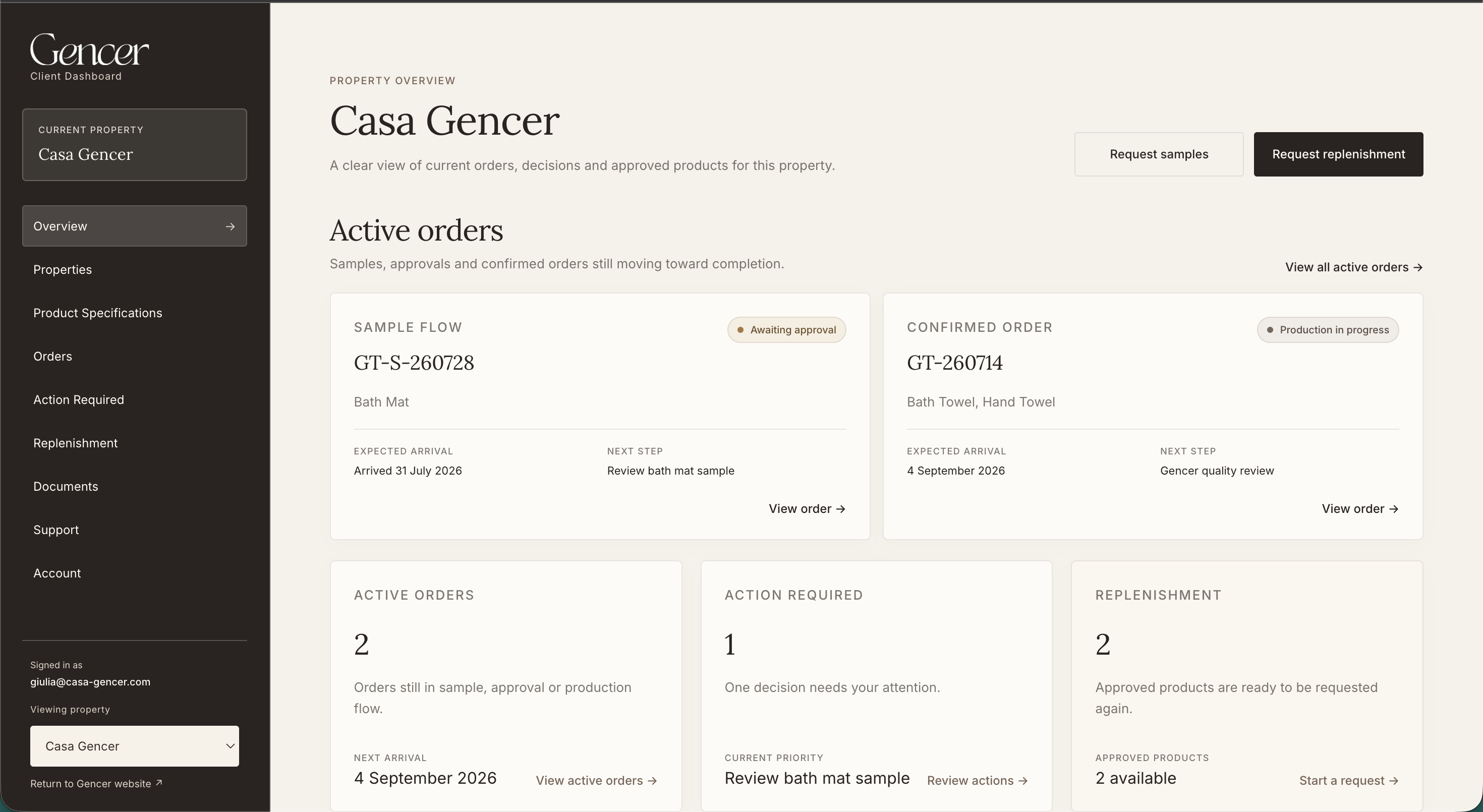
The current Client Portal includes a replenishment area where approved specifications can be selected by property and quantities can be prepared for review. It supports the conversation by keeping the product context attached to the request; clients can still contact Gencer directly when a requirement needs discussion.
Specification drift happens when teams gradually change sizes, materials or finishing because the original standard is unclear. Use property and product references, record approvals, control version changes and require repeat requests to cite the established specification. Give procurement, operations and housekeeping access to the same information and document any deliberate exception.
The Gencer Client Portal is a private environment that keeps property, specification, order, replenishment and document information organised around the client relationship. It gives authorised clients a clearer reference between conversations and repeat requirements. The portal supports direct Gencer service; it does not replace the people involved in reviewing specifications or orders.
The current portal is structured around an overview, properties, product specifications, orders, actions, replenishment, documents, support and account information. What appears depends on the client and property data connected to the authorised access. It does not present payment processing or promise live carrier tracking.
The portal data model supports more than one property and keeps specifications, orders and documents connected to the relevant property. Access and additional-property setup are handled by Gencer. The public interface does not promise unrestricted self-service account administration, so clients should discuss the required account structure with the team.
The Product Specifications area presents property-linked product references and the recorded details available for them. Depending on the record, this can include dimensions, material, construction, weight, colour, finishing, care, customisation and approval information. The portal provides the reference; questions or changes can still be reviewed directly with Gencer.
The replenishment workflow allows approved specifications to be selected for a property, with quantities, delivery context and notes prepared as part of the request. It is intended for products that already have an approved reference. New or changed specifications should be discussed with Gencer rather than treated as a simple repeat.
Access is provisioned by Gencer for an authorised corporate email. The current sign-in uses a one-time verification code rather than a reusable password. If an email is not authorised or account details need to change, the client should contact Gencer; the public login does not create accounts automatically.
The current public implementation confirms access through authorised email records but does not publish a multi-user role or permission system. If several colleagues need access, contact Gencer so the appropriate account arrangement can be reviewed. Teams should not assume that one verification code or authorised email is intended for unrestricted sharing.
The information can support different internal teams, but the current portal does not advertise role-based permissions for procurement, operations or management. Gencer should review who needs authorised access and how the account should be structured. The portal is a shared reference for the relationship, not a substitute for the hotel’s own approval responsibilities.
Yes. Specifications are linked to property records, allowing a group direction to coexist with property-specific dimensions, products and identity details. This structure helps avoid applying one hotel’s room standard to another by mistake. New or revised specifications still require the relevant review and approval process.
The Orders area is designed to organise current and previous order references connected to the property, including available status, product and document context. The exact history shown depends on the client record. Portal status supports communication but should not be interpreted as a guaranteed live feed from every external carrier or production system.
The current document structure supports quotations, invoices, specifications, approvals and shipping-related records when those documents have been issued and connected to the client or order. Availability depends on the project record. If something is missing, the Documents or Support route gives the client context for requesting it from Gencer.
Documents connected to the account can remain available for later reference, subject to the records Gencer has provided in the portal. This is useful when internal teams change or a repeat need arises. Clients can also contact Gencer if a document needs clarification or is not visible in the account.
Property filters and property-linked specification records allow products to be viewed in the correct hotel context. This helps distinguish similar items used by different properties or room standards. The usefulness of the view depends on accurate references, so deliberate changes should be recorded rather than communicated only informally.
A further property can be set up with its identity, contact and delivery context, then connected to its own specifications, orders and documents. Existing group references can inform the starting point, but Gencer should review the new property’s actual requirements. Property creation and access remain controlled rather than open public self-service.
No. The portal is infrastructure that keeps information organised and makes repeat requirements easier to reference, but it does not replace direct communication. Clients can work with Gencer through the agreed contact channels, and the team can help when a specification, order, document or replenishment request needs discussion.
Begin through the Gencer inquiry route with the property, products, quantities, destination and timing you know. The team can then review the requirement and continue the conversation with the right context. There is no need to solve every technical detail before making contact.
Yes. Share the intended use, guest positioning, laundering, dimensions, quantities, budget framework and any existing product issues. Gencer can help compare material, construction, weight, finishing and operational trade-offs. Recommendations still need to be confirmed through the normal specification and commercial process.
An existing program can be reviewed through product samples, specifications, wash performance, replacement history and feedback from housekeeping or guests. Gencer can identify what should remain, what needs clearer definition and where alternatives may improve the next reference. The aim is a practical specification, not change for its own sake.
Send a concise product and quantity list, property location, room count or categories, dimensions, target date, laundering context and any customisation. Include an existing specification, photograph, artwork or sample reference if relevant. Mark unresolved questions clearly. This helps the team respond to the actual requirement instead of making broad assumptions.
Use the established Gencer contact or the Client Portal support context where available. Include the property, order or specification reference and describe the question precisely. References allow the team to review the correct material, dimensions, approval and document history rather than relying only on a product name.
Gencer can help frame a like-for-like comparison around guest feel, appearance, laundering, drying, durability, storage and cost. Samples may be considered where appropriate. The most useful comparison begins with the property’s priorities, because a technically heavier or more expensive option is not automatically the better operational choice.
Yes. Gencer can work from the property’s design direction and coordinate specification, samples, quotation and product questions with authorised teams. Design choices should be translated into measurable textile details, while procurement and operations validate quantity, care and commercial requirements.
Support can continue around documentation, specification questions, replacement planning, repeat requirements and additional properties. The original reference provides useful context, subject to current materials and production availability. Clients can contact Gencer directly; the portal can support that relationship by keeping relevant records organised.
Contact the existing Gencer relationship or use the portal replenishment route where available. Provide the property, approved product reference, quantity, destination and required timing. If anything needs to change, state it separately so the team can distinguish a repeat from a revised specification.
Yes. Share the updated room schedule, dimensions and intended relationship to the existing standard. Gencer can review which specifications can continue and where new sizes, products or approvals are needed. The additions should be documented so later purchasing does not confuse old and new room requirements.
A further property can be reviewed and connected to the client relationship. Gencer will need the property identity, contacts, location and textile requirement before appropriate access and records are established. The current portal does not promise unrestricted self-service property administration, so setup should be coordinated with the team.
Existing clients can request available specification and order documents by providing the property and relevant reference. Portal documents may also remain accessible to authorised accounts. When internal responsibility changes, confirm authorised contact details with Gencer so information is provided in the correct account context.
Contact Gencer promptly with the property, order reference, affected products and quantities, photographs where useful, delivery condition and a clear description of the issue. The team can review the situation against the approved specification and order record. Outcomes depend on the specific facts and agreed terms, so no generic resolution should be assumed.
Use the Stay inquiry or catalogue flow to share the requirement without committing to an order. Explain what you are evaluating and which details remain uncertain. Gencer can respond with relevant product or specification guidance and clarify what information is needed for a meaningful quotation or sampling discussion.
Journal
Guidance on bed linen, bedding, bathroom textiles, room presentation, care, and replacement planning.

Hotel bed linen should be chosen for comfort, laundering resilience, visual consistency, and the daily rhythm of housekeeping. The right specification supports both the guest experience and the team maintaining it.

A lumpy pillow may still be damp inside, or its filling may no longer distribute evenly. Diagnose the insert before changing the wash or replacing stock.
Choose the top-of-bed system that performs best through the hotel’s complete room, laundry and stock workflow—not the one with the strongest generic speed claim.

A freshly laundered protector at each guest changeover is a clear operating policy. Long stays, visible soil and product care limits need their own rules.
Stay Project
Share the products, quantities, dimensions, specifications or references you already have. We can begin from there.