
























How Many Towels Does a Hotel Need?
A hotel needs enough of each towel format to cover peak room presentation, changes during laundry turnaround and a documented operating reserve.
Published by Gencer Textiles

Calculate hotel towel quantities separately for bath towels, hand towels, face towels and bath mats. For each format, add the pieces needed to present every active room, the changes that occur before used stock returns clean, and a reserve tied to credible delays, extra requests, damage and loss. No universal towel par applies to every property.
A room multiplier can be a useful summary after the calculation, but it should not replace the inputs. Double occupancy, family rooms, suites, turndown, pool access, wellness services and outsourced laundry can produce very different requirements. A single total also hides shortages in one format.
Define the standard presentation for every room type
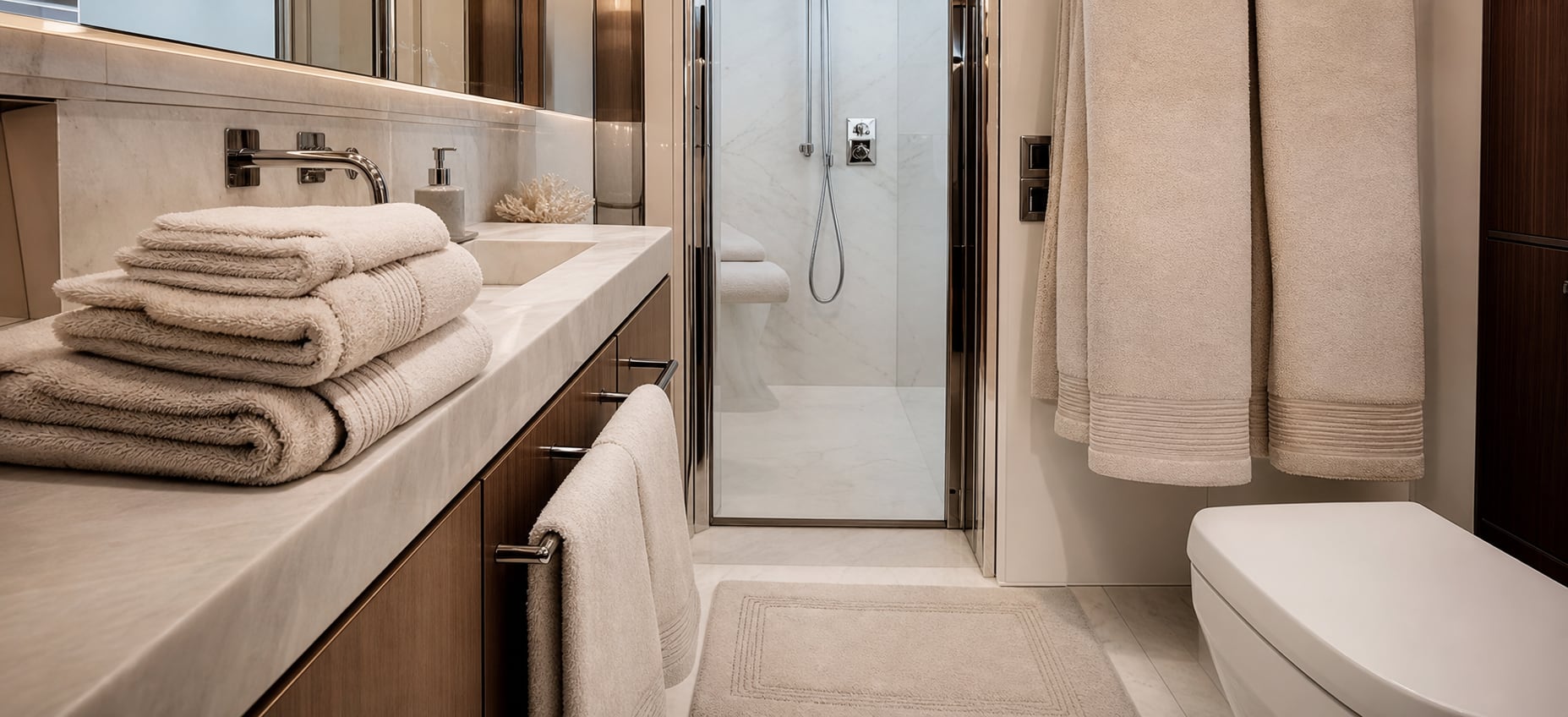
List how many bath, hand and face towels and bath mats are placed in each sellable room at maximum approved occupancy. Include additional toilets, connecting rooms and sofa-bed occupancy only where the service standard provides extra pieces. Distinguish fixed presentation from items supplied on request.
Avoid counting pool, spa, gym or staff towels in the guest-bath total. They have their own use and return patterns. If the same physical towel is intentionally shared across outlets, document that interchangeability and ensure labels, dimensions and laundry routes truly align.
| Input | How to obtain it | Risk if omitted |
|---|---|---|
| Room presentation by format | Housekeeping standard and room audit | One format runs short despite adequate total |
| Peak occupied rooms | Reservation capacity and credible peak mix | Average demand understates busy periods |
| Change and request events | Housekeeping issue data | Stayovers and extras are missed |
| Laundry turnaround | Collection-to-release measurement | Unavailable stock is underestimated |
| Outlet separation | Room, pool, spa and gym schedules | Stock moves without visibility |
| Reserve and loss | Risk policy and count history | Disruption or shrinkage causes shortage |
Calculate each format over the laundry turnaround window
For one format, begin with pieces required to present all relevant rooms. Add expected changes and requests occurring before a used piece returns to available clean stock. Add a reserve justified by the operation. Repeat for every format and size. The slowest critical item, not the largest total, often determines service risk.
Measure full turnaround, including collection, transport, queue, wash, extraction, drying, folding, quality check, delivery and release. Towels can spend more time waiting than washing. Use normal peak and disrupted observations rather than the fastest cycle.
Worked method with stated assumptions
Imagine 30 identical rooms, each presenting two bath towels and one bath mat. At the chosen peak, all rooms are active: 60 bath towels and 30 mats are on display. Before the next clean release, the hotel expects 40 bath-towel changes and 18 mat changes, then approves reserves of 15 and 8 respectively. The starting quantities are 115 bath towels and 56 mats. These numbers illustrate the formula, not a recommended par.
Model stayovers, requests and room moves
Guests may request extra towels, use pieces at different rates or move rooms. Stayover service policies influence how many items are exchanged. Use issue and collection data where available, separated by format and day. A blanket assumption that every occupied room consumes one full new set can overstate some pieces and understate extras.
Decide how unreturned extras are recorded. Towels held in occupied rooms are not available to the laundry pool, even if they have not been used. Longer stays can increase the number temporarily outside circulation. The calculation window should reflect this behaviour during peak periods.
Separate pool, spa, gym and guest-room stock
Outlet towels may be issued by guest count, treatment, lounger or activity rather than room. Their soil, dimensions and laundry route may differ. Create separate models, even when one laundry processes them. This prevents a busy pool day from silently draining bathroom reserve.
If guests can take room towels to the pool, decide whether the policy should change or the quantity model should include that movement. Operational controls such as distinct designs, issue points or collection bins can improve visibility, but they should be tested and communicated rather than assumed to prevent loss.
Build reserve from specific risks rather than a borrowed ratio
List the events reserve must cover: delayed laundry delivery, dryer outage, unusually high occupancy, extra requests, rejected stains or a transport interruption. Estimate how many pieces of each format remain unavailable and how long recovery takes. Review the assumptions with housekeeping and laundry.
Reserve also consumes space and capital. Excess stock can hide loss, age unevenly or occupy scarce linen-room capacity. The aim is not the largest buffer but a documented balance between service risk and control.
Exclude unusable and hidden stock from availability
Quarantined, stained, damaged, missing, repair and unprocessed pieces are not available. Floor closets and housekeeping carts may hold significant quantities that central counts miss. Conduct physical counts by status and location, using the same product code.
If the hotel owns enough towels but still has shortages, examine distribution, collection times, mis-sorting and stock retained in rooms. Buying more without identifying the bottleneck can increase total ownership while leaving the same operational failure.
Connect quantity planning to piece weight and laundry capacity
Changing dimensions or GSM changes kilograms per load, drying demand, folding volume and storage. Recalculate capacity when the towel specification changes, even if the piece count stays constant. A new, heavier bath towel may reduce the number processed or carried in the same equipment and trolley limits.
Use the guides to hotel towel GSM and hotel towel sizes to quantify those changes.
Review loss, rejects and replenishment before shortage
Record why each format leaves service: stain, pulled loops, border or hem failure, thinning, colour, loss or unexplained shortage. Different causes require different responses. Use the recent rate as planning evidence while acknowledging that occupancy and process changes can alter it.
Compare usable inventory with the quantity model on a regular cadence appropriate to the property. Allow time for specification confirmation, samples and delivery without inventing a supplier lead time. A trigger tied to usable stock is more reliable than waiting for attendants to report empty shelves.
Maintain a live towel quantity model
Test the model during a representative peak and record where emergency stock was taken from. Unused reserve, repeated borrowing between outlets and towels held in satellite closets reveal different problems. Adjust the relevant input instead of adding an unexplained multiplier. A pool surge requires outlet planning; a delayed laundry delivery requires turnaround reserve; missing face towels may indicate sorting or small-piece loss.
- List pieces per room and maximum rooms by type.
- Calculate bath, hand, face and mat formats separately.
- Measure full laundry turnaround and peak change events.
- Separate room, pool, spa, gym and staff stock.
- Define extra requests and towels held in occupied rooms.
- Set reserve against named disruption scenarios.
- Exclude rejected, quarantined, missing and hidden stock.
- Recalculate when size, GSM, service or laundry changes.
The correct towel quantity is the component-level stock that keeps presentation and service intact through the measured circulation window. Bring that model to the bath-towels product discussion so size, GSM and quantities are evaluated together instead of applying an unexplained room multiplier.
Document ownership of every stock location and reconciliation point. The person counting a floor cupboard, laundry cage or emergency store should use the same reference codes and status definitions. This prevents a transfer between departments from appearing as consumption or loss and makes the quantity model useful for replenishment rather than only for the opening purchase.
Review the resulting schedule against the hotel bath-towels family and wider Stay collection.
Product catalogue
Request the Stay catalogue
Share your business email and, if useful, your company or property name. We will carry these details into the secure catalogue-request form with the relevant category already selected.
Journal
Continue reading
Hotel Towel Size Guide: Bath, Hand, Face and Bath Mat
A focused guide to choosing finished towel dimensions by function rather than copying universal size labels.
Read Hotel Towel Size Guide: Bath, Hand, Face and Bath MatHow to Choose Hotel Towels for Commercial Laundry
A process-led towel specification covering wash, extraction, drying, lint, borders, folding and guest-room results.
Read How to Choose Hotel Towels for Commercial LaundryHow Many Bed Sheet Sets Does a Hotel Need?
A calculation method for hotel sheet quantities using actual beds, change events, laundry turnaround and operational reserve.
Read How Many Bed Sheet Sets Does a Hotel Need?