








Peshtemal vs Terry Towels: Which Works Better in a Hammam or Spa?
Flat-woven peshtemal and loop-pile terry solve different parts of the guest journey. Compare them by role, finished-piece performance and laundry throughput—not by tradition, appearance or GSM alone.
Published by Gencer Textiles

For most hammams and spas, the useful answer is not one winner. A peshtemal is usually better when the textile must wrap the body, move with the guest and occupy little space. Terry is usually better when the main job is to remove a substantial amount of water and deliver the familiar plush feel of a bath towel. Many well-planned operations use a peshtemal through the thermal journey and offer terry after the final shower.
That recommendation is a starting point, not a rule. “Peshtemal” and “terry” describe construction families, not guaranteed performance. Fibre, yarn, finished weight, dimensions, weave density, finishing and repeated laundering can make two products with the same name behave very differently. Approve a washed finished piece for each intended role.
Compare the two constructions
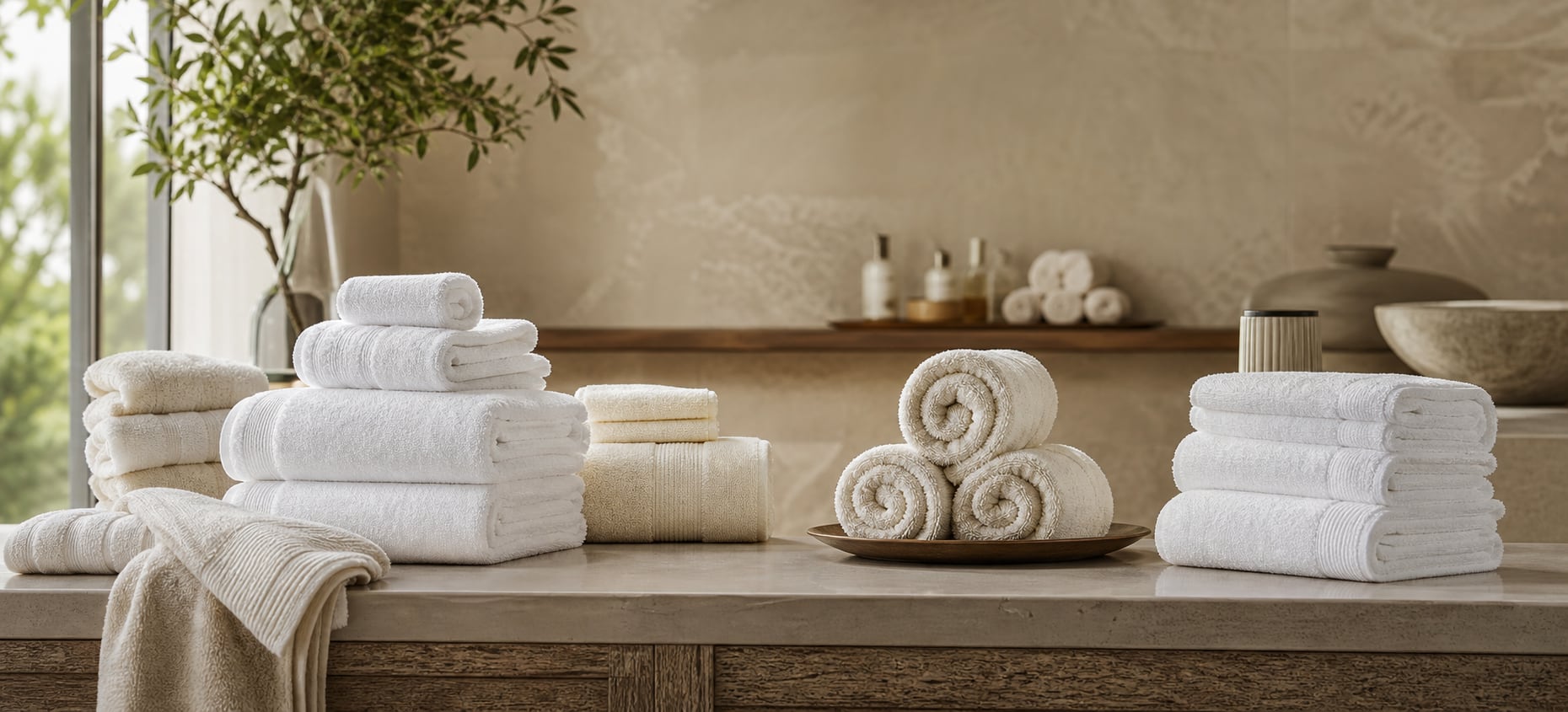
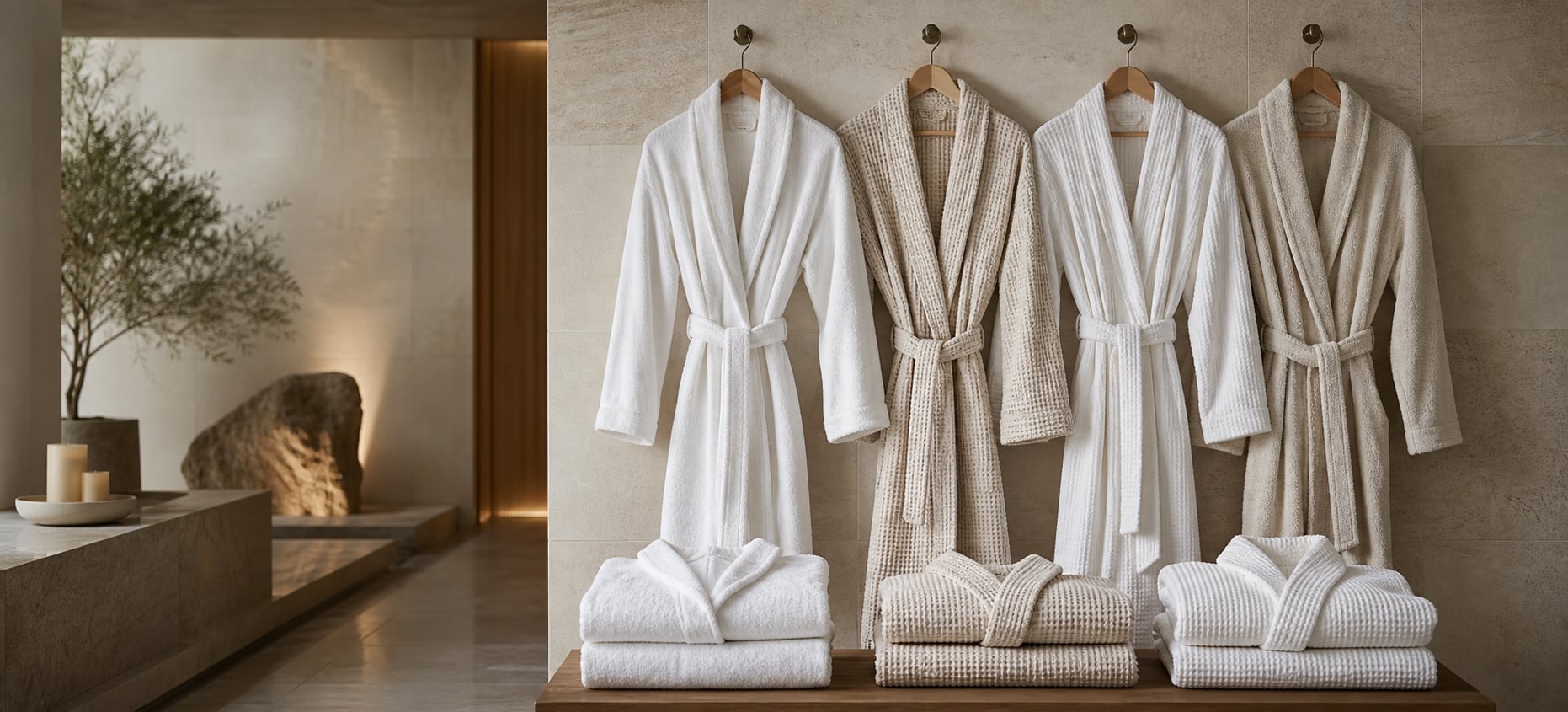
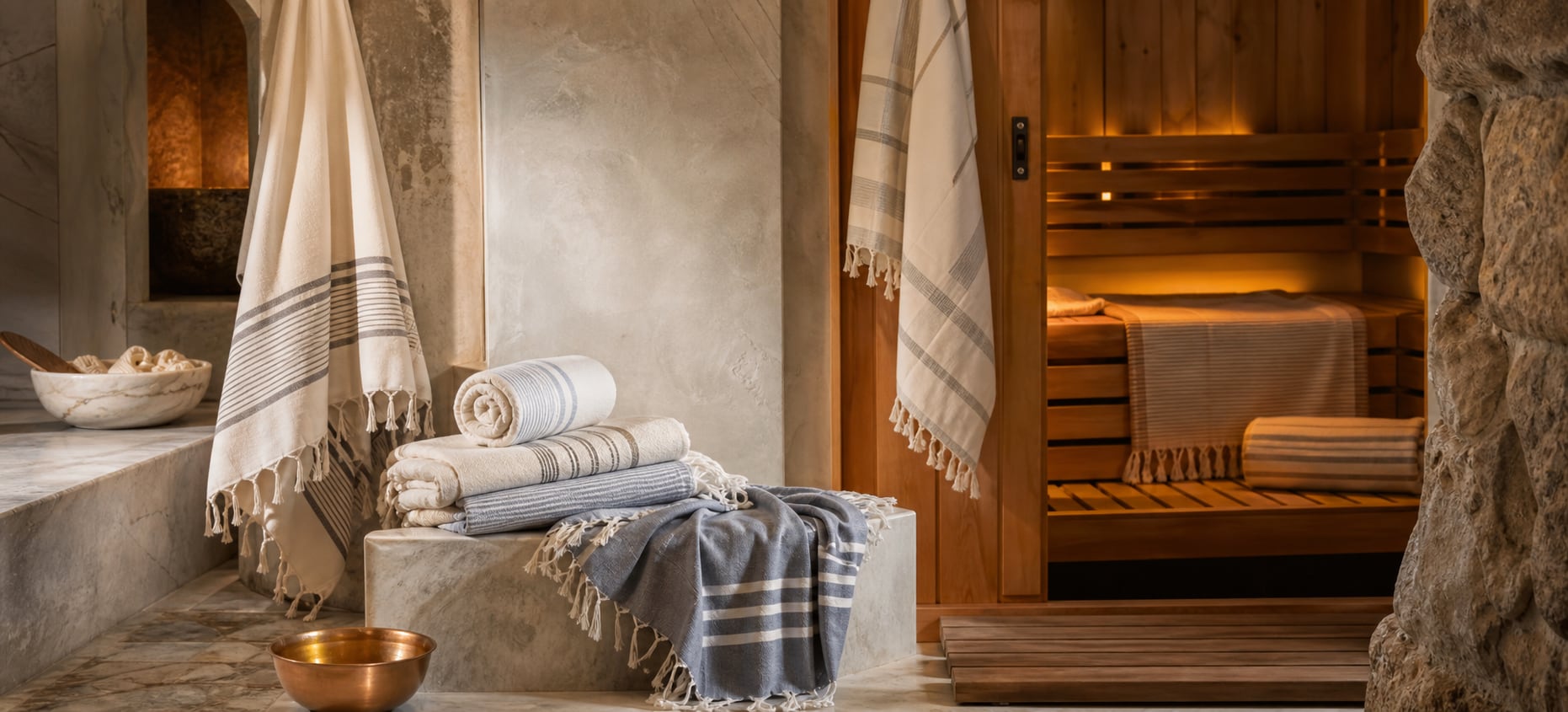
A peshtemal is a flat-woven, generally pile-free towel traditionally associated with bathing. Terry has loops standing from one or both faces of the ground fabric. The loops create a deeper, more cushioned surface; the flat weave creates a thinner, more cloth-like piece. Hybrid products with a flat-woven face and terry reverse also exist, so confirm the actual construction rather than relying on the product name.
| Question | Peshtemal | Terry |
|---|---|---|
| How does it handle? | Drapes and wraps readily; normally folds into a slimmer stack | Feels fuller and more cushioned; normally creates a bulkier stack |
| What is its strongest role? | Body wrap, modesty layer and light drying during the thermal journey | Final drying after showering or rinsing |
| What needs checking? | Wet coverage, opacity, edge or fringe security and water capacity | Loop pulls, lint, wet weight, drying time and shelf volume |
| What can vary? | Weight, density, yarn, weave, finish, fringe and dimensional change | Pile height and density, ground construction, yarn, finish and dimensional change |
Do not translate this table into “peshtemal dries fast” and “terry absorbs well” without testing. A light flat-woven piece will often contain less dry textile than a large heavy terry towel, which can reduce the material and water carried through handling and drying. But absorption speed, total water capacity and drying rate are separate properties. The finishing chemistry and the laundry process can affect them too.
Assign a towel to each stage of the guest journey
Map the route from changing room to warm room, steam or bathing area, rinse, relaxation and return to the locker. At each point, write down what the textile must do. A wrap needs secure coverage, comfortable drape and sufficient opacity when damp. A final bath towel needs useful drying capacity and a size guests understand without explanation. A textile placed on a bench or treatment surface has a different hygiene, coverage and replacement role again.
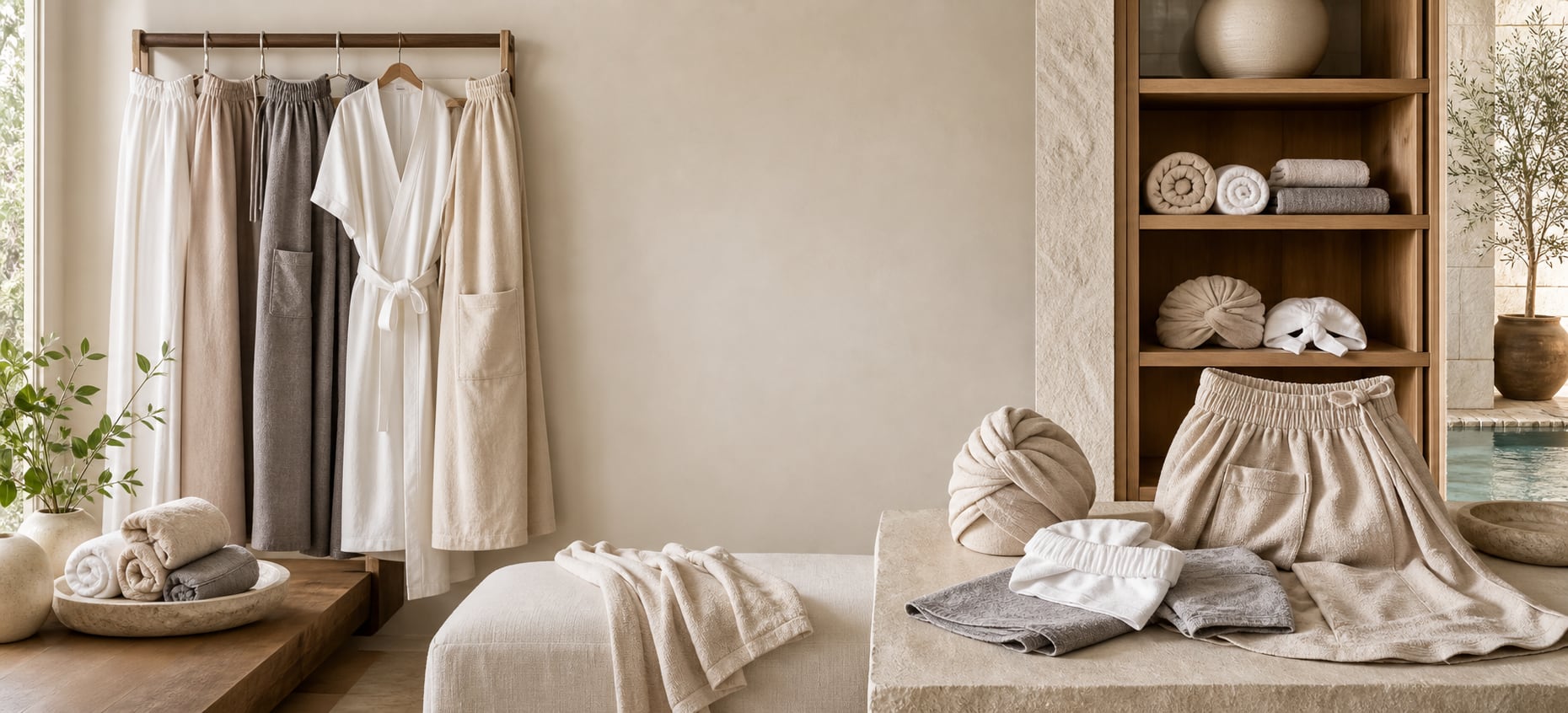
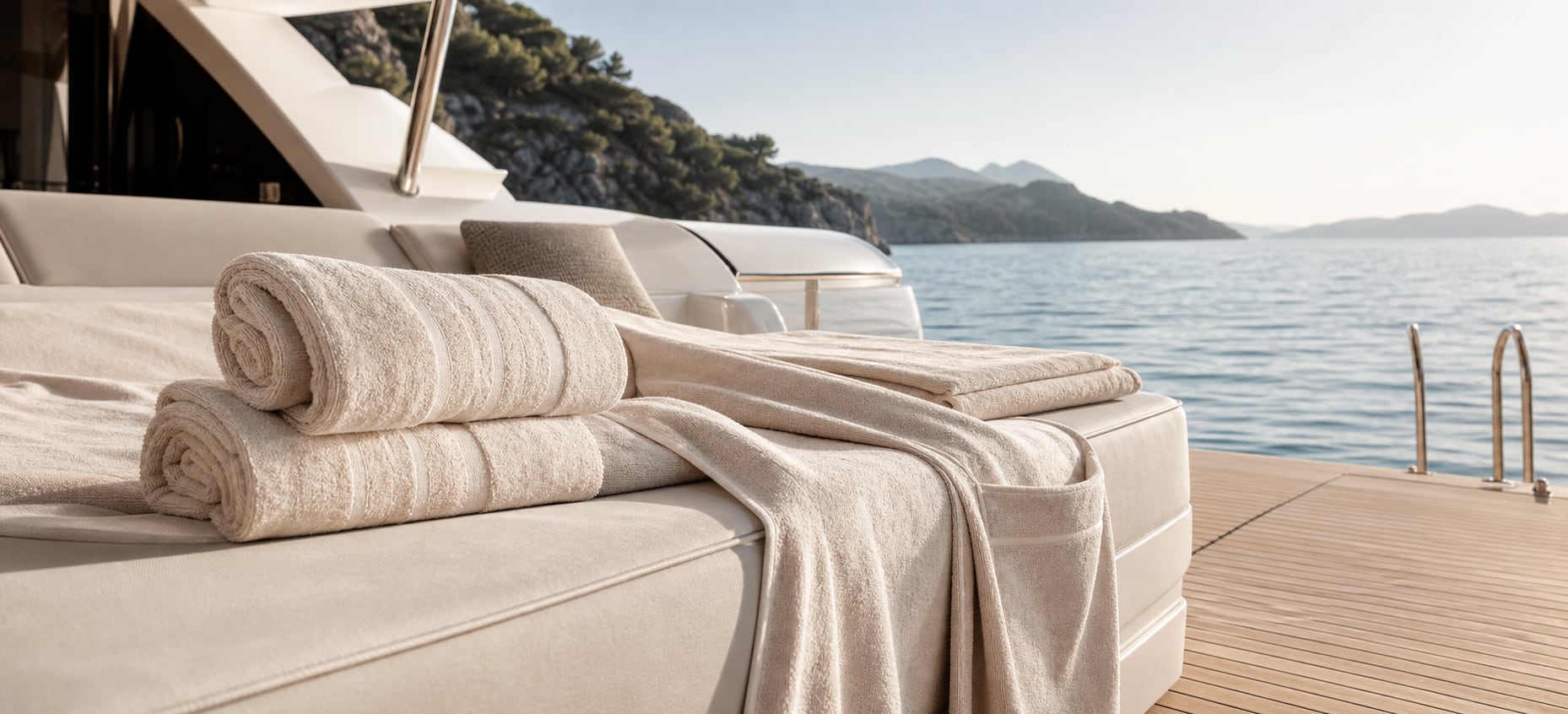
This is where peshtemal often earns its place. It can be wrapped around the body, carried easily between zones and folded into compact presentation stacks. Terry can be reserved for the point at which a guest is wettest. That avoids asking a relatively light wrap to perform like a substantial bath towel and avoids carrying a bulky terry towel through every stage.
If the concept promises one towel only, test whether it succeeds in both roles. A terry-backed peshtemal may combine a decorative flat face with a looped drying face, but it also brings more bulk than a single flat weave. It is an option to sample, not an automatic compromise.
Separate wetting, water capacity and drying
A towel can wet quickly yet have limited capacity, or hold a large amount of water and then take longer to dry. ISO 20158 distinguishes water absorption time from water absorption capacity for absorbent textile fabrics and specifically includes terry-looped and other constructions. AATCC likewise lists separate methods for absorbency and several forms of drying time or drying rate. The procurement lesson is simple: one vague “absorbent” claim cannot describe the whole performance.
Compare samples after the proposed wash and dry process. Record dry finished dimensions and mass. Use the same controlled wetting and extraction procedure for every sample, then record water uptake and time to the agreed dry endpoint. If laboratory data are required, specify the method and conditioning rather than accepting an unreferenced number from a brochure.
Also run a human-use check. Ask testers to wrap, walk, sit and dry with the product in the sequence the guest will follow. Look for clinging, sagging, transparency, poor coverage and a surface that merely moves water around instead of taking it up. Laboratory comparison and a realistic guest trial answer different questions; a strong approval uses both.
Calculate the laundry effect by finished piece
GSM is useful for describing mass per square metre, but the laundry receives whole pieces. Multiply the dry mass of the approved towel by expected daily uses for each role. For example, 120 uses of a 260 g wrap produce 31.2 kg of dry textiles, while 120 uses of a 520 g towel produce 62.4 kg. Those illustrative figures do not prove that either product will use a particular amount of water or energy; they show why finished-piece mass belongs in the capacity calculation.
Give the laundry both samples. Confirm washer loading, extraction, transfer weight, dryer program, moisture endpoint, folding method and pieces per trolley or shelf. A lighter item may improve throughput, but mixed constructions may need separate programs or finishing. Count the labour required to untangle, inspect and fold as well as machine time.
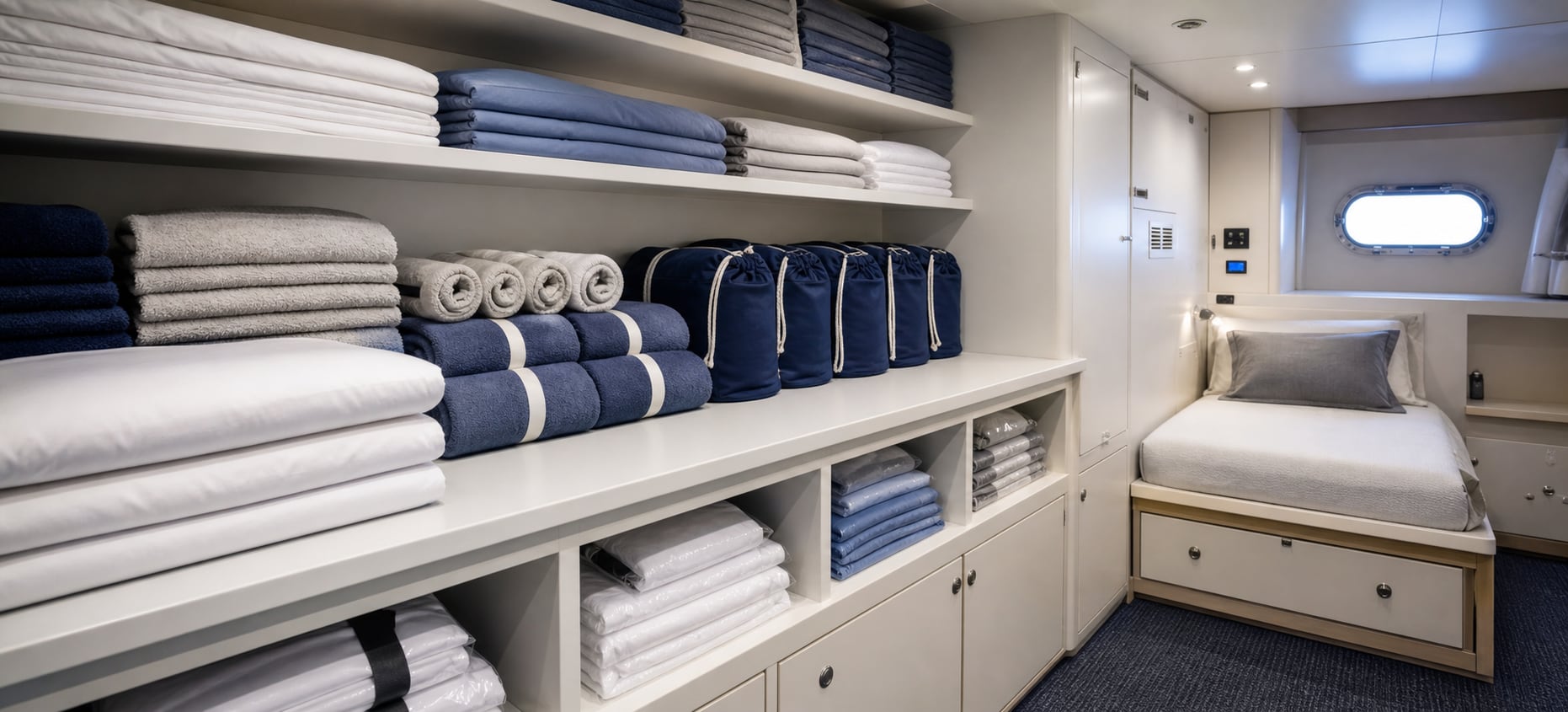
Measure storage rather than describing one option as “space-saving”. Wash and fold ten pieces of each approved sample in the intended presentation, then record stack height and shelf footprint. Repeat the exercise with the reserve quantity. This turns a general construction difference into a number the actual linen room can use.
Inspect edges, loops and appearance after laundering
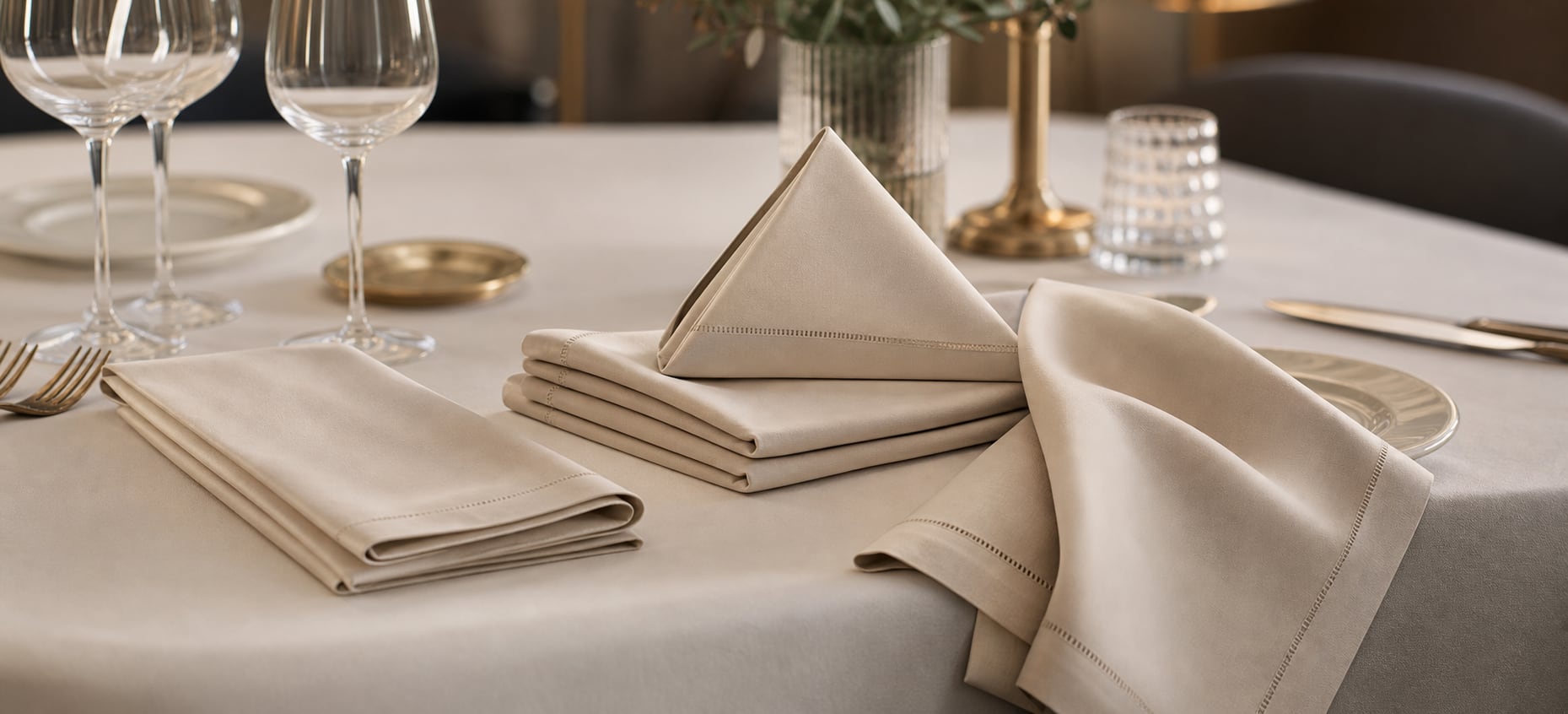
Peshtemal often uses twisted or knotted fringe, but hemmed and other finishes are available. Fringe can support the visual language of a hammam; it can also tangle, loosen or take extra handling in a commercial process. Specify the fringe or hem construction, inspect how it emerges from the washer and dryer, and agree what counts as a repair or rejection.
Terry has no decorative fringe requirement, but its loops can pull on rough surfaces, catches or damaged equipment. Inspect the ground fabric as well as the pile: a pulled loop, distorted border or weak hem can shorten useful life. New towels can also release loose fibre, so include lint, shade change, hand feel and presentation in the washed-sample review.
Test light colours for wet opacity and coloured products for the required colourfastness conditions. Keep supplier claims tied to a named method, grade and care process where performance matters. Do not assume that a natural-looking shade, a heavier GSM or a “premium cotton” label resolves construction and durability questions.
Keep oil-bearing textiles on their own route
A towel used only around heat, water and changing areas does not carry the same soil as a textile used with massage oils, balms or body treatments. Peshtemal does not make oily soil disappear, and terry does not become unsuitable merely because it has loops. If either construction enters treatment service, define the product exposure, collection time, sorting and wash process separately.
Persistent oil odour is a process signal, not a reason to mask the textile with fragrance. Use the diagnostic guide to spa towels that still smell of massage oil after washing and involve the chemical supplier and laundry before approving a shared stock pool.
Write a role-based specification
Name the item by its operational role—thermal-circuit wrap, final-drying towel, treatment cover or bench textile—then record construction. For each item, specify fibre composition, finished dimensions and mass after the agreed care process, colour, weave or pile, border, hem or fringe, label position and presentation fold. Add the performance checks that matter to that role.
- Check body coverage, closure and opacity on a damp wrap in the actual size range of guests.
- Compare absorption time, useful water capacity and drying performance as separate results.
- Record dimensional change, skew, colour change, lint, loop pulls and edge or fringe condition after the trial process.
- Calculate daily dry kilograms, dryer demand, pieces per fold stack and clean storage volume.
- Confirm whether water-only, oil-bearing and other soil groups require separate collection or wash routes.
- Approve a sealed reference sample and a specification that can be used for repeat orders.
Use the broader spa towel selection guide to compare weight, softness and operational resilience, then calculate the number of towels the spa needs by role and laundry turnaround rather than applying one stock ratio to every item.
Choose the system, not the symbol
Choose peshtemal when wrapping, compact presentation and movement through the thermal circuit are the priorities. Choose terry when final drying capacity and a plush bath-towel experience matter more. Choose both when the guest journey genuinely contains both jobs. The right answer is the smallest coherent system that gives guests the coverage and drying they need while the laundry can wash, dry, inspect, fold and replenish it reliably.
When reviewing hammam and sauna textiles, bring the journey map, laundry data and washed samples into the same approval. The visual character of the towel should support the experience, but its role and repeatable performance should decide the specification.
Product catalogue
Request the Wellness catalogue
Share your business email and, if useful, your company or property name. We will carry these details into the secure catalogue-request form with the relevant category already selected.
Journal
Continue reading
What Makes a Towel Suitable for Spa and Wellness Use?
Understanding absorbency, weight, softness, drying time, and operational consistency in professional wellness settings.
Read What Makes a Towel Suitable for Spa and Wellness Use?How Many Towels Does a Spa Need?
Count every towel format through the busiest interval before clean laundry returns, then add measured unavailable stock and a reserve for a named disruption.
Read How Many Towels Does a Spa Need?Why Do Spa Towels Still Smell of Massage Oil After Washing?
A clean-looking towel can retain massage oil or pick it up again in the wash. Diagnose when the smell appears, then correct the whole treatment-to-laundry route.
Read Why Do Spa Towels Still Smell of Massage Oil After Washing?