

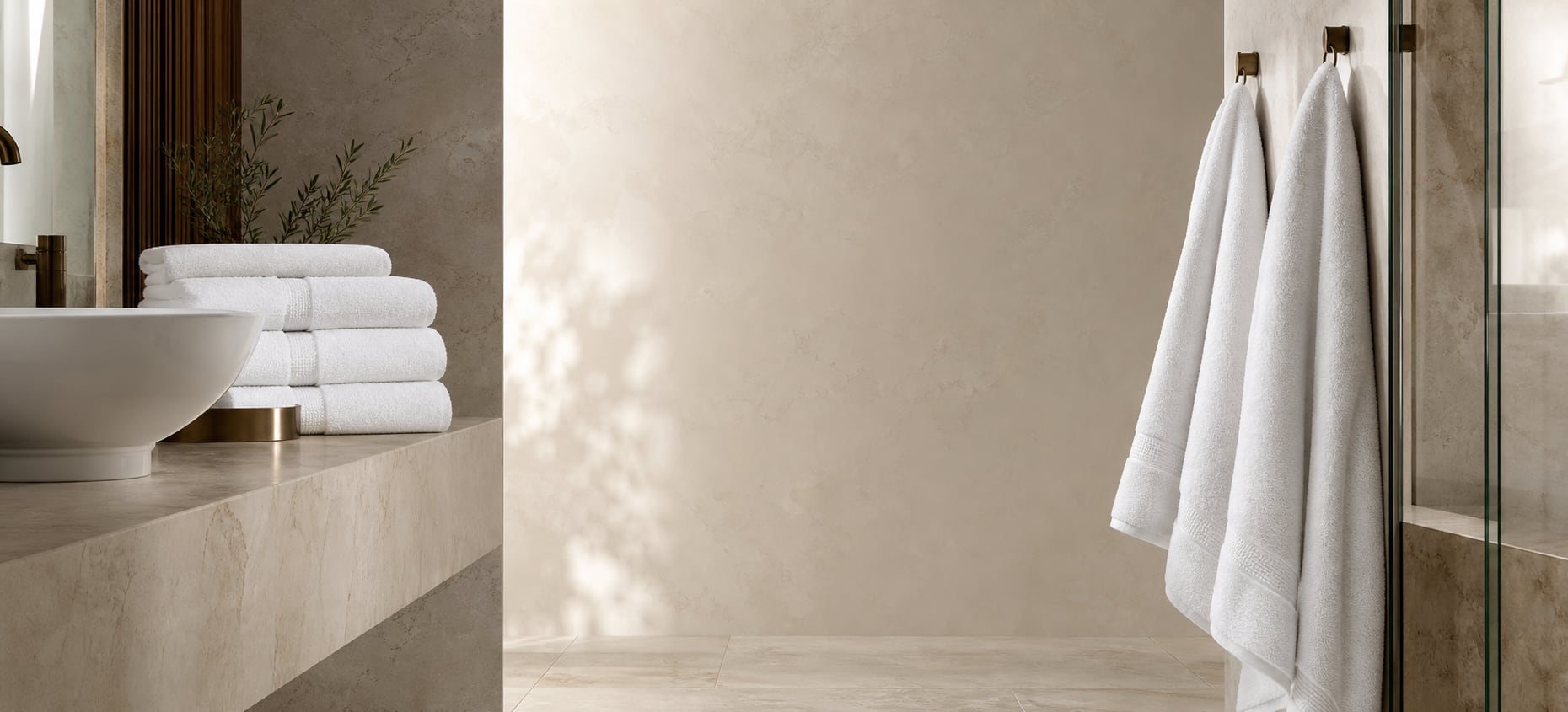



White vs Dark Treatment Linen: Which Handles Massage Oil Better?
Choose the colour whose appearance, approved chemistry and shade stability survive the spa’s real treatment and laundry route. Then prove oil release on the finished linen: dark fabric can hide residue, and white fabric can still retain it.
Published by Gencer Textiles
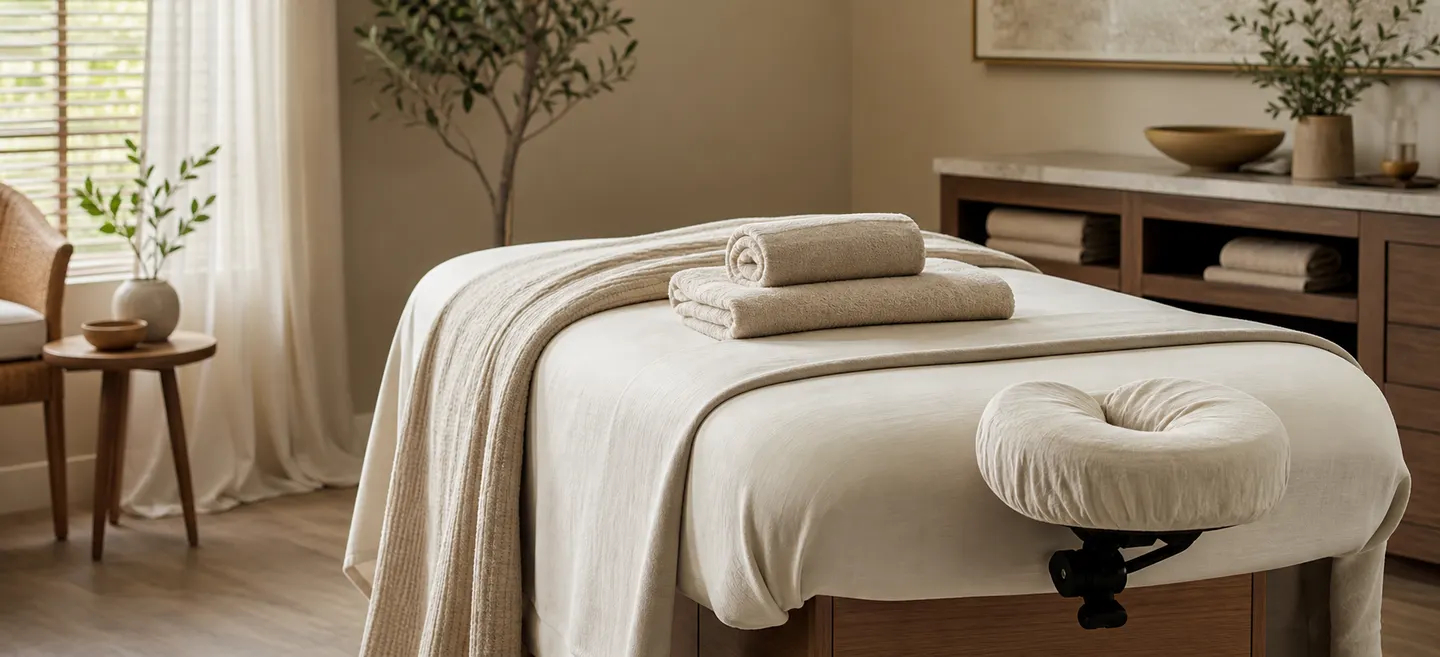
Dark treatment linen can make some oily shadows less conspicuous during service. White linen usually makes yellowing, greying and many treatment marks easier to compare against a clean reference, and a compatible white construction may tolerate laundry options that a dyed fabric cannot. Those are appearance and process differences—not proof that either colour releases massage oil better.
Oil removal depends on the treatment product, fibre, yarn and fabric construction, finishes, time before washing, load sorting, chemistry, temperature, mechanical action, rinsing, extraction and drying. A dark sheet can look even while carrying residual oil; a white sheet can look clean and still retain enough oil to smell or cause a laundry-safety concern. The useful question is therefore which complete linen and care system performs better, not which colour hides the evidence.
Colour changes the evidence, not the oil
| Decision point | White or light linen | Dark linen | What actually decides |
|---|---|---|---|
| Fresh oily mark | Often appears as a darker, translucent or yellow-toned area | May blend into the shade or appear as a halo, gloss or uneven patch | Oil type, amount, surface, pile and lighting |
| Residual soil after washing | Greying, yellowing and local shadows may be easier to compare | May be masked until odour, handle or repeated build-up becomes obvious | A defined inspection plus oil-release testing |
| Laundry chemistry | A compatible white product may allow a broader stain-recovery route | The formula must remove oil without unacceptable dye change or transfer | Fibre, dye, finish, trim and approved care process |
| Appearance ageing | Can grey, yellow, lose brightness or show optical-brightener differences | Can fade, crock, look dusty or develop shade variation | Colourfastness and repeated real-process trials |
| Room presentation | Signals brightness and makes replacement differences conspicuous | Can support a quieter palette and disguise some marks between inspections | Spa concept, light, replacement matching and housekeeping standard |
| Hygiene and safety | Colour alone proves neither | Colour alone proves neither | Validated cleaning, inspection, cooling and storage controls |
Transparent oil does not acquire a warning colour when it remains in a textile. Staff may see a change because oil alters how the surface reflects light, attracts soil or oxidises, but that change varies with the product and fabric. Inspect the linen flat and folded, under the treatment-room light and a consistent laundry-inspection light. Looking only for a brown stain on a white cloth—or assuming an even dark shade is clean—misses too much.
White treatment linen makes change easier to read
White offers a stable visual reference when the spa defines what acceptable white looks like. Local oil shadows, yellowing, overall greying and colour transfer from another load can be easier to detect than on a deep neutral. It also makes shade continuity between fitted sheets, top sheets, face-cradle covers and towels straightforward to inspect, although two whites can still differ in base tone, fluorescence and ageing.
A white textile may also give the laundry more recovery choices, but only when every component is compatible. Fibre, sewing thread, elastic, labels, coatings, finishes and any coloured detail must tolerate the selected process. “White” is not permission to use chlorine bleach, high alkalinity or extra heat. The supplier’s care limit and the laundry chemical specialist’s process must agree, and an oxidising system still has to be tested for strength, handle, dimensions and repeated appearance.
White does not prevent oil staining. If treatment residue is held for too long, transferred across a mixed load, under-dosed, poorly emulsified or dried in place, a white sheet may leave the wash with a shadow or later develop an odour. Repeated aggressive reclaim can then shorten useful life without fixing the upstream problem.
Dark treatment linen can hide some marks—and create new ones
Charcoal, chocolate, navy and other deep shades can reduce the contrast of some massage-oil marks in the room. That can preserve a calm presentation during a treatment and reduce immediate cosmetic rejection. It can also delay recognition of a process failure. A dark cover that looks uniform may still feel oily, smell after warming or transfer residue to another textile.
Dark linen has its own visible failure modes. Oil can create a darker wet-looking area, a lighter halo, surface gloss or a patch that attracts lint. Repeated washing can expose fading, abrasion, seam contrast and batch-to-batch shade differences. Residues from powders or inadequate rinsing may show more clearly on a deep surface, while treatment products with oxidising or acidic ingredients can alter some dyes. The result belongs to the exact dye and finish—not to “dark colours” as a class.
Colour transfer also matters in guest contact. A shade should be checked for laundering fastness and for rubbing transfer in dry and wet conditions, especially on face-cradle covers, towels and sheets that meet damp skin or pale garments. Separating dark and light classifications helps manage dye transfer, but it adds stock, bags, machine loads and room for sorting error.
Oil type and fabric matter more than shade
“Massage oil” can mean a light mineral-oil blend, vegetable oils, an aromatic formulation, a semi-solid balm, a cream or an emulsion. Therapists may use different quantities and add products during one service. These soils do not release identically, and ingredients that are clear when fresh can change as they age. Record the exact products, supplier instructions and safety information used in each treatment family.
The textile is another complete system. Cotton-rich woven sheeting, knitted stretch covers, terry towels, microfibre surfaces, water-resistant layers and coated protectors expose different fibre surfaces and trap soil differently. Pile, yarn density, absorbency, soil-release finish and previous care can outweigh the visual shade. A white cotton sheet and a dark polyester cover compare two constructions as well as two colours.
| Variable to record | Why it changes the result |
|---|---|
| Treatment product and dose | Changes oil load, viscosity, pigment, fragrance and oxidation behaviour |
| Contact zone | Face cradle, table centre, towels and bolsters receive different pressure and concentration |
| Fibre and construction | Changes wetting, oil affinity, soil trapping, drying and surface appearance |
| Finish or coating | May help release, repel liquid, soften the hand or restrict available chemistry |
| Time and holding condition | Allows spreading, transfer, ageing, odour development and unsafe storage conditions |
| Laundry classification | Changes soil level, colour mix, load ratio and the formula the piece actually receives |
Control the quantity used where the treatment protocol allows, and keep linen intended to absorb product separate from waterproof protection intended to stop it reaching the table. Reducing unnecessary oil loading can improve both colours more than changing shade.
Build the laundry route before picking colour
Map the linen from treatment room to clean shelf before approving a palette. Remove heavily oiled pieces promptly under the spa’s documented procedure; do not leave them tightly bagged, heaped warm or mixed with lightly soiled guest textiles. Give the laundry the treatment-product list and separate exceptional contamination that falls outside its agreed process.
- Define which pieces are white, light, medium and dark classifications and how staff identify each bag.
- Set a holding limit and container method for oil-bearing linen with the responsible safety and laundry teams.
- Agree whether each treatment product needs normal washing, pre-treatment or a separate classification.
- Validate detergent, builder, surfactant, oxidant, time, temperature and mechanical action on the exact linen.
- Check rinsing, extraction and the dry endpoint instead of compensating with extra heat.
- Inspect under consistent light for oil shadow, dye change, transfer, residue, odour and unacceptable handle.
- Complete the full dryer cool-down, unload promptly and allow heat to dissipate before folding or storage.
- Record rewash and reject reasons by colour, item, treatment product and room.
Do not assume the hottest or strongest formula is the safest answer. The process must remove the relevant soil while remaining inside the product’s validated limits. Dark linen may need colour-protective chemistry; white linen may tolerate an oxidising stage; either may fail if overloaded, badly sorted or dried before the oil is released. A commercial laundry trial should reproduce the real load, not a single clean swatch in a beaker.
Colour is not a safety control
Oil-bearing laundry has a fire risk independent of shade. Fire services have documented incidents in which residual massage or other oil contributed to self-heating after washed textiles were tumble-dried and left hot in a machine, bag or compact stack. A dark fabric does not make that residue safer, and a bright white appearance does not demonstrate that it is gone.
Follow the textile, treatment-product, chemical and equipment instructions established for the site. The complete dryer cool-down matters; so do prompt unloading, ventilation, clean filters, equipment maintenance and avoiding warm compact storage. Linen that remains oily or has an unusual hot or rancid odour should not be returned to routine use or simply run through more heat. Escalate it under the facility’s laundry and fire-safety procedure.
Use the diagnostic sequence in why spa towels still smell of massage oil after washing to trace the treatment product, holding, sorting, wash, drying and storage route rather than covering odour with fragrance.
Ask for separate proof of soil release and colourfastness
Oil release and colour durability are different properties. A dark sample can keep its shade and retain oil; a white sample can release a reference oil and still grey in the site’s mixed process. Specify both outcomes and ask which test method, soil, wash procedure, rating scale, colour and number of cycles produced each result.
| Question | Useful evidence | Important limit |
|---|---|---|
| Does the fabric release oily soil? | A named oil-release method plus a trial with the spa’s treatment products | AATCC TM130 uses a prescribed oily stain and home-laundering conditions; it is comparative, not a commercial-spa formula |
| Does the dark shade withstand washing? | Colour change and staining results under an agreed laundering method | ISO 105-C06 uses specified reference conditions; industrial or special processes can be more severe |
| Will colour rub onto skin or pale linen? | Dry and wet rubbing or crocking results on the finished colour | The result does not replace laundering or treatment-product exposure |
| Can the white or colour tolerate the proposed bleach system? | Product-specific bleach compatibility and repeated processed samples | Care labels state treatment limits; colour alone does not establish permission |
| Will the programme still look coordinated? | Approved new and repeatedly processed standards under defined light | Instrumental or visual shade evidence does not demonstrate soil removal |
ISO 105-C06 covers colour resistance to prescribed domestic and commercial laundering and explicitly notes that industrial and hospital articles may face special, more severe procedures. ISO 3758 describes care symbols as the most severe treatment that avoids irreversible damage and does not substitute for an industrial-laundry qualification. Read the scope before turning a pass result into a care claim.
Run a paired treatment-linen trial
The fairest colour trial uses white or light and dark candidates in the same fibre, construction, mass, finish and sewn design. If that is not commercially possible, record every product difference and treat the exercise as a comparison of complete linen systems. Use production-representative pieces, not hand-dyed lab samples.
- Retain one new control and one processed control for each colour and production batch.
- Photograph and, where relevant, measure the starting shade under a defined light source.
- Apply the exact treatment products in representative amounts to mapped contact zones.
- Include normal holding time, container, load classification, wash, extraction, drying and cool-down.
- Inspect fresh, after treatment, after washing, after drying and after storage—not only immediately after the wash.
- Score visible oil, odour, handle, shade change, transfer, residue, dimensions, drying and room presentation separately.
- Repeat enough cycles to reveal build-up, fading and batch coordination rather than judging one wash.
- Track rewash, reclaim, rejection, labour, energy, sorting capacity and replacement matching for each programme.
Ask therapists, housekeeping and laundry staff to score independently. A therapist may prefer the calmer room appearance of charcoal; laundry staff may find a pale tone easier to inspect; procurement may discover that replacing one dark batch creates a visible mismatch. The decision should expose these trade-offs rather than compressing them into a single “stain resistance” score.
Choose by operation, not by stain hiding
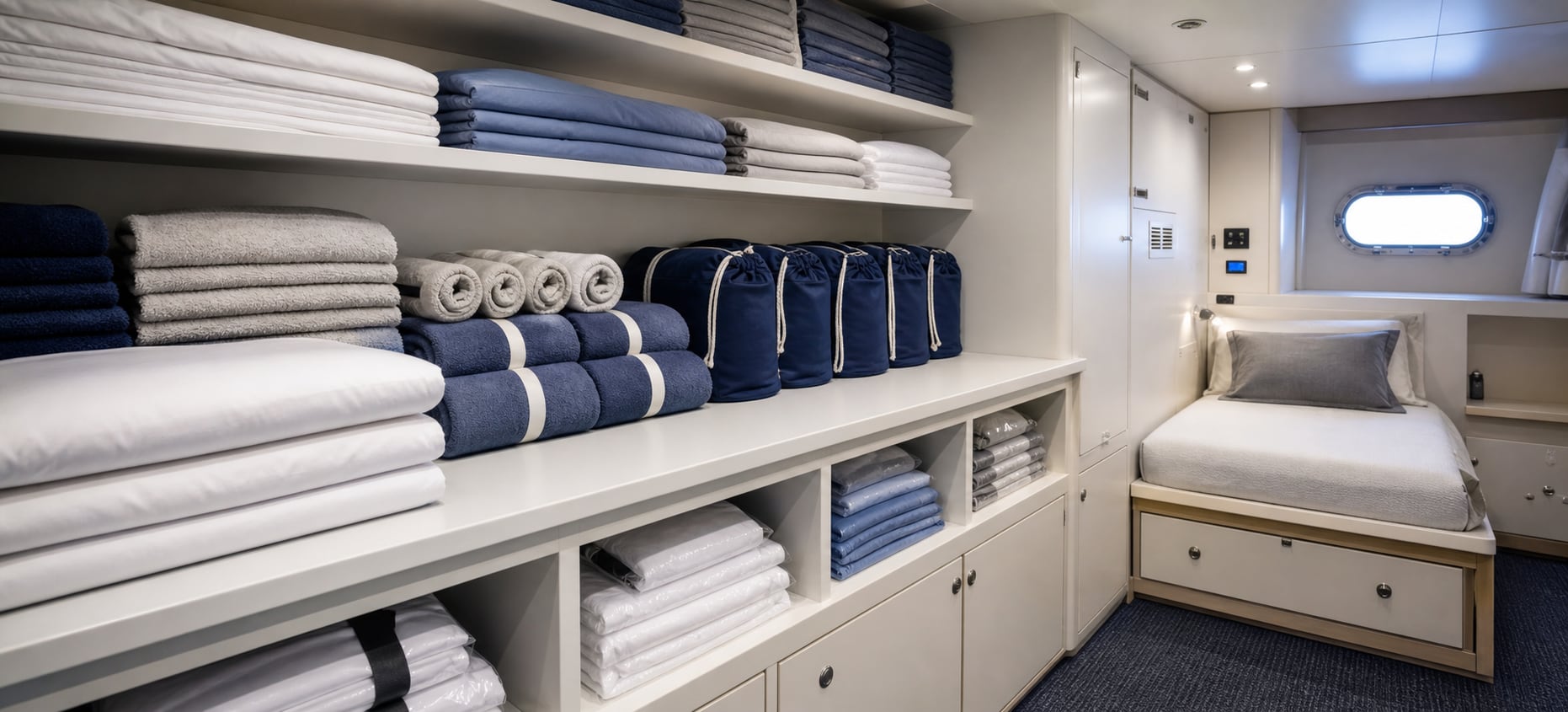
Choose white or a light neutral when visible inspection, a bright coordinated presentation and a validated recovery route are the strongest priorities. Choose a dark shade when the room concept and control of minor cosmetic contrast justify the extra demands of colourfastness, shade matching, separate sorting and inspection. Neither choice is sound until the exact linen releases the spa’s oils and survives the intended process.
A mixed palette can work when it has a clear purpose—such as room or treatment identification—but every extra shade creates a stock and laundry classification. Do not use dark linen as a destination for treatments the laundry cannot clean. Reduce the oil load, define the route, test the fabric and retain processed standards; then choose the colour that still looks, feels and performs acceptable.
Review treatment linen for massage and spa tables, confirm fit with the guide to massage-table sheet sizes and connect colour, construction and room-set approval through the wider Wellness textile programme.
Product catalogue
Request the Wellness catalogue
Share your business email and, if useful, your company or property name. We will carry these details into the secure catalogue-request form with the relevant category already selected.
Journal
Continue reading
Why Do Spa Towels Still Smell of Massage Oil After Washing?
A clean-looking towel can retain massage oil or pick it up again in the wash. Diagnose when the smell appears, then correct the whole treatment-to-laundry route.
Read Why Do Spa Towels Still Smell of Massage Oil After Washing?What Size Sheets Fit a Massage Table?
Many full-size massage tables are around 28–32 inches wide and 73 inches long, but the sheet must also fit the cushioning, added pads, corner shape and laundry process.
Read What Size Sheets Fit a Massage Table?How Many Towels Does a Spa Need?
Count every towel format through the busiest interval before clean laundry returns, then add measured unavailable stock and a reserve for a named disruption.
Read How Many Towels Does a Spa Need?