




What Size Sheets Fit a Massage Table?
For a typical 30 × 73 inch (about 76 × 185 cm) table, begin with a professional massage-table sheet set declared for that exact size family. Do not approve it until the fitted sheet stays secure over the complete padding stack and the top sheet gives the required client coverage after laundering.
Published by Gencer Textiles
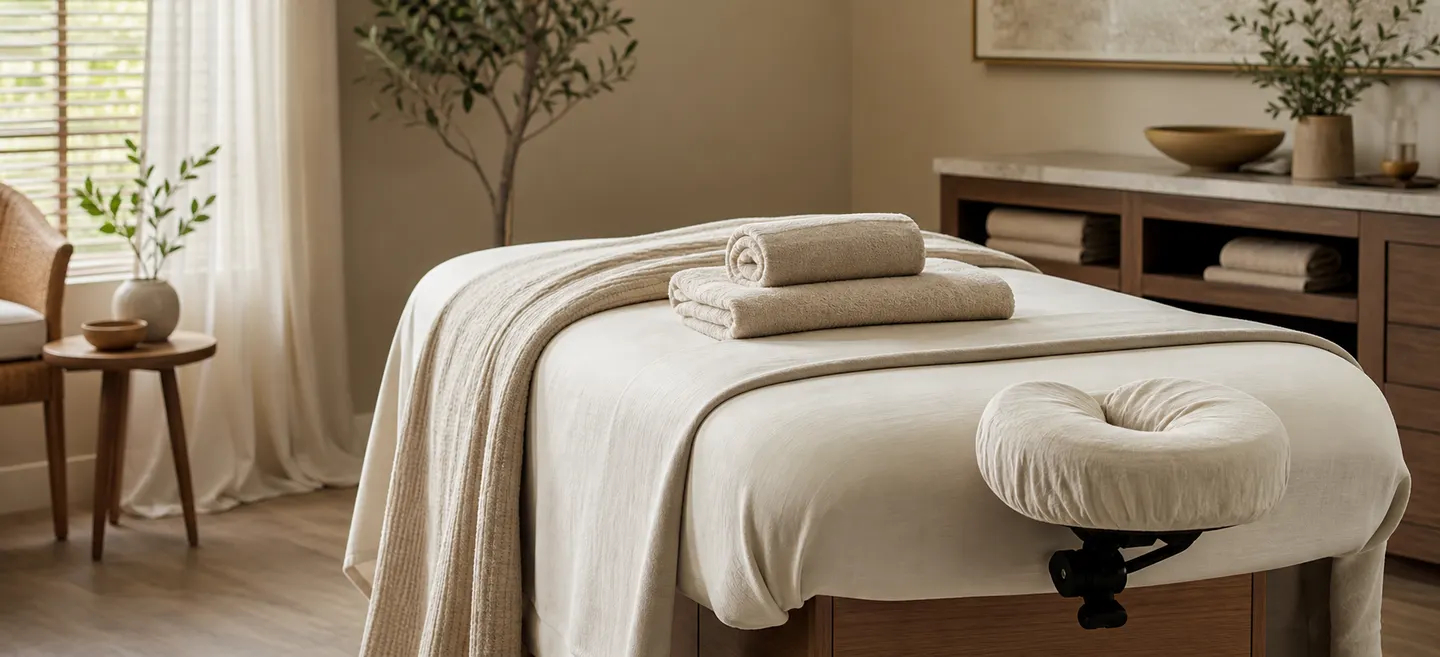
A professional sheet set sold for tables around 30 × 73 inches—about 76 × 185 cm—is the most sensible first sample for a conventional full-size massage table. Many current portable and stationary models sit within a broader 28–32 inch (71–81 cm) width family and are about 73 inches (185 cm) long. That does not make every “standard” sheet interchangeable.
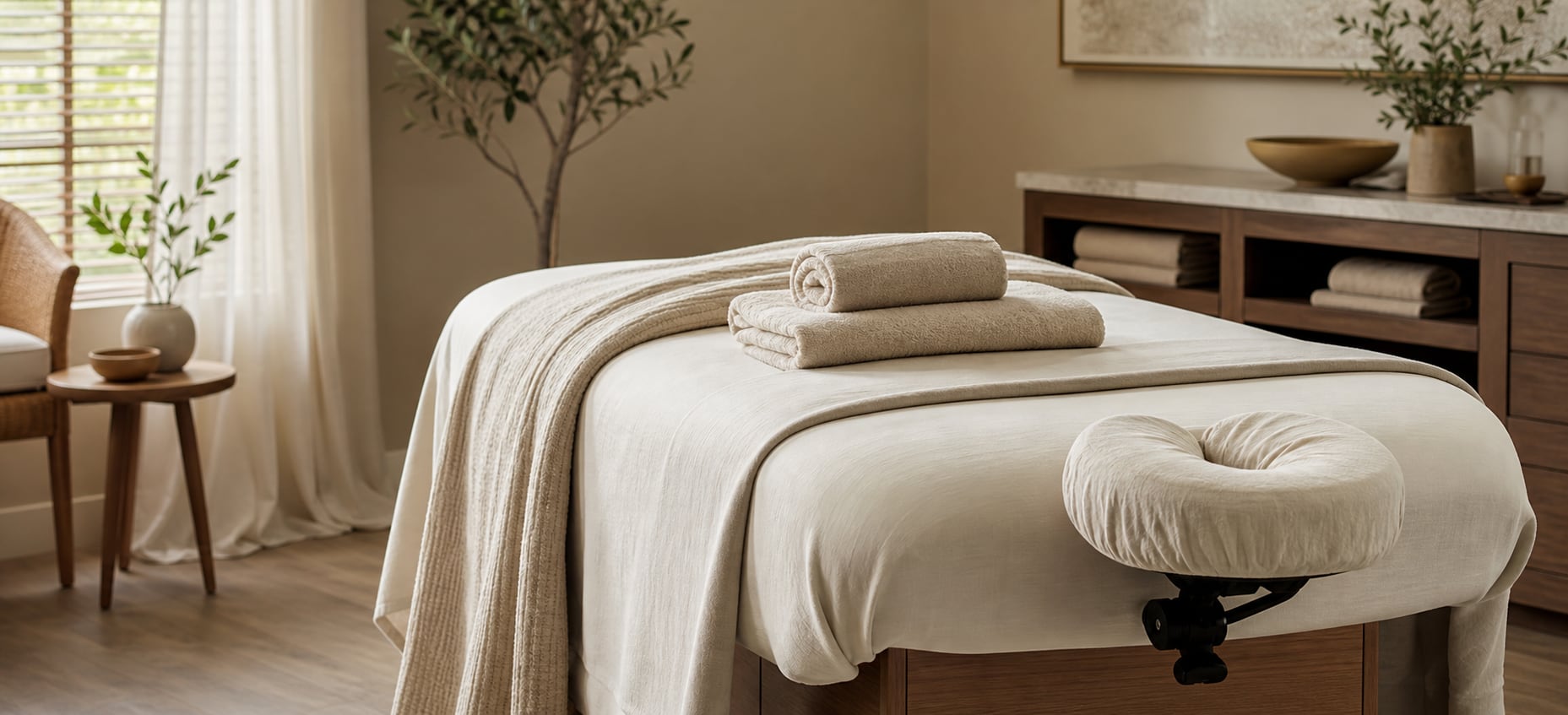
The fitted bottom sheet must match the table top, cushion depth, corners and every layer that remains underneath it. The flat top sheet is selected for client draping and the treatment protocol, not simply the tabletop footprint. The external face cradle needs its own fitted cover. Measure these three jobs separately, then approve the complete set after the intended laundry process.
Start with the table size family
Current professional equipment ranges illustrate why the label “massage table” is not a dimension. Manufacturers offer widths from 27 or 28 inches through 31 or 32 inches, often with a 73-inch top, while some portable tables are narrower or shorter. Spa and multipurpose tables may add thicker cushioning, square corners, articulating sections, side arms or a salon headrest.
Professional linen ranges reflect the same variation. One fitted sheet may be described for a 30 × 73 inch top with a 5-inch pocket; another may be made to accommodate tables up to 32 × 73 × 8 inches; a deeper flannel construction may have a nominal body around 36 × 78 × 7.5 inches. These numbers describe different patterns, elastic behaviour and fit claims. Compare the maker’s stated compatible table dimensions—not only the loose sheet dimensions.
| Starting table family | Useful first sheet sample | What can change the fit |
|---|---|---|
| 28–30 in wide × about 73 in long | Professional fitted sheet whose declared table range includes the measured top | Corner radius, padding depth, warmer, fleece or protector |
| 31–32 in wide × about 73 in long | A wider or stretch-compatible fitted construction specifically declared for that width | Overstretched elastic, shallow pockets and square corners |
| Narrow portable table or non-73 in top | Size against the actual model rather than a “standard” label | Loose fabric, movement and excess under the table |
| Articulating spa or treatment table | Table-specific or approved multipurpose cover system | Moving sections, hinges, side arms, mattress thickness and raised positions |
Measure the complete table
Measure the upholstered top with the table flat and accessories removed. Record length and width at the widest points. Measure the vertical depth from the upper surface down around the padded edge to the point where the fitted sheet can hold securely. Note whether the corners are square, rounded or strongly radiused.
Then rebuild the table exactly as it is used. Add any non-removable protector, fleece pad, table warmer, cushioning topper or waterproof layer that sits beneath the bottom sheet and measure again. A 30-inch table can become too large for its previous fitted sheet once a thick fleece and warmer are added, even though the furniture model has not changed.
- Record manufacturer, model, room code and quantity of matching tables.
- Measure top length and width rather than the base or frame.
- Measure the complete edge depth with every permanent under-sheet layer installed.
- Trace or photograph the corner profile and any cut-outs or split sections.
- Identify face hole, external face cradle, headrest, side-arm and bolster accessories separately.
- Repeat the measurement on the smallest and largest examples if supposedly identical tables vary.
Size the fitted bottom sheet by fit
A fitted-sheet specification needs more than nominal length and width. It must state the table dimensions it is intended to cover, the maximum finished padding depth, corner form, fabric construction, pocket or skirt design and elastic placement. A dimension printed for the loose textile is not automatically the size of the table it fits.
The approved sheet should pull over the corners without excessive force, sit smoothly on the working surface and keep its elastic or holding edge beneath the padded top. It should not compress the cushion, lift at the corners or work loose when the client turns. Excessively generous fabric is not safer: folds beneath the client and material hanging into table mechanisms create their own problems.
| Fit symptom | Likely sizing or construction issue | Next check |
|---|---|---|
| Corners lift or the sheet springs off | Top range or pocket depth is too small; elastic may be too short or stiff | Remeasure the full padding stack and corner radius after laundering |
| Sheet is smooth but visibly compresses the cushion | Too much negative ease or insufficient pocket depth | Compare unloaded cushion profile with and without the sheet |
| Loose folds remain on the client surface | Sheet body is too large or fabric recovery is insufficient | Check declared table range, elastic condition and processed dimensions |
| Holding edge cannot reach beneath the top | Added layers have consumed the pocket depth | Measure with protector, fleece and warmer installed |
| Fit changes when the table articulates | The cover does not accommodate moving sections | Test every approved position and use model-specific guidance |
For custom development, give the supplier the table dimensions and a profile rather than prescribing an untested amount of negative ease. Stretch, weave, laundering and elastic construction determine how much smaller the textile pattern may need to be. Approve the result on the actual table.
Choose the flat top sheet for draping
The top sheet has a different job. It must support the facility’s draping method, client coverage, warmth and practitioner access through the complete treatment sequence. Its useful size therefore depends on the client population, the body areas treated, whether a blanket or towel layers over it, and how the practitioner folds or secures the drape.
Current professional massage top sheets vary substantially. Manufacturer examples include widths around 56–63 inches and lengths around 80–100 inches. That range is more useful than declaring one universal number: a 56 × 80 inch sheet and a 63 × 100 inch sheet will not create the same coverage, weight, fold or laundry load.
| Top-sheet decision | What to test on the table | Operational consequence |
|---|---|---|
| Width | Lateral coverage in supine, prone and side positions | Privacy, access, bulk at the sides and laundering volume |
| Length | Coverage from shoulders or head area through the feet | Warmth, end folds and excess near therapist movement |
| Fabric body | Whether the drape stays where placed without feeling heavy | Handling, drying, folding and client comfort |
| Layering | Interaction with blanket, towel, wrap and warmer | Combined weight, slipping and reset time |
| Processed dimensions | Coverage after repeated representative care | Whether the original draping method remains possible |
Do a draping trial with trained treatment staff and the facility’s approved procedure. A top sheet can look generous on an empty table yet become inadequate around a client or awkward when folded away from the treatment area. Record the fold sequence and the minimum processed coverage the protocol requires.
Cover the face cradle separately
An external face cradle is a shaped cushion attached beyond the end of the table. Its cover must match the cushion’s outline, opening, thickness and attachment method. Manufacturers sell crescent covers for different cushion depths, and “universal” covers still have declared limits. A flat piece folded over the cradle is not the same fit as a constructed cover.
Distinguish an external cradle from a face hole cut into the table top. A fitted sheet over an integrated opening may need a shaped aperture or a facility-approved arrangement that does not obstruct the opening. Bolsters, neck rolls, pillows and side-arm pads also need their own recorded covers rather than being counted as part of the sheet size.
Specify the processed size
Approve treatment linen in its laundered condition. Fibre, weave or knit, finishing, wash chemistry, drying, temperature, mechanical action and pressing can change dimensions and elastic recovery. The supplier should use the selected construction and intended process to propose the manufactured size; the spa should approve the finished performance rather than adding a generic shrinkage allowance.
Measure the fitted sheet flat according to an agreed method, but judge it on the table. Measure the top sheet from finished edge to finished edge after it has cooled. Record tolerance, corner and pocket construction, elastic position, label location and any colour or room code. Where massage oil or treatment product reaches the linen, validate stain treatment and drying with the responsible laundry and chemical teams.
Use the massage-oil laundry guide to keep sizing approval separate from oil-removal and drying decisions. A sheet can fit correctly and still fail the care process.
Approve a complete room set
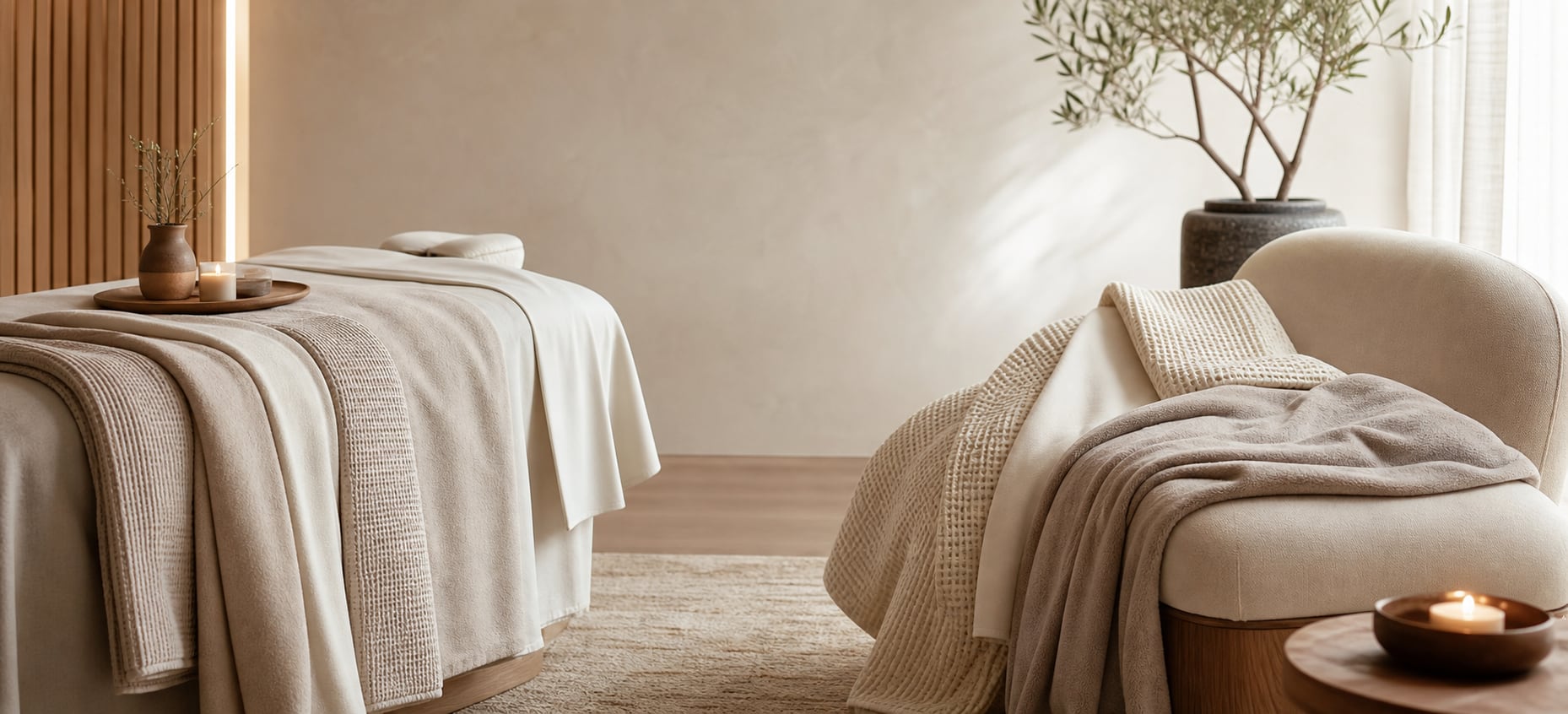
Build one complete processed set for each table family: fitted bottom sheet, flat top sheet, face-cradle cover and any required bolster covers, towels, blanket or protective layers. Dress the room in normal sequence, move the table through every used position and run a representative treatment simulation. Check client coverage, surface smoothness, access, slipping, corner hold and removal speed.
After laundering, repeat the trial and inspect seams, elastic and finished dimensions. Keep the processed approval sample with a table code and a simple size matrix. If several models share one linen set, list every approved model; do not assume a new 30-inch table belongs to the programme just because its headline width matches.
- Confirm the fitted sheet on the full padding stack before and after care.
- Confirm the top sheet through every required client position and draping step.
- Confirm the face-cradle or face-hole solution without obstruction or loose fabric.
- Test articulating sections, accessories and table-warmer cables in normal use.
- Record processed dimensions, table models, layer stack, fold and room identifier.
- Retain an approved processed set for future purchases and replacement checks.
For a conventional 30 × 73 inch table, a professional set declared for that table family remains the right place to start. The final answer, however, is the smallest fitted construction that stays secure without distorting the table and the top sheet that maintains the approved drape after laundering. Those are two different dimensions, proved by one complete room trial.
Explore treatment linen for massage and spa tables, connect the set to the wider Wellness textile programme, and use the on-site measurement guide when the table profile, padding or accessories require custom development.
Product catalogue
Request the Wellness catalogue
Share your business email and, if useful, your company or property name. We will carry these details into the secure catalogue-request form with the relevant category already selected.
Journal
Continue reading
Why Do Spa Towels Still Smell of Massage Oil After Washing?
A clean-looking towel can retain massage oil or pick it up again in the wash. Diagnose when the smell appears, then correct the whole treatment-to-laundry route.
Read Why Do Spa Towels Still Smell of Massage Oil After Washing?How Many Towels Does a Spa Need?
Count every towel format through the busiest interval before clean laundry returns, then add measured unavailable stock and a reserve for a named disruption.
Read How Many Towels Does a Spa Need?What Makes a Towel Suitable for Spa and Wellness Use?
Understanding absorbency, weight, softness, drying time, and operational consistency in professional wellness settings.
Read What Makes a Towel Suitable for Spa and Wellness Use?