










Why Do Pool Towels Fade and Wear Out So Quickly?
Pool towels rarely fail for one reason. Chlorinated water and daylight can alter colour; sunscreen and body oils can stain; decks, loungers and laundry create abrasion; and uncontrolled chemistry or drying can accelerate damage. The useful question is where each failure begins.
Published by Gencer Textiles

Pool towels fade and wear quickly because they pass through a demanding compound route: chlorinated water, daylight and heat, sunscreen and body oils, wet collection, repeated washing and drying, and friction against decks, loungers, carts and laundry equipment. Any one of these can matter; several usually act together.
Start by separating colour loss from staining and physical wear. A faded towel needs a different investigation from a yellowed towel, a rough towel or one with thinning pile. Replacing the product or increasing the wash chemistry before identifying the pattern can conceal the real cause and shorten the life of the next batch as well.
Separate fading from wear and staining
Inspect rejected towels dry, cool and under the same neutral light. Compare several pieces from the same batch with an unused approved reference where possible. Turn each towel over and check edges, borders and the centre separately; the distribution of the change is often more useful than the severity alone.
| Visible pattern | Possible pathway | Evidence to check |
|---|---|---|
| Even loss of shade across the towel | Repeated light, pool-water or laundry exposure | Age, use zone, shade history, wash formula and a retained reference |
| One face or one folded edge is paler | Uneven daylight exposure during use, storage or presentation | Fold direction, lounger setup, stack position and time outdoors |
| Small pale spots or splashes | Local contact with an oxidising chemical or concentrated product | Chemical handling, dosing point, spot-treatment and incident records |
| Yellow, orange or grey areas | Sunscreen, body oil, minerals, redeposition or incomplete soil removal | Location of marks, water data, sorting, load mix and wash results |
| Thin pile, bald tracks or heavy lint | Abrasion, weakened fibres or excessive mechanical action | Deck and lounger surfaces, carts, wash load, filters and dryer lint |
| Torn hems, pulled loops or isolated snags | Contact damage rather than general ageing | Rough edges, lounger mechanisms, baskets and equipment condition |
| Harsh or stiff hand without major fibre loss | Residue, water conditions or overdrying | Rinse performance, dosing, water analysis and dryer endpoint |
These observations are diagnostic clues, not proof by themselves. For example, an oxidised sunscreen mark and a local chemical splash may both look pale. Keep suspect pieces identifiable and compare their operating history before changing the process.
Chlorinated water is only one exposure
Chlorinated pool water can change dyed textiles through oxidation, but pool-water colourfastness is a specific property rather than a claim that every coloured towel either “handles chlorine” or does not. ISO 105-E03 and AATCC TM162 describe controlled methods for assessing colour resistance to chlorinated water. The test conditions help procurement compare materials; they are not operating recommendations for pool chemistry.
A supplier should identify the test method, conditions, exact finished colour and result behind any colourfastness statement. A result for one shade, fibre blend or finish should not be transferred automatically to another. Nor does a pool-water result establish resistance to daylight, repeated commercial washing or abrasion.
| Evaluation | What it helps establish | What it does not establish alone |
|---|---|---|
| Chlorinated-water colourfastness | Comparative colour response under defined pool-water conditions | Daylight resistance or total service life |
| Lightfastness | Comparative colour response under a defined light exposure | Resistance to pool chemistry or laundering |
| Repeated-laundry trial | Change through the proposed wash and dry process | Abrasion on the actual deck or lounger |
| Abrasion and strength checks | Resistance to specified mechanical stresses | Guest comfort, absorbency or shade continuity |
| Full-size operational trial | How the combined real route behaves | A universal result for every site, season or process |
Sunlight and wet outdoor holding change colour
Outdoor pool service adds daylight exposure that an indoor spa towel may not encounter. Lightfastness is tested separately from pool-water colourfastness because the mechanisms and test conditions differ. A towel may perform acceptably in one assessment and change noticeably in the other.
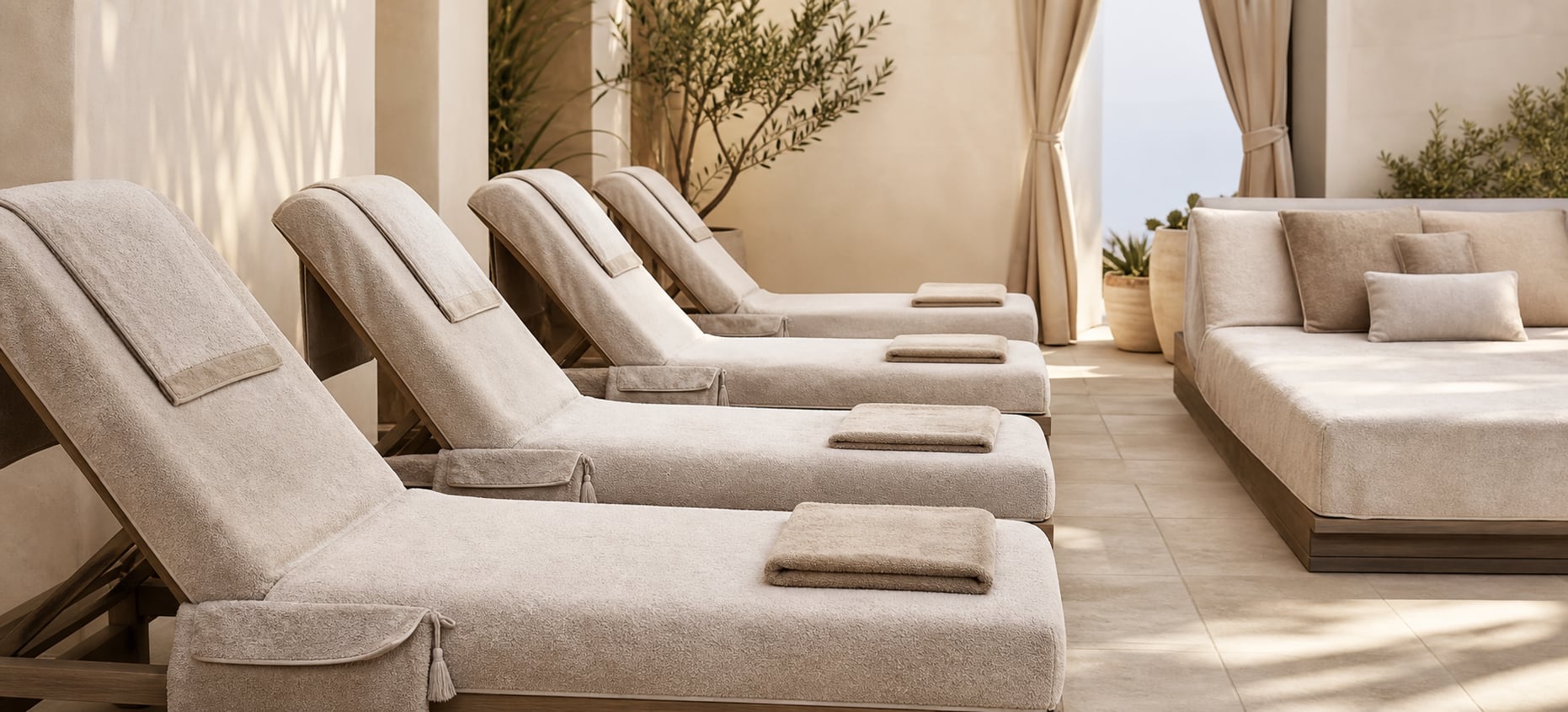
Exposure is rarely even. The upper face of a folded stack, the face presented on a lounger or one edge hanging in direct sun can receive more light and heat. A wet towel left spread on a hot surface or compressed in a collection point also follows a different route from one collected promptly and dried through the approved process. Log the zone and handling pattern when change is one-sided or location-specific.
Sunscreen and body oils create a different problem
Sunscreen, tanning products and body oils create soil and staining; they should not automatically be labelled as fading. Their residues can produce translucent, yellow, orange or grey marks, attract further soil and drive extra stain-treatment or rewash cycles. Those additional cycles then add chemical, mechanical and thermal exposure.
Separate heavily marked pieces and follow the laundry’s approved pretreatment route for the exact towel. Record the topical-product context where a repeated pattern appears. Avoid improvising a stronger oxidiser simply because the towel is white or the mark is pale: colour, decorative borders, optical appearance and fibre strength may respond differently.
Abrasion removes pile before the towel tears
A terry towel can lose surface pile long before its ground fabric tears. Dragging across textured paving, catching on loungers, rubbing against rough basket edges and repeated movement in overloaded equipment all remove or disturb fibres. The result may appear as lint, short loops, flattened tracks or a locally thin face.
Inspect where the damage sits. Repeated parallel marks can point to furniture or handling contact; frayed borders can point to edge stresses; random pulled loops can indicate snags. Check deck finishes, anti-slip surfaces, lounger hinges, trolley interiors and laundry equipment instead of treating every thin towel as ordinary end-of-life wear.
Laundry can accelerate or reveal damage
Commercial laundering does not merely clean the towel; it applies chemistry, water, temperature, mechanical action, extraction and drying on every cycle. Excessive oxidiser, poor dilution, unsuitable pH, incomplete rinsing, overloaded machinery, repeated reclaim and overdrying can alter shade, hand or fibre condition. Strong chemical damage may only become visible as holes or tears after later cycles.
Define the process by the exact load weight and supplier instructions rather than a generic towel recipe. Verify dosing and injection, water conditions, wash classification, rinses, extraction and dryer controls. Dry to an established endpoint and include cool-down; leaving mixed goods in heat until the slowest item is dry can overprocess lighter pieces.
Do not blame GSM alone
GSM describes mass per square metre; it does not, on its own, predict how quickly a pool towel will fade, snag or lose pile. Yarn quality, pile and ground construction, loop height, border and hem design, dye system, finishing, absorbency, drying behaviour and the care route all contribute to performance.
A heavier towel may feel substantial but carry more water, take longer to dry and occupy more machine and storage capacity. A lighter towel may dry faster but still needs a stable ground and suitable surface construction. Compare processed samples and failure modes, not a single specification number.
Run a full-route pool-towel trial
Laboratory results narrow risk, but the most useful approval combines them with a controlled trial of the exact finished towel. Include the proposed colours, borders and identification details, not only an undyed fabric swatch. Give the trial pieces a unique code so they are not confused with current stock.
- Record the finished towel reference, shade, dimensions, weight and construction details supplied.
- Review evidence for chlorinated-water colourfastness and lightfastness on the relevant finished shade.
- Process samples through the proposed commercial wash and dry route before judging hand, size and shade.
- Place coded towels in representative pool zones and record dates, handling and approximate cycles.
- Include normal exposure to pool water, loungers, sunscreen soils, collection and storage without creating unsafe test conditions.
- Inspect dry and cool at defined intervals against the retained approved reference.
- Record colour change, staining, absorbency, lint, pile loss, snags, seams, borders and drying behaviour separately.
- Agree what is acceptable, what can be reprocessed or downgraded, and what requires retirement.
There is no universal number of washes that makes a pool towel durable. The acceptable threshold depends on the exact product, colour, process, use intensity and presentation standard. Procurement and operations should agree the trial conditions and acceptance criteria with the supplier and laundry before scaling the order.
Build controls around the failure pattern
Once the main pathway is known, controls can be targeted. Reduce uneven outdoor exposure through rotation and covered clean storage. Keep used towels off rough surfaces and collect them promptly. Separate pool stock from loads with different soil, colour or drying requirements. Maintain equipment and chemical systems, and inspect at a consistent point after the towel has cooled.
| Operating stage | Control | Record |
|---|---|---|
| Issue and setup | Rotate stacks and presentation faces; use one identifiable batch | Date, zone and batch reference |
| Guest use and collection | Provide clear return points; avoid dragging and snagging surfaces | Location and damage incidents |
| Sorting and washing | Separate by colour, soil and approved process; verify dosing and load | Formula, load weight, rewash and stains |
| Drying and finishing | Use the defined endpoint and cool-down; avoid mixed dryness needs | Programme, residual concerns and lint |
| Inspection and retirement | Judge dry, cool towels in consistent light against the reference | Fade, stain, abrasion, snag, seam or loss reason |
| Replenishment | Compare new production with the approved reference and aged service stock | Lot, shade decision and deployment plan |
White towels do not fade in the same way as a dyed shade, but they can grey, yellow, stain or lose an optically bright appearance. Coloured towels add the questions of shade change and matching replenishment to aged stock. In either case, record the reason for withdrawal instead of grouping every reject under “worn”. A simple failure code reveals whether procurement, pool operations, laundry or handling needs attention.
Use the broader comparison of spa, pool and beach towel requirements to set the operating brief, then review pool and beach towels through the complete service route. The guides to towel durability and replacement-cost control help turn the recorded failure reasons into a purchasing and maintenance decision.
Product catalogue
Request the Wellness catalogue
Share your business email and, if useful, your company or property name. We will carry these details into the secure catalogue-request form with the relevant category already selected.
Journal
Continue reading
Which Spa Pool and Beach Towel Differences Affect Daily Operations?
A comparison of the towel differences that matter between clean storage, guest use, collection, laundry, and return.
Read Which Spa Pool and Beach Towel Differences Affect Daily Operations?What Makes a Hotel Towel Durable?
A practical look at the construction and operating conditions that help a hotel towel remain fit for service.
Read What Makes a Hotel Towel Durable?How to Reduce Hotel Towel Replacement Costs
A cause-led process for reducing premature retirements, unexplained loss and emergency buying without lowering the room standard.
Read How to Reduce Hotel Towel Replacement Costs