



























Feather, Down, Microfibre or Hollowfibre Hotel Pillows
The filling name does not tell you how the finished pillow will feel. Down and feather are natural materials, while microfibre and hollowfibre describe synthetic fibre forms that may overlap. Construction and fill quantity complete the picture.
Published by Gencer Textiles
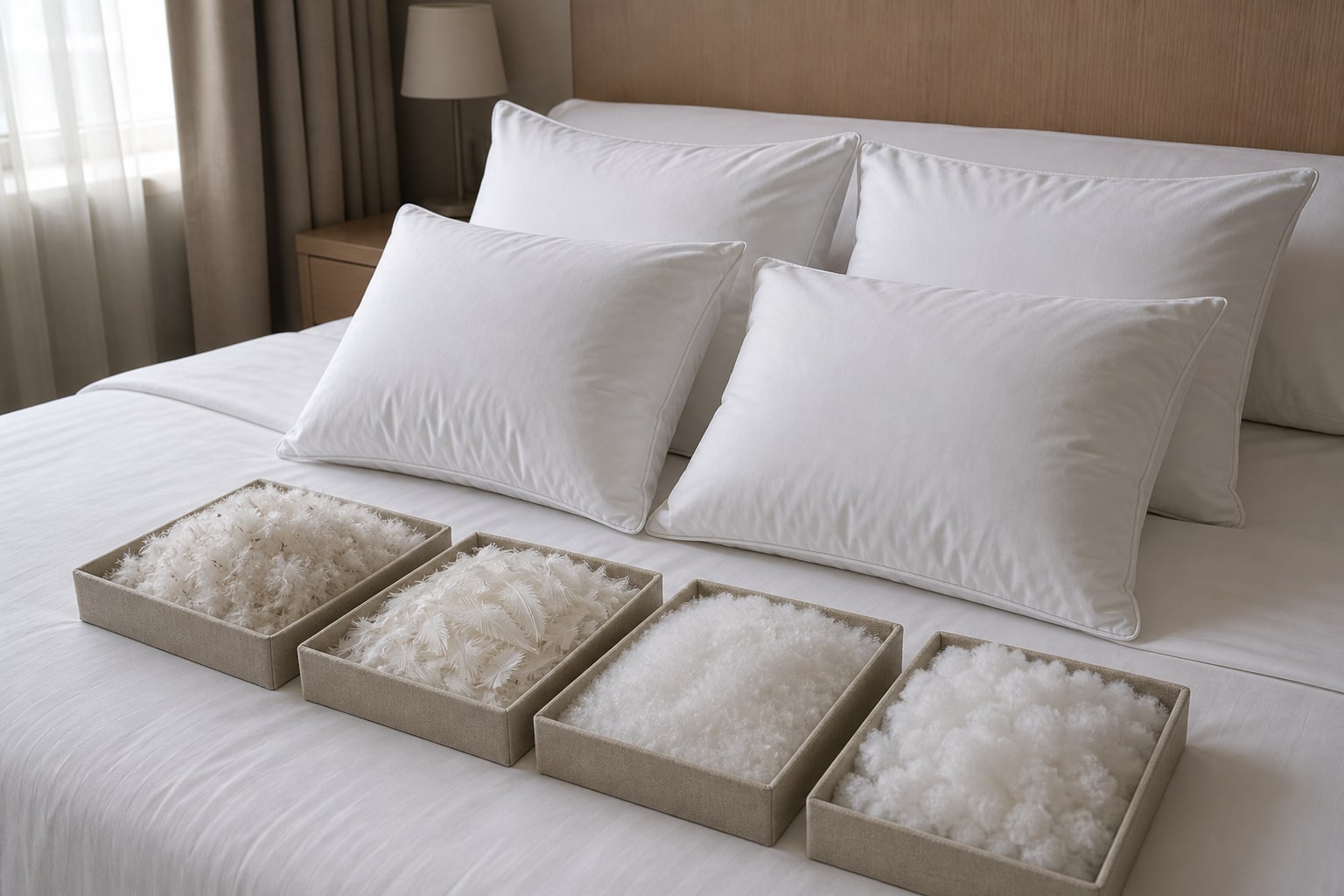
For most hotels, a well-made synthetic pillow is the practical default for standard rooms. Feather and down make sense when the hotel specifically wants a softer, more mouldable option and can support the sourcing and care it needs. Neither family is automatically better. The useful choice depends on the finished feel, how well the pillow returns to shape and whether the hotel can keep that result consistent.
Do not choose from the four filling names alone. Down and feather identify natural components. Microfibre describes very fine manufactured fibres, while hollowfibre describes fibres with a hollow centre. The last two are usually polyester and are not mutually exclusive. A fine fibre can also be hollow, so two suppliers may use different names for quite similar products.
What the four filling names mean
Down consists of soft three-dimensional clusters without a stiff central shaft. It creates light volume and lets the pillow compress and mould around the head. Feather has a stiff central shaft and a flatter structure. It adds weight and resistance, which is why many natural-fill pillows combine feather and down rather than relying on only one of them.
Microfibre pillows use fine synthetic fibres to create a smooth, soft filling. Hollowfibre has an empty channel through the fibre, which helps create bulk with relatively little weight. Fibre thickness, crimp, surface finish, cluster shape and fill quantity all change the result. The word hollowfibre does not guarantee a firm pillow, and microfibre does not guarantee that it will feel like down.
| Filling label | What it usually describes | Typical feel | What to confirm |
|---|---|---|---|
| Down | Soft clusters without a stiff central shaft | Light, yielding and easy to mould | Down percentage, fill weight, chamber construction, care and certified source |
| Feather | Waterfowl plumage with a stiff central shaft | Heavier and more resistant than down | Feather and down ratio, casing, leakage, noise and care |
| Microfibre | Very fine manufactured fibres, usually polyester | Smooth and soft, sometimes made to resemble down | Fibre composition, fibre form, fill weight, recovery and care |
| Hollowfibre | Manufactured fibres with a hollow centre, usually polyester | Bulky, light and often springier | Fibre shape, surface finish, fill weight, recovery and care |
These descriptions are tendencies, not grades. A heavily filled microfibre pillow can feel firmer than a lightly filled feather pillow. A chambered pillow can put feather in the centre for support and down around it for a softer surface. The complete construction matters more than the most prominent word on the label.
A synthetic pillow is usually the practical default
A good microfibre or hollowfibre pillow is often the simplest starting point when a hotel needs one model across many rooms. Synthetic fillings can be specified in a wide range of weights and shapes, and they avoid animal-derived material where that matters to the hotel or its guests. They are also widely available, which can make it easier to compare replacements using the same composition and construction.
That does not make every synthetic pillow practical. A low fill quantity can collapse quickly. Loose fibres can gather into uneven areas, while a very dense fill can become hard inside a close protector and pillowcase. Washability also belongs to the finished product, not to polyester as a category. The casing, stitching and manufacturer's care method still decide what the hotel can safely wash and dry.
Filling does not set firmness on its own. If the hotel is deciding how much choice to give guests, compare this article with the guide to soft, medium and firm hotel pillows.
When feather and down are useful
Feather and down are useful when the hotel wants a pillow that guests can shape easily and that settles around the head rather than pushing back strongly. More down usually creates a lighter, softer and more yielding pillow. More feather generally adds weight and structure. The exact ratio still does not tell you the firmness because fill weight, pillow size and chamber design change it.
Natural fill needs a casing that contains the small components and keeps stiff feather shafts from becoming noticeable through the protector and pillowcase. Listen for rustling, press the surface with a forearm and check for sharp points after repeated use. Also look at how much plumping the pillow needs to return to the presentation expected in the room.
A hotel does not need to choose natural fill for every room to use it well. It can serve as a clearly different option in suites, as part of a small pillow menu or as an alternative available on request. This is more useful than treating feather and down as an automatic quality upgrade regardless of guest preference or hotel policy.
Compare the complete pillow, not only the filling
Ask for the exact filling composition rather than accepting down, feather or down alternative as a complete specification. For a natural blend, record the stated feather and down percentages. For a synthetic pillow, record the polymer, fibre description and any recycled content claim. For both, record the finished size, fill weight, number of chambers, casing fabric, stitching and care instructions.
Fill weight is useful only beside the other details. The same weight spread across a larger pillow produces a different result. A gusset or internal chamber can hold filling in a deeper shape, while a simple edge seam lets it spread more freely. A tightly woven casing can contain fine filling well but may also change how quickly air leaves the pillow when the head settles.
Use the broader hotel pillow selection guide when comparing the pillow with the mattress, protector and pillowcase. This filling article does not replace that complete bed test.
Test care and recovery before ordering
Follow the care label for the finished pillow and check that the hotel or laundry can complete the whole process, especially drying. A pillow that remains damp inside is not ready to return to a guest room. Down and feather can clump if care is incomplete, while synthetic fibres can also gather, flatten or change shape when the wrong wash or drying method is used.
Run the approved process on samples, then compare them with an unused reference. Check for uneven filling, loss of height, lumps, casing distortion, retained odour and any feather leakage. Put the protector and pillowcase back on and sleep on the pillow again. This shows whether the care method has changed the feel rather than only the appearance.
Recovery after normal use matters as much as washing. Leave each sample overnight, then see how much handling it needs in the morning. A pillow that returns with a few shakes is different from one that needs its filling pushed back into place by hand. Housekeeping should see this test because the extra work repeats in every occupied room.
Check sourcing and product claims
When natural fill is considered, ask where it comes from and what evidence supports the sourcing claim. A named third-party standard such as the Responsible Down Standard is more useful than a general statement about responsible material because it includes animal-welfare requirements and chain-of-custody checks. Confirm that the certification applies to the product being quoted, not simply to one company in the supply chain.
Treat allergy wording with the same care. Synthetic does not automatically mean allergy-proof, and natural fill is not automatically unsuitable for every guest. A claim such as hypoallergenic needs a clear basis. The hotel should rely on its own guest policy, approved protectors, cleaning process and documented product information rather than making a medical promise from the filling name.
The final choice is usually simple once the labels are translated into finished behaviour. Start with a good synthetic pillow when you need a practical standard for most rooms. Add feather and down when you want a softer, more mouldable alternative and can manage its care and sourcing. In either case, approve the complete pillow after use and care, then keep the exact specification and a dated sample for future orders.
The Gencer hotel pillow collection provides a practical starting point for comparing filling, construction and support on the actual guest-room bed.
Product catalogue
Request the Stay catalogue
Share your business email and, if useful, your company or property name. We will carry these details into the secure catalogue-request form with the relevant category already selected.
Journal
Continue reading
How to Choose Pillows for Hotel Guest Rooms
A hotel pillow should be chosen as the guest experiences it: under weight, inside its protector and case, and after a full night in the room.
Read How to Choose Pillows for Hotel Guest RoomsSoft, Medium or Firm: Which Pillows Should Hotels Offer?
Use medium support when one pillow must cover most guests. If you can offer two choices, make them clearly soft and firm rather than barely different versions of medium.
Read Soft, Medium or Firm: Which Pillows Should Hotels Offer?Hotel Pillowcase Size Guide
How to measure each pillow, allow for loft and protectors, and approve a finished pillowcase after laundering.
Read Hotel Pillowcase Size Guide