






How Often Should Spas Change and Wash Massage Blankets?
Change and launder a massage blanket after every client whenever it touches skin, hair, product, dampness or visible soil. If it stays completely outside a fresh per-client barrier, a spa may be able to use a documented routine schedule—but only when local requirements and the treatment protocol allow it.
Published by Gencer Textiles
There is no useful universal answer such as “wash massage blankets once a day” or “once a week.” The correct interval follows what the blanket actually touches. If it contacts the client, the practitioner’s oiled hands, damp linen or visible soil, remove it after that treatment and launder it before reuse. A blanket that remains completely outside a fresh per-client sheet can sometimes follow a documented routine schedule, but only if local rules and the spa’s treatment protocol allow that arrangement.
This distinction matters because “change” and “wash” are not the same event. A blanket may leave the room after one client and enter a controlled used-linen route, then be washed in a later batch. It must not return to clean storage or another treatment room in between. Enough clean stock is what makes the policy workable.
Classify the blanket by actual contact
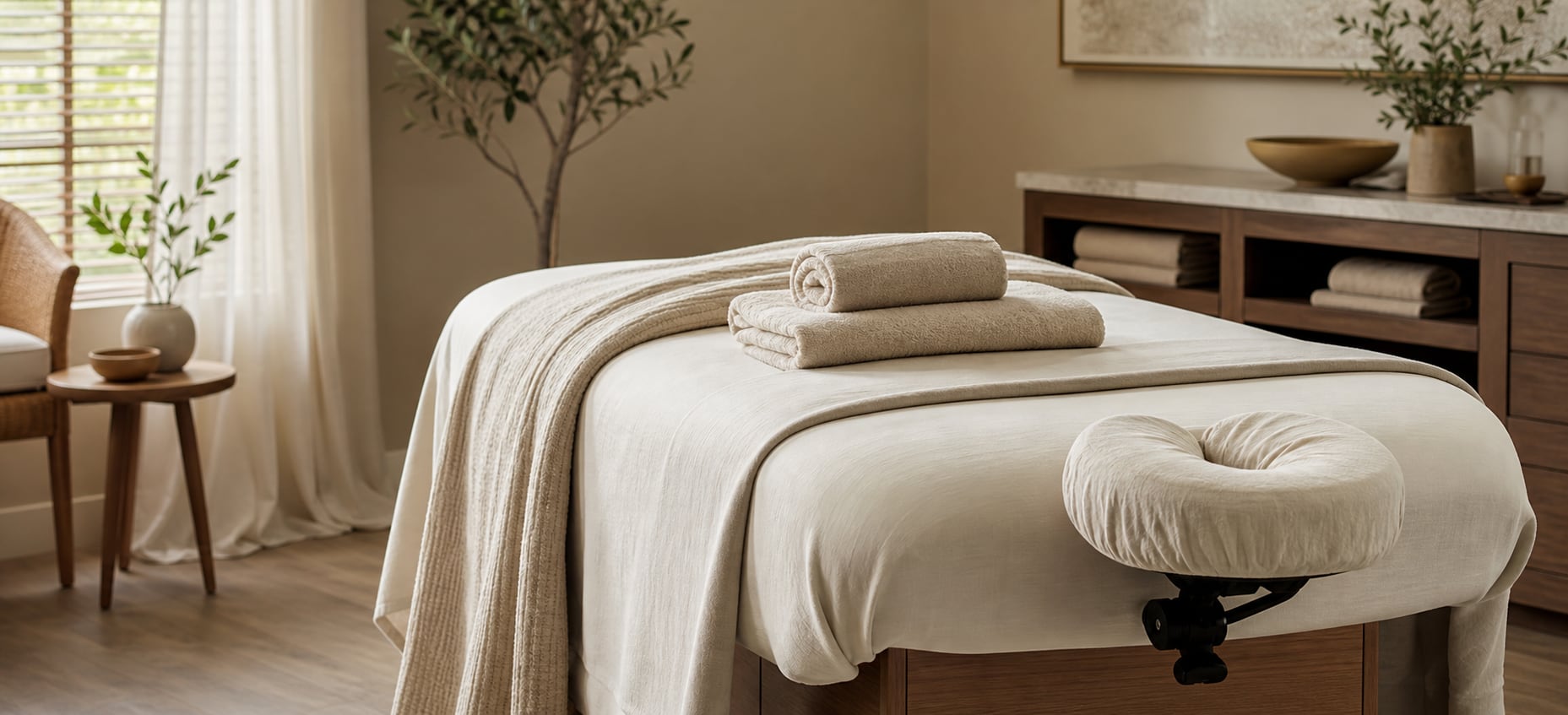
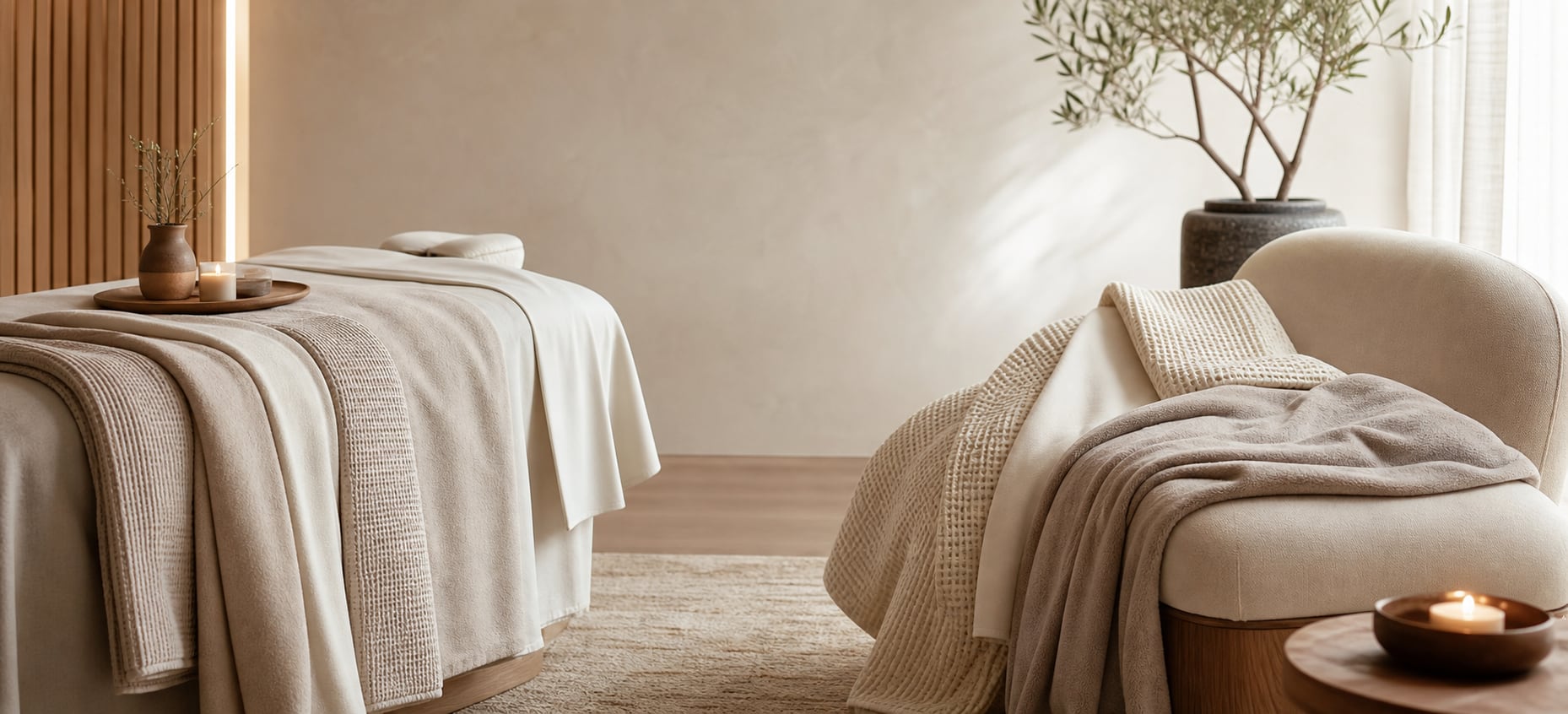
Start with the treatment sequence, not the product name. A light blanket directly over a client, a warming layer outside a top sheet and an electrically heated table pad are three different items. They have different contact patterns and care routes even if staff casually call all three “the blanket”.
| What happens during treatment | Default action after the client |
|---|---|
| The blanket touches skin, hair, uncovered feet or arms | Remove it and launder before reuse |
| The practitioner handles it with hands carrying oil, lotion or treatment product | Treat it as product-exposed linen; remove it and follow the approved laundry route |
| It remains outside a fresh sheet for the entire session with no client or product contact | Apply the documented routine interval only if local requirements and the treatment protocol permit it |
| The sheet shifts, the blanket becomes damp, smells, or shows soil | Remove immediately; do not wait for the routine interval |
| It is an electric pad or table warmer | Treat it as equipment and follow the manufacturer’s cleaning instructions; do not send it through an ordinary textile wash unless expressly allowed |
Direct contact is broader than a blanket lying on the torso. Feet can emerge at the end of a treatment, arms can rest over the edge, hair can touch the upper section, and a client may pull the layers upward. Observe a complete real session before deciding that a blanket is protected.
Make the fresh-barrier rule specific
A fresh top sheet can keep a warming blanket away from the client, but the word “covered” is too vague for an operating procedure. State which layer is fresh for each client, where the blanket sits, how far the sheet must extend, and what the therapist does if the layers move. Include side access, turning, limb work and the moment the client gets on and off the table.
Rules vary by jurisdiction. Some massage-establishment standards explicitly require reusable cloth that contacts a client to be laundered after each use and enough clean linen to be available for every client. Other local codes specify fresh towels or couch coverings. Use the strictest applicable legal requirement, public-health direction, treatment protocol and internal hygiene standard; a general article cannot replace that local check.
Write immediate-change triggers that staff can see
A routine maximum interval, where permitted, is only the background rule. The immediate-change list takes priority. Remove the blanket after any direct contact, visible mark, oil or cosmetic transfer, dampness, unusual odour, body-fluid incident, pest concern, or client-specific infection-control instruction. Also remove it when staff cannot confirm how it was used.
Do not judge oil exposure by colour alone. A dark blanket may hide a mark while still feeling greasy or releasing odour when warmed. A pale blanket can make some soils easier to see but does not prove that the fibre is residue-free. Inspection should combine sight, touch, smell and the recorded treatment setup.
Where massage products are part of the problem, use the separate guide to white versus dark treatment linen to review visibility, stain treatment and colour care.
Control the route from room to clean store
After removal, place the blanket directly in the designated used-linen container. Do not shake it, carry it against uniforms or drape it over a trolley shared with clean stock. Wet or incident linen may need a separate contained route under the property’s risk procedure. Keep clean and used textiles physically separate through collection, transport, processing and delivery.
The wash programme must suit the fibre, construction, care label, soil level, equipment and applicable hygiene requirements. Cleaning performance depends on more than temperature: time, chemistry, mechanical action, water quality, load size, rinsing and drying all interact. Validate the actual programme with the laundry and chemical supplier rather than copying a temperature from an unrelated rule or fabric.
Dry blankets completely before folding or storing them. Residual massage oil also needs prompt, controlled handling: do not leave oil-bearing textiles warm in a dryer, trolley, bag or tight stack. The existing guide to massage-oil odour explains the treatment-to-laundry checks and the associated heat risk in more detail.
Trace persistent residue with the massage-oil laundry guide instead of masking an odour or repeatedly increasing chemistry without diagnosis.
Calculate the clean stock the policy needs
A strict change rule fails if the spa has only one blanket per room. Calculate each blanket reference separately: the quantity on all active tables, plus every change that can occur before used pieces return clean and inspected, plus a reserve tied to credible delays, contamination events or demand peaks. The relevant turnaround runs from removal in the room to release back into clean storage—not just the washer cycle.
| Input | What to record |
|---|---|
| Blankets in use | Peak simultaneous rooms and the approved layers on each table |
| Changes during turnaround | Booked sessions and expected immediate-change events before the first batch returns |
| Unavailable stock | Pieces awaiting wash, drying, inspection, repair or investigation |
| Reserve | A named disruption such as a delayed collection, failed load or unusually high treatment volume |
Do not hide shortages by adding unlike items together. A lightweight cotton blanket, a fleece relaxation throw and a shaped table layer may not substitute for one another. Count by product code, size and treatment use. Review actual issues and returns after a representative peak before changing the reserve.
Choose a blanket that can follow the policy
The best blanket is not merely the softest new sample. It must tolerate the required processing, dry within the available turnaround, fit the table and draping method, and remain comfortable without making layer changes awkward. Heavy bulk can increase drying time and storage volume; an unstable or undersized blanket can make barrier failure more likely.
Test a processed sample in a complete room setup. Wash and dry it through the proposed route, then assess finished size, surface, lint, pilling, odour, drying, fold volume and warmth. Dress the table with the real bottom sheet, top sheet, face-cradle cover and towels; run the normal movements and check whether the blanket stays where the written policy assumes.
Use the massage-table sheet sizing guide when the protective layers do not cover the table or blanket reliably.
Turn the rule into an auditable procedure
- Name every blanket, warming layer and heated item used in each treatment setup.
- Mark which pieces are fresh per client and which may follow a routine interval.
- List direct-contact, product, dampness, soil, odour and incident triggers that override the interval.
- Define removal, containment, collection and clean-storage locations without cross-contact.
- Attach the approved care programme and the escalation route for oil or body-fluid incidents.
- Calculate clean stock from peak rooms, changes during full turnaround, unavailable pieces and a named reserve.
- Train staff on barrier failure and record checks during real treatments.
- Revalidate the policy when the treatment, product, blanket, laundry route or local requirement changes.
The answer to “how often?” is therefore a decision tree, not a calendar slogan. Client contact means a new blanket for the next client and laundering before reuse. A genuinely protected warming layer may have a longer documented interval where permitted, but immediate-change triggers remain active throughout. That is the rule a therapist can follow, a laundry can support and a manager can verify.
Review the spa blanket range alongside the complete treatment-linen system so the blanket, barrier, processing route and clean-stock calculation are specified together.
Product catalogue
Request the Wellness catalogue
Share your business email and, if useful, your company or property name. We will carry these details into the secure catalogue-request form with the relevant category already selected.
Journal
Continue reading
What Size Sheets Fit a Massage Table?
Many full-size massage tables are around 28–32 inches wide and 73 inches long, but the sheet must also fit the cushioning, added pads, corner shape and laundry process.
Read What Size Sheets Fit a Massage Table?White vs Dark Treatment Linen: Which Handles Massage Oil Better?
Dark linen may disguise some oily marks, while white makes change easier to inspect and may allow a broader wash process. Neither colour removes massage oil.
Read White vs Dark Treatment Linen: Which Handles Massage Oil Better?Why Do Spa Towels Still Smell of Massage Oil After Washing?
A clean-looking towel can retain massage oil or pick it up again in the wash. Diagnose when the smell appears, then correct the whole treatment-to-laundry route.
Read Why Do Spa Towels Still Smell of Massage Oil After Washing?