



















How to Choose Pillowcases for Hotels
Start with the pillows used in each room, then test the complete pillowcase through bed making, guest use and the intended laundry process.
Published by Gencer Textiles

Choose hotel pillowcases by starting with the pillows already used in the room. Measure them, note their fill and firmness, and decide how the finished bed should look. Then compare full-size cases after the hotel’s normal laundry process. A fabric label or thread-count figure cannot show whether a case fits, stays closed, folds cleanly and remains practical for housekeeping.
Follow one candidate from the clean-linen shelf to the bed and back again. Watch how staff identify its size, insert the pillow, arrange the opening, strip it, sort it and fold it. This short trial often reveals more than a showroom swatch because a pillowcase is handled at every room change and rests directly against the guest’s face.
Start with every pillow that is actually in use
List sleeping pillows, spare pillows, square pillows and any bolsters by room type. Do not rely on names such as standard, queen or king, because those labels can describe different dimensions in different markets. Measure the pillow across the filled body without crushing it, then record the width, length and approximate loft. A full, firm pillow may need more working room than a soft pillow with the same flat measurements.
Check protectors as part of the assembly. A protector adds bulk and changes how easily the pillow slides into the case. If the hotel changes pillow suppliers or offers a pillow menu, test each case against every approved combination. One case size may work across several pillows, but only a made-bed trial can show whether that simplification produces loose corners or excessive tension.
Choose the opening and border for the room
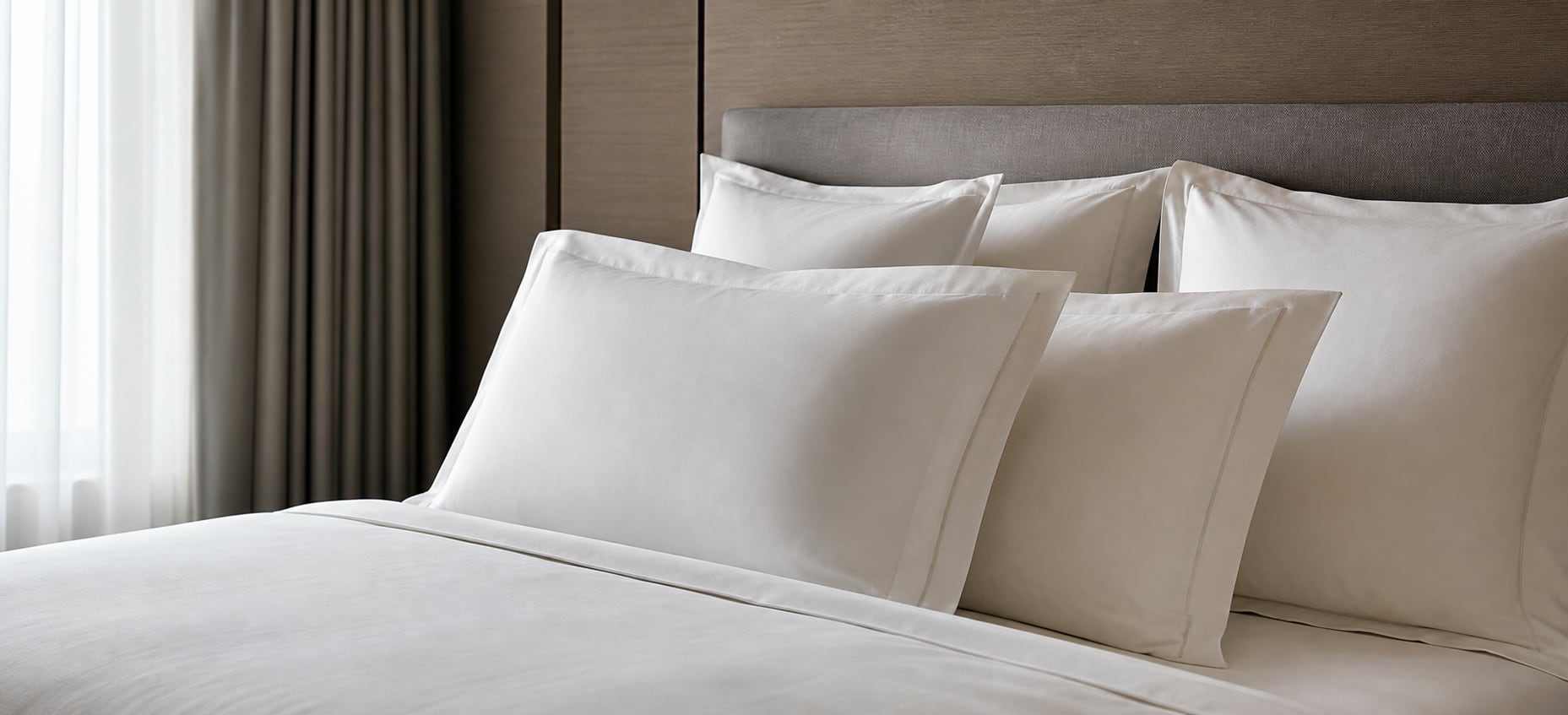
A housewife case has a plain sewn edge and usually an internal flap that helps retain the pillow. An Oxford case adds a visible fabric border around the body. These terms describe a general form, not every construction detail. Ask for the finished body size, flap depth, border width, seam position and opening direction. A labelled drawing prevents the name from carrying more meaning than it should.
The border changes presentation and handling. An Oxford edge can frame the pillow on the bed, yet it must sit evenly and may require more arranging after laundering. A plain case can be quicker to align, but its opening and flap still need to contain the pillow. Let attendants make several beds at normal pace before deciding which detail belongs in every room category.
Compare fabric as a complete construction
Read fibre, yarn, weave, weight and finish together. Cotton often provides a familiar absorbent hand. A cotton-polyester blend may dry or release creases differently. Percale generally feels crisper and looks more matte, while sateen usually has a smoother face and more lustre. These are tendencies, not guarantees. Two fabrics with the same composition can behave differently because their yarns, density and finishing differ.
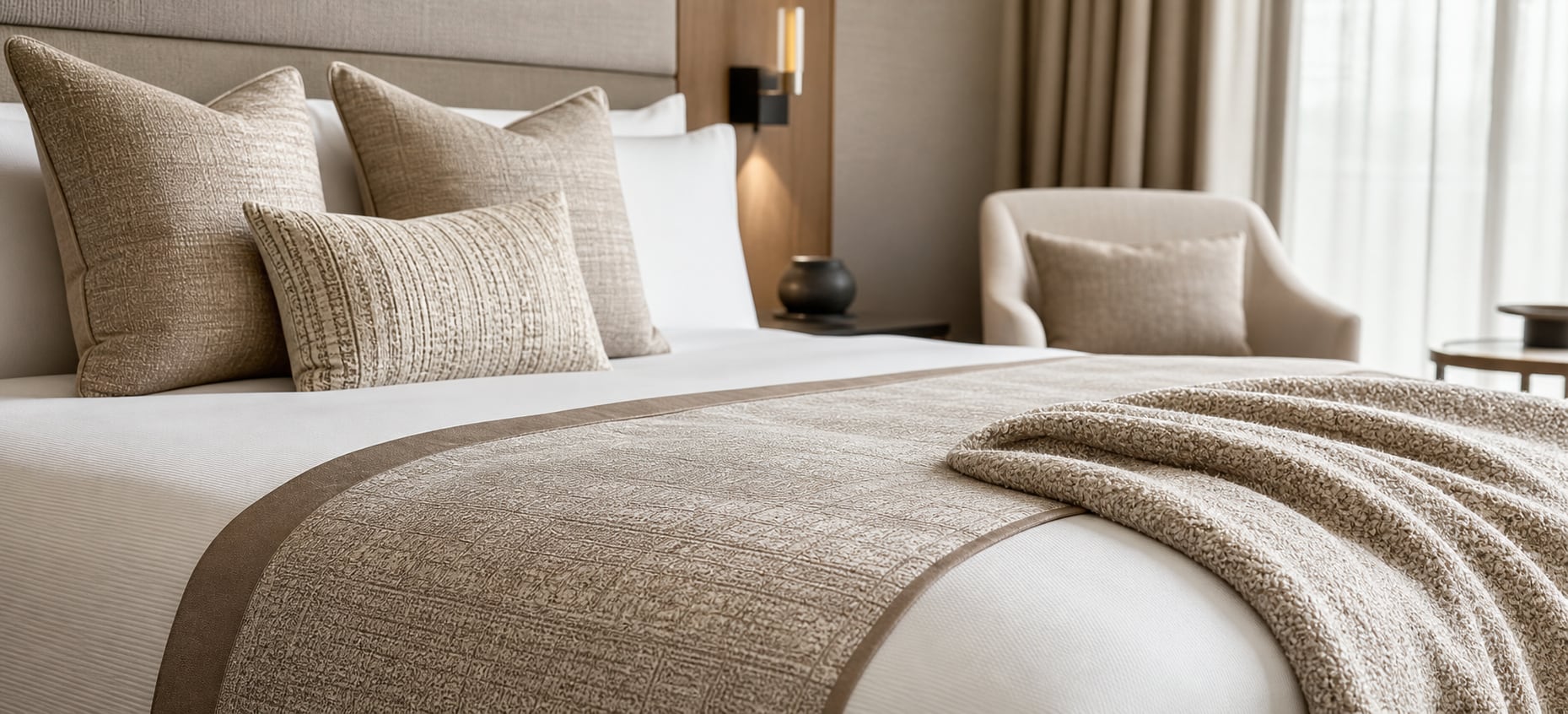
Place the pillowcase beside the sheets and duvet cover under the room’s daytime and evening lighting. Whites and colours that match on a specification sheet can look different when weave and surface reflection change. Feel both sides, inspect opacity over the protector and check whether decorative borders or embroidery create a rough area near the face. Keep the choice tied to the whole bed rather than an isolated swatch.
Test full-size cases in the intended laundry process
Ask the responsible laundry team to process marked samples through its intended sorting, washing, extraction, drying, finishing and folding route. The correct programme depends on fibre, colour, soil, equipment, chemistry and local hygiene requirements, so an article cannot supply one universal temperature. Record the route used and compare the finished dimensions, hand, colour, seams, flap and border with an untreated control.
Pillowcases are small enough to hide inside larger linen during processing and sorting. Check whether the trial pieces separate cleanly, feed through the chosen finishing method and arrive in consistent stacks. A border that curls or a flap that twists adds correction on every change. If a case looks good only after careful hand finishing, include that labour in the decision.
Let housekeeping test the whole change
Give the trial to several attendants rather than one specialist. Time the complete task: finding the right case, opening it, inserting the pillow, seating the corners, arranging the bed and stripping it later. Watch for repeated shaking, overreaching or fingers catching inside a deep flap. The fastest sample in a demonstration is not necessarily the easiest one to repeat across a full floor.
Inspect the bed after it has been used, not only after styling. Look for exposed protectors, pulled seams, empty corners and borders that collapse behind other pillows. If the room uses several pillow types, confirm that labels can be read without unfolding every case. Clear identification often saves more time than a small construction change.
Approve a processed reference, not a description alone
Write down fibre composition, weave, colour, finished body size, flap or closure, border, seams, labels, tolerances and the agreed care route. Keep a new sample and a processed sample. Add a photograph showing how the approved case sits on each relevant pillow, but do not use the photograph as a substitute for measurements.
Before a full order, inspect several pieces from the proposed production sample. Small items can vary in squareness, seam alignment and flap depth even when the headline size is the same. Measure the agreed points, make the beds and confirm folding. A repeatable record helps the hotel identify a later change before mixed stock reaches guest rooms.
Make the final choice with three teams
Housekeeping sees fitting and presentation. Laundry sees processing and finishing. Procurement sees continuity, variants and total cost. Bring the three views together after the same trial rather than asking each team to judge a different sample. If their findings conflict, identify the exact cause: dimensions, fabric, closure, finish or labelling. That makes the next sample more useful.
The right pillowcase is the one that fits the approved pillow after laundering, feels appropriate beside the face and can be handled consistently. Start with the physical pillow, not a market name. Then use the processed result to settle fabric and construction. This order keeps appearance, comfort and daily work in the same decision.
Use the hotel pillowcase range and the wider Stay textile category to connect the tested case with the rest of the bed-linen brief.
Frequently asked questions
Is a higher thread count always better for hotel pillowcases?
No. Thread count describes only part of a woven construction. Yarn size, weave, fibre, weight and finish also change hand, opacity, airflow and laundry behaviour. Compare complete, processed cases on the approved pillows instead of choosing the largest number.
Can one pillowcase size cover every hotel pillow?
Sometimes, but confirm it with every approved pillow and protector. Loft and firmness change how a case fills even when flat dimensions are similar. The hotel pillowcase size guide explains what to measure before standardising.
How should a hotel test pillowcase samples?
Mark several full-size cases, retain an untreated control and process the rest through the intended laundry route. Let several attendants fit and strip them, then compare dimensions, seams, flap, border, hand and folding. Record the accepted result rather than relying on memory.
Where can a hotel discuss pillowcase options for a project?
Prepare the pillow schedule, finished dimensions, preferred construction, fabric direction and laundry information first. Then share that brief through the inquiry route so the discussion begins with measurable requirements.
Product catalogue
Request the Stay catalogue
Share your business email and, if useful, your company or property name. We will carry these details into the secure catalogue-request form with the relevant category already selected.
Journal
Continue reading
Hotel Pillowcase Size Guide
How to measure each pillow, allow for loft and protectors, and approve a finished pillowcase after laundering.
Read Hotel Pillowcase Size GuideHousewife vs Oxford Pillowcases for Hotels
Housewife cases use a plain edge; Oxford cases add a fabric border. Compare both on the bed and after laundry.
Read Housewife vs Oxford Pillowcases for HotelsWhat Fabric Is Best for Hotel Pillowcases?
There is no universal best fabric. Compare complete pillowcases for face feel, laundering, finishing and fit.
Read What Fabric Is Best for Hotel Pillowcases?