











What Fabric Is Best for Hotel Pillowcases?
Choose the fabric that gives the intended face feel and returns from the intended laundry process at the approved size and finish.
Published by Gencer Textiles

The best hotel pillowcase fabric is the complete construction that feels right beside the face and returns from the intended laundry process clean, correctly sized and presentable. Cotton, cotton-polyester blends, percale and sateen can all be suitable under different conditions. Fibre or thread count alone cannot predict the finished result.
Start with full pillowcases, not small swatches. Put them on the approved pillow and protector, process them with the normal bed linen and let housekeeping handle them. Compare hand, surface, opacity, creasing, seams, drying, finishing and fit. That evidence turns a broad fabric preference into a usable specification.
Begin with the surface that touches the guest’s face
Feel the case when new and after processing. Check both sides and the areas around seams, embroidery or borders. A finish that seems smooth by hand may feel different under the weight and warmth of a head. Review the pillow with the room’s usual temperature, protector and bedding because comfort comes from the whole assembly.
Avoid treating softness as the only goal. The case also needs enough cover, a stable surface and a finish that the laundry can reproduce. Heavy softeners or special finishing may change absorbency, hand and processing, so the responsible laundry team should define what is appropriate for the product and service standard.
Read cotton and blends as starting points
Cotton is commonly chosen for its familiar hand and moisture interaction. Polyester in a blend can change drying, crease release, strength and feel. Those are broad tendencies. Yarn size, spinning, blend ratio, weave, density, weight and finish decide how a particular case behaves. Compare declared compositions only when the rest of the construction is also clear.
Ask for accurate fibre information and keep it in the product record. The required labelling depends on the market and transaction, so confirm legal requirements with the responsible supplier or adviser. For the hotel’s operational decision, the important step is to match the declared construction to a processed physical sample.
Compare percale and sateen on the pillow
Percale is a plain weave often associated with a crisp, matte character. Sateen uses longer floats and is often smoother with more lustre. The structures can also respond differently to abrasion, snagging, creasing and finishing. Neither label guarantees quality, and one weave name covers many yarn and density combinations.
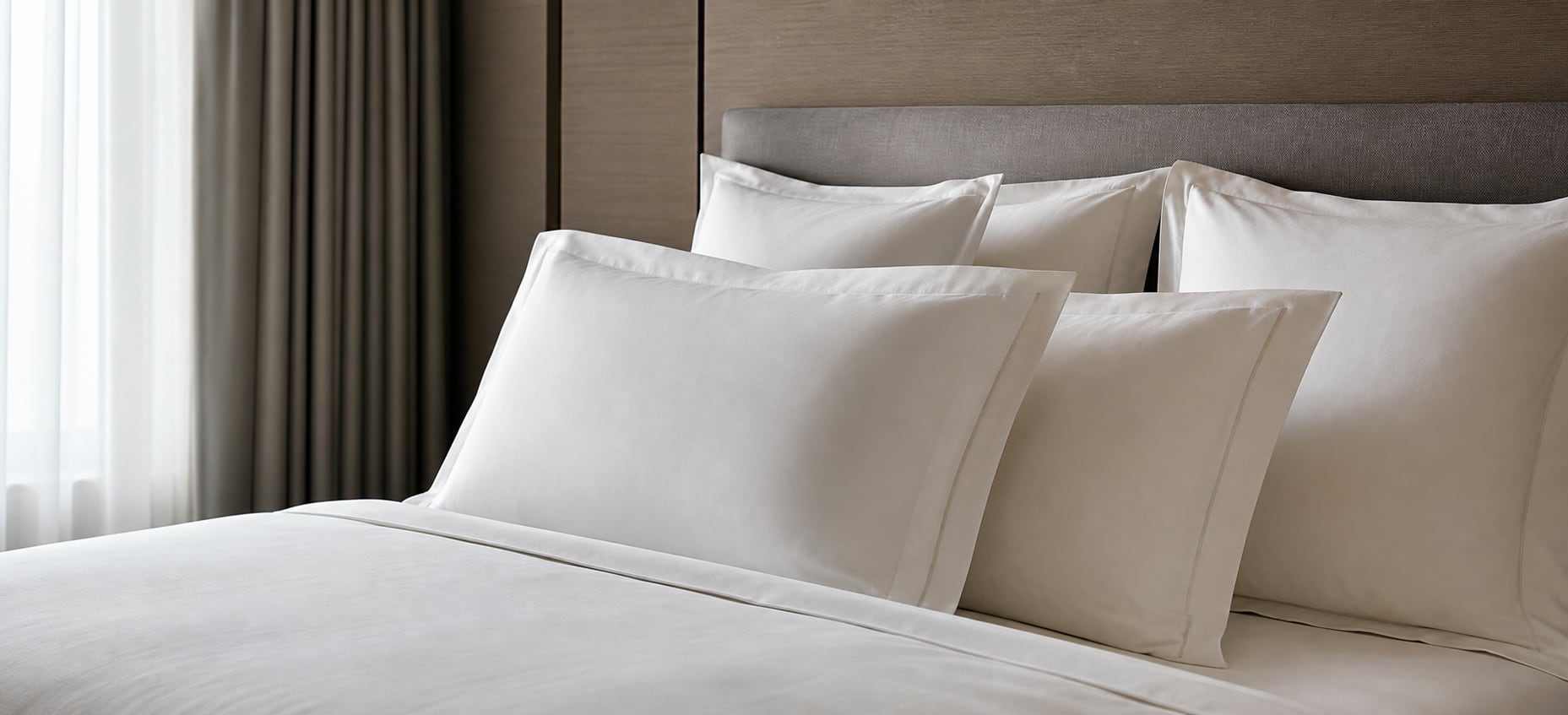
Place both candidates beside the approved sheets and duvet cover. A pillowcase is close to the guest’s face and visually prominent at the head of the bed, so a mismatch in lustre, colour or texture can be noticeable. Decide whether exact coordination or a deliberate contrast is intended, then inspect it under real room lighting.
Treat thread count as one number, not a grade
Thread count reports yarns within a stated area, but counting conventions and yarn construction can complicate comparisons. It does not reveal fibre quality, yarn size, fabric weight, finishing or seam construction. A larger number can still produce an unsuitable hand or processing result. Ask what the number describes, then judge the complete case.
Opacity and cover should be reviewed directly over the pillow protector. A balanced lower count may be more useful than a dense fabric that adds finishing work, but the reverse can also be true for a particular construction. Sample evidence is stronger than a universal recommendation.
Include the laundry before choosing the fabric
Document the intended sorting, wash, extraction, drying, finishing and folding route. Soil, hygiene requirements, colour, fibre, equipment, chemistry and local rules affect the programme. Do not select a fabric around an invented universal temperature or cycle. Let the responsible laundry and chemical specialists confirm the process.
Compare candidate cases in equivalent loads and retain an untreated control. Record finished dimensions, hand, colour, crease level, seam puckering and the correction needed before folding. A fabric that needs slower finishing or repeated manual touch-up may add work even when its purchase price is attractive.
Watch white, colour and surface under room lighting
Whites can differ in undertone, and different weaves reflect light differently. Review pillowcases with the rest of the bed in daylight and evening lighting. Cameras and screens can shift colour, so photographs should support rather than replace the physical approval. If coloured or embroidered, inspect transfer, bleeding and appearance through the intended trial.
Use objective references where the project has them, but still make the bed. A numerical colour difference cannot explain whether guests or staff will notice the result in the room. Record the accepted sample and lighting conditions so later comparisons are more consistent.
Inspect fabric, seams and finishing together
A strong fabric does not compensate for weak seams, and a neat seam does not rescue unstable cloth. Check stitch balance, thread, back-tacking, hems, flap and Oxford border after processing. Look for skew, puckering, loose ends and rough areas. The pillowcase should be evaluated as a sewn product.
Compare several pieces rather than the best single sample. Variation across a small group can reveal alignment or finishing problems. If one piece fails, record the cause before making a broad claim about fibre or weave.
Run a controlled room and laundry trial
Mark candidates, measure them, process them and put them into a representative room rotation. Let several attendants fit and strip them. Review guest-contact hand, fit, opening, folds and bed presentation after use. Repeat enough to reveal early movement, with the trial length defined by the project rather than a universal cycle claim.
Keep notes simple and comparable. Change one main variable at a time where possible. If composition, weave, weight, finish and construction all change together, the team may know which sample it prefers but not why.
Approve the construction that can be repeated
Record composition, weave, colour, weight or density information used, finished body dimensions, construction, labels, tolerance and care route. Keep new and processed references. For repeat orders, compare the incoming product with those references instead of accepting a familiar marketing name.
Choose after the face feel, room appearance and laundry result agree. If two fabrics both work, select according to the service character, processing effort and continuity needed. There is no reason to invent one universal best fabric when a controlled local comparison gives a clearer answer.
Use the pillowcase product family and the wider Stay collection to review the tested construction in context.
Frequently asked questions
Are 100% cotton pillowcases always best for hotels?
No. Cotton can offer a familiar hand, while blends can change drying and crease behaviour. Construction, finish, laundry and the required feel decide the result.
Is percale better than sateen for pillowcases?
Neither is universally better. Percale is generally crisper and matte; sateen is generally smoother and more lustrous. Compare processed cases beside the rest of the bed.
What thread count should a hotel choose?
There is no universal number. Ask how it was counted and compare yarn, weave, weight, finish and processed performance. The complete case matters more than the largest figure.
Should fabric be tested as a full pillowcase?
Yes. Seams, flap, border, dimensions and finishing affect the result. A swatch cannot show fit, folding or the guest-contact surface on the real pillow.
Product catalogue
Request the Stay catalogue
Share your business email and, if useful, your company or property name. We will carry these details into the secure catalogue-request form with the relevant category already selected.
Journal
Continue reading
How to Choose Pillowcases for Hotels
A practical way to match pillowcase fit, fabric and construction to the room, laundry and housekeeping routine.
Read How to Choose Pillowcases for HotelsHousewife vs Oxford Pillowcases for Hotels
Housewife cases use a plain edge; Oxford cases add a fabric border. Compare both on the bed and after laundry.
Read Housewife vs Oxford Pillowcases for HotelsHow Commercial Laundry Affects Hotel Duvet Covers
A duvet cover passes through a full process, not just a wash. Each stage can change its fit, surface, seams, closure and daily handling.
Read How Commercial Laundry Affects Hotel Duvet Covers