






Tablecloths and Commercial Laundry: Inputs to Confirm
A tablecloth specification should be reviewed against the real soil, wash, drying, finishing, folding, transport, and storage process before it is approved.
Published by Gencer Textiles
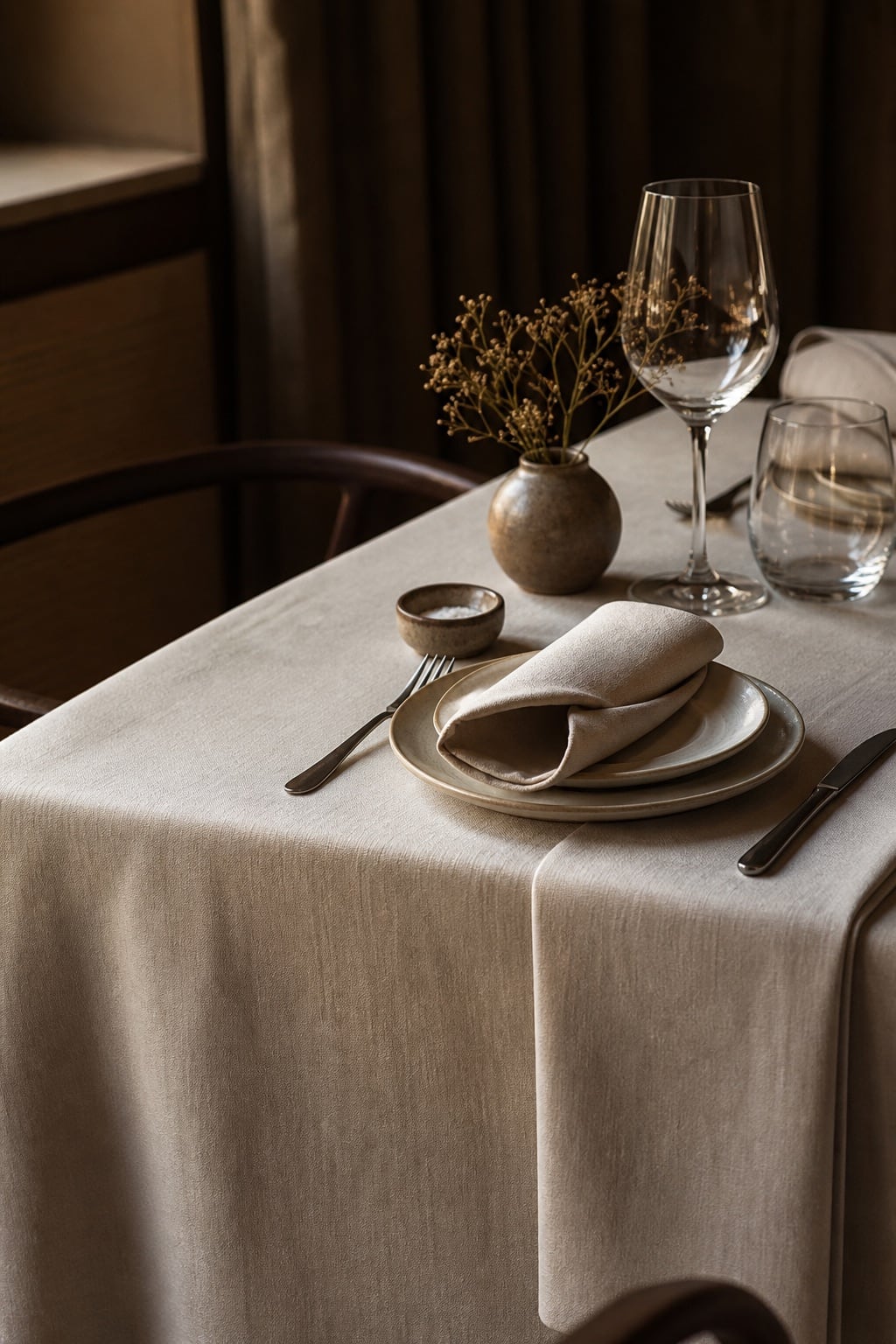
Confirm the complete laundry process before approving tablecloth material, construction, dimensions, or finish. Restaurant soils, collection timing, washing, drying, ironing, folding, transport, and storage all influence whether the approved table appearance can be reproduced in service.
The goal is not to prescribe one universal process. It is to make the operating conditions visible so the restaurant, procurement team, and laundry can evaluate the same sample against the same expectations.
Document the soil and collection profile
Record the typical food, beverage, oil, wax, and cosmetic exposures, along with how used linen is collected and how long it may wait before processing. Separate exceptional event soils from the normal service profile so they do not distort the everyday specification.
Map the laundry and finishing process
| Stage | Input to confirm | Reason for recording it |
|---|---|---|
| Sorting | Colours, soil categories, and mixed-product loads | Helps assess colour and cross-contamination risk |
| Washing | Actual programme, chemistry, temperature, and load practice | Connects sample testing to operating conditions |
| Drying | Dryer, extraction, or finishing route | Affects handling and dimensional result |
| Finishing | Ironer, press, hand finish, or fold | Influences final appearance and labour |
| Return | Fold size, trolley, transport, and storage | Checks whether the finished dimensions remain manageable |
Laundry equipment guidance commonly treats correct loading and separation as part of process control. The textile specification should therefore be tested in the actual or representative workflow instead of relying on a new, unlaundered sample.
Measure before and after the agreed test
Record the sample’s finished dimensions before testing and again after the agreed sequence. Dimensional change depends on fibre, yarn, construction, wet processing, finishing, manufacture, and care, so a rigid generic allowance should not replace a project-specific test.
Turn the result into an operating record
- Name the approved tablecloth and table format.
- Record finished dimensions and the measurement method.
- Attach the representative laundry and finishing process.
- Describe acceptable appearance, flatness, seams, and edges.
- Keep pre-test and post-test observations with the sample reference.
- Reconfirm the record if the process, material, or finishing changes.
This shared record is more useful than a general claim about easy care. It allows future samples and repeat requests to be compared with a known operating context.
Product catalogue
Request the Dine catalogue
Share your business email and, if useful, your company or property name. We will carry these details into the secure catalogue-request form with the relevant category already selected.
Journal
Continue reading
Why Table Linen Still Matters in Modern Hospitality
How proportion, texture, drape, and care influence the experience of a restaurant or hotel dining room.
Read Why Table Linen Still Matters in Modern HospitalityA Practical Table Runner Buying Guide for Restaurant Procurement Teams
How to evaluate table runners through proportion, service style, care, storage, and replacement.
Read A Practical Table Runner Buying Guide for Restaurant Procurement TeamsHow to Coordinate Replacement Planning Across Textile Categories
How to coordinate condition reviews, operating inputs, records, and replenishment decisions without relying on universal replacement cycles.
Read How to Coordinate Replacement Planning Across Textile Categories