




























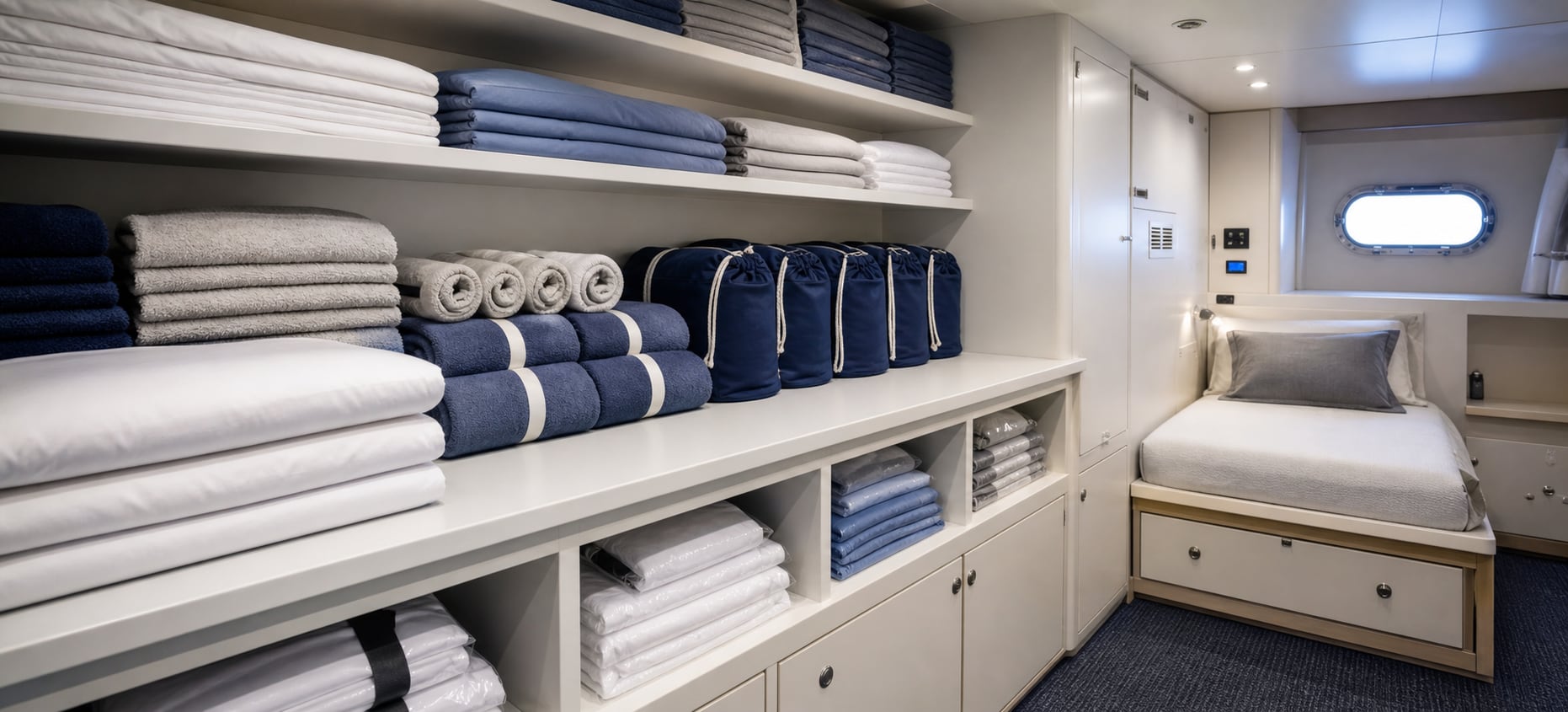


What Makes Hotel Sheets Suitable for Commercial Laundry?
Commercial-laundry suitability is not a fibre label. It is the repeatable fit between the sheet and the property’s complete care and handling process.
Published by Gencer Textiles

A hotel sheet is suitable for commercial laundry when its fibre, construction, dimensions, seams, hems, labels and finish produce a repeatable result through the property’s actual sorting, washing, extraction, drying, flatwork finishing, folding, transport and bed-making process. “Commercial grade” on its own is not enough. Suitability must be demonstrated against defined care conditions and acceptance criteria.
The assessment should involve the laundry, housekeeping and procurement teams before the order. Laundry sees processing and finishing; housekeeping sees fit and presentation; procurement sees documentation, continuity and cost. A sheet can appear strong in one part of the cycle and fail elsewhere, for example by washing clean but returning undersized, feeding poorly or requiring excessive manual correction.
Map the real laundry route before selecting fabric
Write down every stage from the guest room to clean storage. Include collection bags, soil sorting, transport time, wash categories, equipment type and rated load, dosing control, extraction, tumble drying or direct flatwork route, ironer, folding, stacking, transport and linen-room conditions. If work is outsourced, record the service specification and arrange direct input from the laundry rather than relying on assumptions.
Hotels often process more than one sheet construction, size and soil class. The candidate must fit the relevant load family without creating an impractical separate route. Separating cotton and blended sheets, whites and colours, or heavily soiled items may be necessary under the laundry’s process. The operational cost of an extra sort should be visible before the room team adopts a new variant.
| Process stage | Evidence to collect | Failure that may appear |
|---|---|---|
| Collection and sorting | Bag, soil class, size and composition identification | Mixing, delayed treatment or wrong programme |
| Washing | Programme, chemistry, temperature, time and loading | Residual soil, damage, redeposition or colour change |
| Extraction and drying | Residual moisture and transfer route | Long drying, tangling, heat exposure or uneven moisture |
| Flatwork finishing | Feed, speed, pressure or temperature and exit condition | Creasing, tracking, damp areas or manual rework |
| Folding and transport | Fold format, stack stability, trolley and storage | Poor stacks, mixed sizes or re-creasing |
| Bed making | Finished dimensions, hand and presentation | Insufficient tuck, loose fit or unacceptable surface |
Construction must match the process window
Composition, yarn, weave, density, weight and finishing influence how a sheet wets, releases soil, holds moisture, moves through equipment and responds to heat and pressure. Cotton and polycotton can both be suitable, as can percale and sateen, but they may need different controls. The laundry should approve the complete construction instead of accepting a fibre percentage or thread count as a performance certificate.
A very dense or heavy sheet may require different extraction, drying or finishing conditions. A very light construction may be easier to dry but create feeding, opacity, wear or handling concerns. These are hypotheses to test, not automatic outcomes. Ask for the fabric weight, stated thread-count method and care information, then compare full-size samples in the representative equipment route.
The guides to thread count and cotton versus polycotton help separate construction variables before the laundry trial.
Washing requires controlled inputs
The correct wash programme depends on soil, hygiene requirements, fibre content, colour, finish, equipment and chemical system. An editorial guide should not prescribe a universal time, temperature or dose. The responsible laundry specialist and chemical provider should define the process using product care information, local requirements and verified equipment capability. Record the programme used in the trial so later results can be interpreted.
Loading is part of control. Equipment makers warn that overloading can harm results and textiles, while underloading wastes resources. Use the machine’s rated and programme-specific guidance rather than judging by sight. Also document water quality, dosing calibration, load mix and maintenance where they may explain variation. A test result without process conditions cannot credibly be transferred to production.
Dimensional stability must be measured, not assumed
Measure length and width at agreed points before and after the trial using a consistent conditioning method. For fitted sheets, add pocket depth, elastic position and recovery. For flat sheets, assess the amount available for tuck and the hotel’s chosen fold. Compare the result with the complete mattress, topper and protector rather than a nominal bed-size chart.
Dimensional change may occur during manufacturing wet processing, initial washes and later use. The pattern depends on fibre, yarn, weave, finish and care. Do not promise a standard shrinkage percentage without a test method and product evidence. Procurement should state whether ordered dimensions are nominal before care or accepted finished dimensions and specify the agreed tolerance and measurement stage.
Drying and flatwork are part of textile performance
Residual moisture after extraction influences drying and ironer behaviour. Sheets that enter finishing too wet, too dry or unevenly conditioned may crease, scorch, track or leave damp areas depending on the process. Controls belong to trained operators and equipment instructions. The trial should capture entry condition, settings, speed, exit condition and any need for reprocessing.
Observe how the sheet separates from the load and feeds into flatwork equipment. Record tangling, twisted hems, edge alignment, feeding effort, exit flatness, fold accuracy and stack stability. A construction that slows the line or needs frequent hand finishing creates a real operating cost. A faster line is not automatically better if the resulting dimensions, hand or appearance miss the room standard.
Seams, hems and elastic are common failure points
Inspect more than the fabric field. Hem width, stitch type and density, thread, back-tacking, joins, labels and elastic construction can determine whether the product stays serviceable. Loose stitches, seam puckering, twisted hems and failing elastic may remove an otherwise sound sheet from use. Review both the new sample and processed pieces under consistent lighting.
Specify where manufacturing joins are acceptable, how corners should be formed and whether labels may create a hard or visible area. For fitted sheets, test elastic recovery and attachment after repeated care. For flat sheets processed through ironers, confirm that hem construction feeds and folds consistently. Avoid prescribing a single seam solution for every supplier; define the required finished result and inspect evidence.
Identification prevents process errors
A durable, legible label can carry size, composition, care and product reference information. The laundry may also need colour coding, woven markers, heat-resistant tags or machine-readable systems, depending on its equipment and tracking practice. Any solution must be sampled because label edges, adhesives, inks and placement can affect comfort, finishing or readability.
Use stable internal names rather than “new white sheet” or supplier nicknames. If several constructions look alike but require different routes, identification must work at the point of sorting, not only in a purchasing file. Keep the approved code consistent across orders, stock records, laundry instructions and rejection reports so process issues can be traced to the right reference.
Test soil removal without inventing a guarantee
No sheet is universally stain-proof. Body oils, cosmetics, self-tan products, food, beverages, medicines and cleaning agents have different chemistry. Agree representative test soils and evaluation methods with the laundry and chemical specialist. Note the limits of any trial and never promise that a fabric will release every stain under every programme.
Track residual marks, greying, redeposition, odour and local fabric damage. If performance deteriorates, investigate sorting, delay before treatment, chemistry, water, loading, rinsing, drying and previous finish before assigning the cause to fibre. Equally, do not keep escalating chemistry or heat to force an unsuitable sheet through the process without reviewing textile damage and safety requirements.
Calculate productivity and cost from observed data
Measure what the operation can support: pieces or kilograms per load, cycle and transfer time, drying demand, flatwork throughput, operator touch time, rewash, reject rate and storage volume. Use a defined observation period and state exclusions. A small trial will not predict years of service, but it can expose early bottlenecks and provide a better comparison than unit price alone.
Keep retirement reasons by product reference. Stains, tears, hem failure, thinning, pilling, loss, size change and guest-standard rejection suggest different corrective actions. Cost per use is only reliable when issue, return and retirement data are sufficiently complete. Where tracking is weak, present the decision as a provisional operational judgement and plan a post-launch review.
The wider hotel bed-sheet selection guide connects these laundry findings to room and housekeeping requirements. The relevant Stay category and bed-sheets product family can then frame a precise sample request.
Approve a documented production trial
- Record the candidate’s composition, construction, weight, density, finish, dimensions, seams, hems, labels and care guidance.
- Retain unused controls and mark multiple full-size trial sheets so each can be traced.
- Measure agreed dimensions before processing and photograph construction details for the record.
- Run the documented representative sort, wash, extraction, dry, finishing and folding route under responsible supervision.
- Measure again and inspect soil removal, colour, surface, seams, hems, labels, hand and fold quality.
- Make the intended beds and collect separate housekeeping and room-review observations.
- Repeat a project-defined number of cycles, then approve or revise the specification with stated evidence and limits.
If the outsourced laundry cannot trial a small quantity in its normal line, agree the closest representative method and record the difference. A supplier-run test can support development but does not replace local validation when equipment and chemistry differ. For a large order, a pilot room group and planned post-launch checkpoint can reduce the risk of discovering incompatibility after full deployment.
Commercial suitability is a repeatable fit
The final approval should identify the sheet, the acceptable finished result and the care route that produced it. Include the physical sample, measurement record, programme reference, finishing notes, inspection criteria, labels and responsible sign-off. If the process changes later, retest rather than assuming the old result still applies.
A commercially suitable hotel sheet is therefore not simply heavy, blended, white or labelled for hospitality. It is a documented construction that returns clean, correctly sized, serviceable and presentable through the actual operation at an acceptable level of work. That standard is specific enough to guide purchasing while remaining honest about the conditions that must be controlled.
Product catalogue
Request the Stay catalogue
Share your business email and, if useful, your company or property name. We will carry these details into the secure catalogue-request form with the relevant category already selected.
Journal
Continue reading
How to Choose Bed Sheets for a Hotel
A practical method for specifying hotel sheets around the room, the laundry process, housekeeping and repeat supply.
Read How to Choose Bed Sheets for a HotelWhat Thread Count Is Best for Hotel Sheets?
Why thread count is a useful construction input but an unreliable quality ranking when considered alone.
Read What Thread Count Is Best for Hotel Sheets?100% Cotton vs Polycotton Sheets for Hotels
A fibre comparison that connects guest feel with drying, finishing, stain response and operational control.
Read 100% Cotton vs Polycotton Sheets for Hotels