






















How Many Cloth Napkins Does a Restaurant Need?
A restaurant needs enough cloth napkins to cover its busiest realistic service while used stock is being collected, washed, finished, transported and returned. Calculate every napkin type separately; a fixed number per seat is only a rough shortcut.
Published by Gencer Textiles
The useful answer is not a universal number per seat. A restaurant needs enough cloth napkins to supply every cover and other legitimate use during the longest period before used napkins return clean and ready for service, plus a buffer for normal variation and a separately controlled reserve for permanent losses.
A seat is furniture; a cover is one guest served. A 60-seat dining room may serve 60 covers on a quiet evening or 180 across several turns. Buying from the seat count alone ignores turnover, lunch and dinner, private events, room service, laundry timing and the napkins that are rejected after washing.
Use one formula for each napkin type
Calculate dinner napkins, breakfast napkins, cocktail napkins and any distinct banquet or private-dining format as separate stock-keeping units. They may have different sizes, colours, folds, uses and laundry flows. Adding them into one total can create an apparent surplus while the format needed for tonight’s service is short.
This formula is deliberately expressed in pieces, not “par”. Par is useful shorthand for a defined quantity in circulation, but businesses do not always define it in the same way. Writing down the pieces assigned to service, laundry, clean backup and replacement stock makes the assumption visible.
1. Calculate the peak issue requirement
Start with the busiest realistic service pattern the operation intends to support, not the average week and not an exceptional event that will be rented or supplied separately. Reservation forecasts, point-of-sale cover counts, banquet event orders and room-service records are better inputs than multiplying the number of seats by a generic factor.
| Input | What to record | Why it changes the quantity |
|---|---|---|
| Guest covers | Peak covers by breakfast, lunch, dinner, banquet and private dining | Each place setting normally consumes one guest napkin |
| Napkins per cover | The actual service standard for that outlet | Some concepts issue a second napkin or replace one during service |
| Non-cover uses | Bread baskets, trays or presentation uses approved for this exact napkin | These pieces leave clean stock without appearing in cover counts |
| Service replacements | Clean pieces used for dropped, marked or reset place settings | A fully set room can consume more than the final number of diners |
| Stock shared between outlets | Which outlets can genuinely use the same specification | Physically similar napkins are not interchangeable when size, colour or finish differs |
Count only uses that belong to the guest napkin specification. Waiter cloths, glass-polishing cloths, kitchen cloths and cleaning textiles require their own product and stock calculation. Treating a dining napkin as a general service cloth makes both hygiene control and inventory records less reliable.
2. Calculate the laundry loop
Next, measure the longest normal gap from issuing a clean napkin to receiving that batch back washed, fully dry, finished, inspected and ready for the side station. Include collection cut-off, transport, sorting, washing, drying, ironing or folding, quality rejection and delivery timing. “Next-day laundry” is not next-day availability if the delivery arrives after the restaurant has set the room.
Add the napkins required for every service that occurs inside that gap. If used stock from Monday lunch returns before Tuesday lunch setup, one day of peak issue may cover the loop. If it returns only before Wednesday dinner, the calculation must include all intervening lunch, dinner and other services. Weekend closures, public holidays, missed delivery windows and banquet peaks can create a longer gap than the stated processing time.
- Confirm when used napkins leave each outlet.
- Confirm the laundry collection and room-ready return times, not only the wash duration.
- Include pieces held for stain treatment, rewash or quality review.
- Model the longest planned interval between clean returns.
- Recalculate when the delivery schedule or service pattern changes.
3. Add a buffer that has a job
The operating buffer covers ordinary uncertainty: a stronger-than-forecast service, extra resets, a late clean delivery or a temporary rise in rewashes. It should be based on the difference between forecast and actual issue, plus the reliability of the laundry loop. A new opening can begin with an explicit provisional allowance, but the restaurant should replace that assumption with its own data as soon as a representative operating period is available.
Keep permanent loss outside this buffer. Napkins that are stained beyond the acceptance standard, torn, missing or removed because sets no longer match need replacement, not repeated circulation. A small labelled replacement reserve can be held unopened and released through an authorised stock adjustment. If operations repeatedly draw on it to complete ordinary service, the active circulation quantity or laundry schedule is too low.
Worked example: from covers to an order quantity
Consider a hypothetical restaurant using one dinner-napkin specification. Its busiest supported day is forecast at 135 lunch covers and 165 dinner covers. Records and the intended service standard allow for another 12 napkins for legitimate resets and replacements during those services.
| Step | Calculation | Pieces |
|---|---|---|
| Peak issue for one day | 135 lunch + 165 dinner + 12 service allowance | 312 |
| Longest clean-return gap | 312 × 2 peak operating days | 624 |
| Operating buffer in this example | 15% × 624, rounded up | 94 |
| Active circulating stock | 624 + 94 | 718 |
| Separate opening replacement reserve | Chosen opening provision | 36 |
| Opening requirement | 718 + 36 | 754 |
If this napkin is ordered by the dozen, the restaurant could round 754 up to 756 pieces. The two-day return gap, 15% buffer and 36-piece reserve are assumptions for this example, not universal recommendations. A restaurant with same-day finishing and stable covers may need less; one with external transport, weekend peaks or frequent event resets may need more.
Opening stock and replenishment are different calculations
Opening stock establishes a functioning circulation loop. Replenishment keeps that loop at its approved level. Set a count point for each napkin type and record clean shelf stock, stock issued to outlets, soiled stock, stock at the laundry, rewash, rejected pieces and unopened replacement reserve. The locations should reconcile to the owned or contracted total.
A simple weekly record can show whether the assumptions are working. Compare forecast covers with napkins issued, and used pieces sent with clean pieces returned. Record stains or damage beyond recovery separately from unexplained loss. A growing gap between clean returns and issues can indicate counting errors, delayed processing, mismatched bundles, quality rejects or real loss.
| Measure | What it reveals | Possible response |
|---|---|---|
| Napkins issued per cover | Extra resets, non-cover uses or uncontrolled use | Clarify service standards and separate other cloth types |
| Clean return rate | Rewash, rejection or laundry-count differences | Reconcile dispatch and return records |
| Emergency top-ups | Insufficient active stock or an unreliable return gap | Adjust circulation or the delivery schedule |
| Permanent rejects | Actual replacement demand and recurring defect patterns | Review stain handling, care process and specification |
| Unexplained loss | Stock leaving the recorded loop | Check sorting, bins, transport, outlet transfers and counts |
Check the answer against the real service
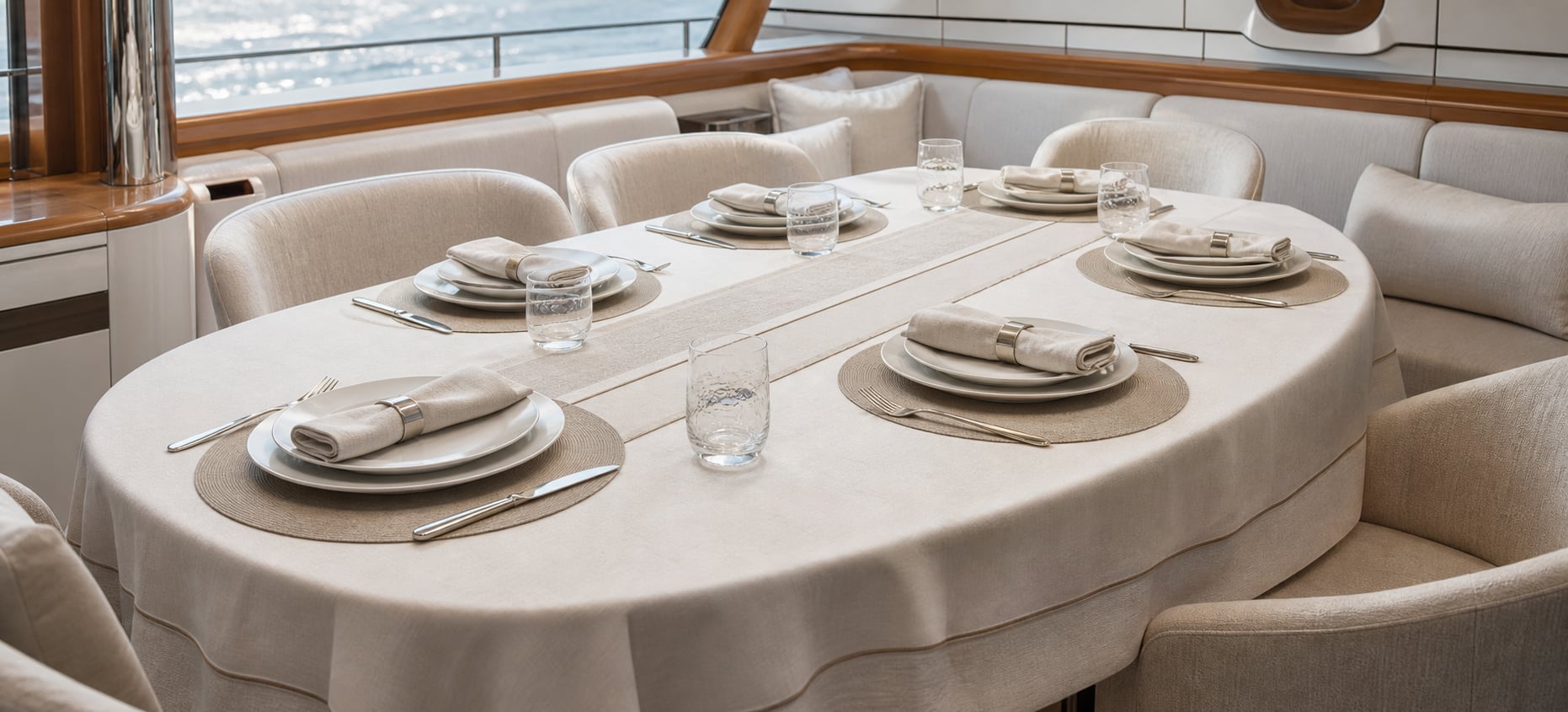
Before placing the main order, stage one representative service with the proposed napkin size, fold, side-station quantity, bundles and storage. Process sample pieces through the intended laundry and finishing route. This confirms whether the fold is repeatable, bundles are easy to count, shelf space is adequate and the clean-return time used in the calculation is realistic.
The result should be a quantity sheet for each outlet and napkin specification, showing the peak issue, services inside the return gap, operating buffer, replacement reserve, pack rounding and responsible count point. That record is more useful than saying the restaurant holds “three par” without defining what one par contains.
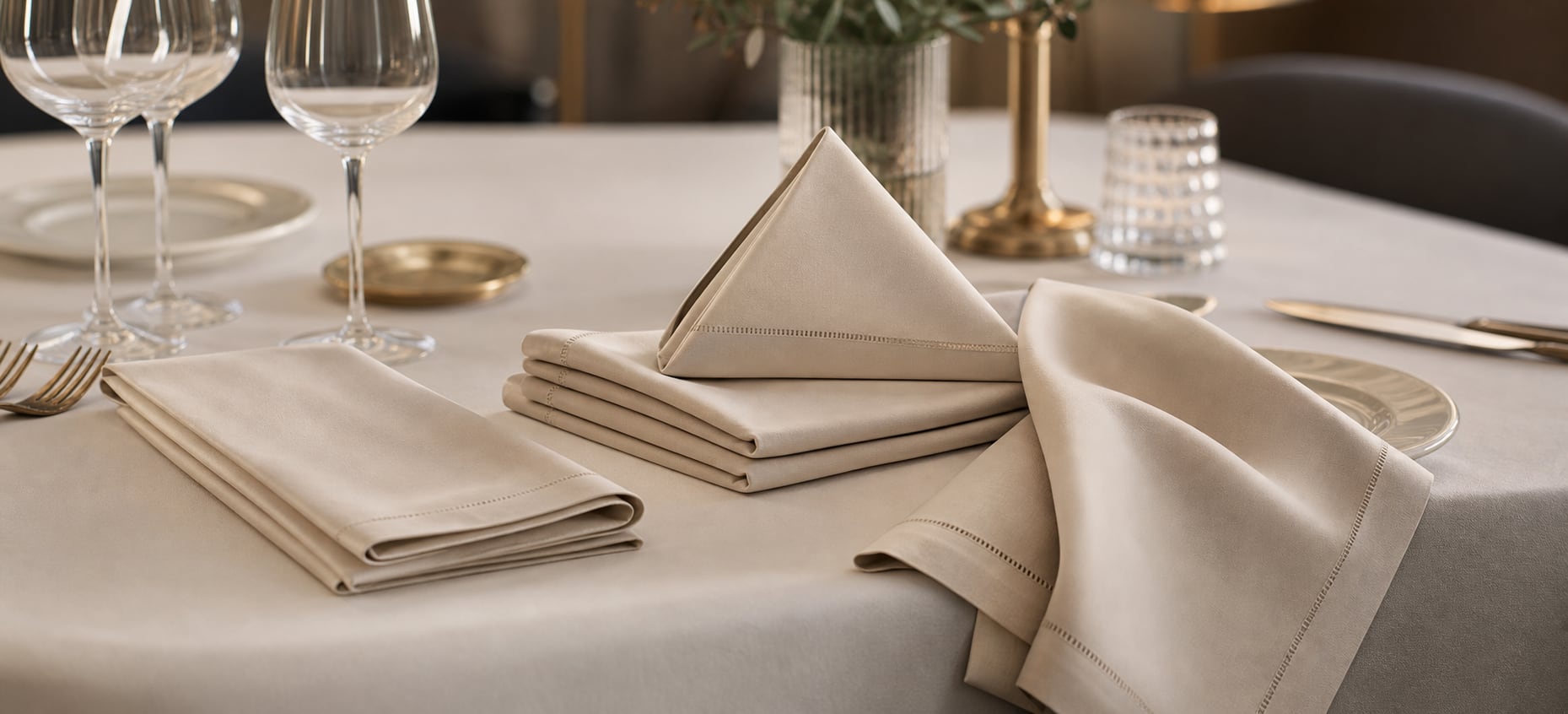
Review the available restaurant napkin formats, connect the quantity plan to the wider Dine collection, and confirm the laundry handover alongside the commercial tablecloth planning guide.
Product catalogue
Request the Dine catalogue
Share your business email and, if useful, your company or property name. We will carry these details into the secure catalogue-request form with the relevant category already selected.
Journal
Continue reading
Why Table Linen Still Matters in Modern Hospitality
How proportion, texture, drape, and care influence the experience of a restaurant or hotel dining room.
Read Why Table Linen Still Matters in Modern HospitalityTablecloths and Commercial Laundry: Inputs to Confirm
A working handover between restaurant, procurement, and laundry teams before tablecloth approval.
Read Tablecloths and Commercial Laundry: Inputs to ConfirmA Practical Table Runner Buying Guide for Restaurant Procurement Teams
How to evaluate table runners through proportion, service style, care, storage, and replacement.
Read A Practical Table Runner Buying Guide for Restaurant Procurement Teams