



How to Calculate Tablecloth Size and Drop for Restaurant Tables
For a round table, add twice the desired drop to the tabletop diameter. For a square or rectangular table, add twice the drop to both length and width. Then test the result on the actual furniture after the intended laundry and finishing process.
Published by Gencer Textiles
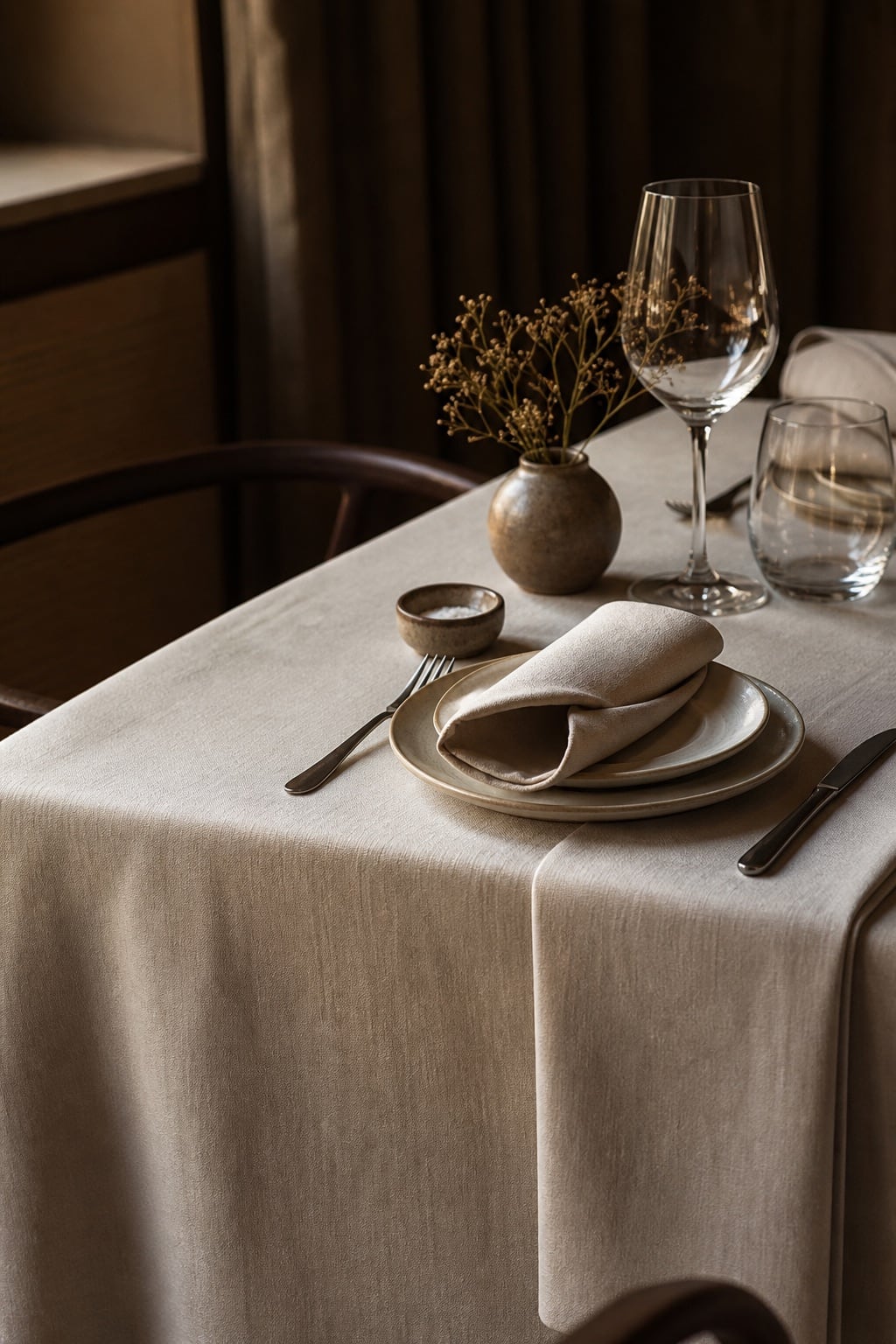
The basic tablecloth calculation is straightforward: add the drop on both sides of every tabletop dimension. A 120 cm round table with a 25 cm drop needs a 170 cm round cloth. An 80 × 120 cm rectangular table with the same drop needs a 130 × 170 cm cloth.
That number is a target finished size, not an automatic order size. Restaurant tables sold under the same nominal description can differ, a floor-length cloth behaves differently at the corners, and laundering can change dimensions. Measure the actual furniture, decide what the cloth must do in service, calculate each table family, and approve a processed production sample.
Measure the table that will be dressed
Measure the bare tabletop rather than relying on a purchase invoice or a label such as “six-foot banquet table”. For a rectangle, record finished length and width. For a square, record both directions in case it is not perfectly square. For a round table, measure the diameter through the centre in more than one direction. Also record the height from the floor to the top surface.
Check the edge profile, top thickness, pedestal, legs, levelling feet and anything fixed below the top. A deep apron or projecting base can push the cloth outward. If tables are regularly joined, measure the complete assembled layout in its service position; adding catalogue dimensions can miss gaps, connectors and small alignment differences.
- Give each table family a clear code and record the quantity in service.
- Measure length, width or diameter at more than one point.
- Record tabletop height and any required clearance above the floor.
- Photograph the edge, corners, legs, pedestal and joined-table arrangement.
- Note whether an undercloth, topper, overlay, runner or table clip will sit with the main cloth.
- Identify the smallest and largest examples when nominally matching tables vary.
Choose the drop by service job
The drop is the distance from the tabletop edge to the finished edge of the hanging cloth. There is no single restaurant drop that suits every room. A shorter drop can be easier around seated guests and fast table turns; a deeper drop creates more visual coverage but adds fabric near knees, chairs, service trolleys and the floor.
Commercial guides often show everyday drops around 20–30 cm and deeper banquet presentations around 35–40 cm, while a full drop is calculated from the actual table height. Treat these as sampling ranges, not standards. Sit at the table in the intended chair, stage a complete cover and test staff movement before approving the depth.
| Drop intention | How to define it | What to verify |
|---|---|---|
| Compact dining drop | Sample a depth that clears the guest’s lap and chair movement | Coverage, seated comfort and appearance from the room |
| Deeper restaurant or banquet drop | Sample the visual depth wanted on all exposed sides | Knee space, chair legs, trolleys and resetting speed |
| Near-floor or floor-length drop | Table height minus the chosen floor clearance | Corners, trip risk, cleaning, levelling feet and uneven floors |
| Unequal or one-sided drop | Set a separate depth for each edge | Whether the cloth is deliberately aligned and repeatable in setup |
Calculate round, square and rectangular cloths
Use one unit throughout the calculation. If the table is measured in centimetres, keep the drop and cloth size in centimetres. Do not round midway through the arithmetic or treat an inch label as an exact metric equivalent.
| Table and intended fit | Formula | Calculated finished cloth |
|---|---|---|
| 120 cm round table; 25 cm even drop | 120 + (2 × 25) | 170 cm round |
| 80 cm square table; 25 cm even drop | 80 + (2 × 25) in both directions | 130 × 130 cm square |
| 80 × 120 cm rectangle; 25 cm even drop | 80 + (2 × 25); 120 + (2 × 25) | 130 × 170 cm rectangle |
| 76 × 183 cm banquet table; 73 cm drop | 76 + (2 × 73); 183 + (2 × 73) | 222 × 329 cm rectangle before corner review |
In symbols, a round cloth diameter is tabletop diameter + 2D, where D is the desired drop. A square or rectangular cloth is tabletop width + 2D by tabletop length + 2D. If opposite edges need different drops, replace 2D with the sum of those two drops: cloth width = table width + left drop + right drop.
The same arithmetic works in reverse when the laundry or supplier offers a stock size. For an even rectangular fit, side drop = (cloth width − table width) ÷ 2 and end drop = (cloth length − table length) ÷ 2. A 140 × 180 cm cloth on an 80 × 120 cm table therefore gives 30 cm on every side. If the two answers differ, the cloth has different side and end drops even when it is centred.
Treat corners and shaped tables separately
The formula controls the drop at the midpoint of each straight edge. It does not guarantee how a square-cornered cloth will behave at a rectangular table corner. A long near-floor cloth has extra diagonal fabric there, which can flare, fold or pool. Rounded corners, shaped construction or a deliberately shorter clearance may give a cleaner and safer result, but the decision must be made on the real table.
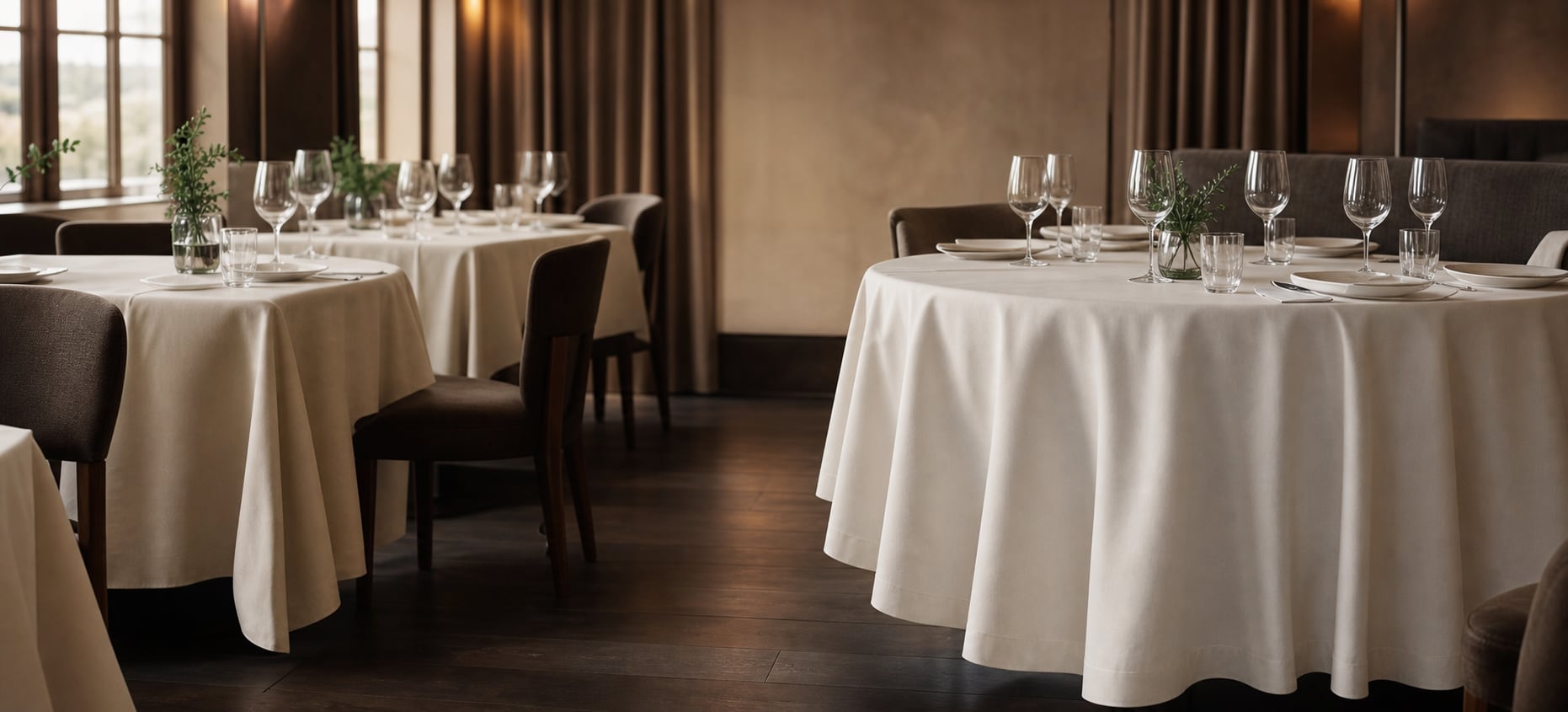
A square cloth on a round table also has a changing drop: the midpoint of each cloth edge is shortest and the four corners hang farther. Calculate the midpoint drop from the cloth side, then drape the physical sample to judge the corner points and folds. Do not describe it as an even drop.
For a true oval, ellipse, racetrack end, half-round, serpentine or irregular top, overall length and width do not fully describe the perimeter. A stock rectangular or oval cloth may be acceptable for a short drop, but a close or floor-length fit can require a dimensioned drawing, radii or a full-size template. Mark orientation and the guest-facing edge so the finished cloth is not rotated during setup.
Specify finished size after processing
The calculated dimensions should describe the cloth at the point of use: laundered, dried, finished, cooled and ready to dress the table. A supplier may need to cut or manufacture a different size to achieve that result. The allowance depends on the selected fabric, construction, grain direction, edge finish and actual care process; adding a generic shrinkage percentage yourself can create the wrong proportion.
State how the finished cloth will be measured—flat, without stretching, from finished edge to finished edge—and the agreed tolerance in each direction. For a round cloth, define how diameter is checked. For a shaped cloth, identify the control dimensions, profile and orientation. If a repeat, stripe, woven border or logo is involved, its alignment belongs in the same approval record.
Confirm washing, drying, ironing, folding and storage with the commercial tablecloth laundry guide. The mathematical fit is useful only if the laundry can reproduce it consistently.
Build a size matrix instead of guessing
A restaurant with several table families should keep a matrix linking the furniture code, measured top, height, intended drop, calculated cloth size, approved finished size and cloth identifier. Record whether the cloth may be rotated, which edges face guests, how tables are combined and which fold belongs in storage.
Avoid forcing every table onto one cloth size merely to reduce stock codes. One versatile size can be efficient when the resulting side and end drops are all approved; it becomes false economy when staff improvise alignment, corners drag or an apparently similar cloth is repeatedly sent to the wrong room. Colour-coded labels or unobtrusive woven identifiers can support sorting without changing the guest-facing design.
| Table code | Measured top | Approved drop | Finished cloth target | Setup note |
|---|---|---|---|---|
| R120 | Ø 120 cm; height 74 cm | 25 cm even | Ø 170 cm | Centre seam or motif if present |
| S80 | 80 × 80 cm; height 74 cm | 25 cm even | 130 × 130 cm | May rotate only if design is non-directional |
| B183 | 76 × 183 cm; height 74 cm | 72 cm near-floor | 220 × 327 cm | Approve corner shape and 2 cm floor clearance |
| J2 | Two joined tables measured assembled | Front, back and end drops recorded separately | Use approved layout drawing | Connector gap and guest-facing edge marked |
Approve the cloth on the table and after laundry
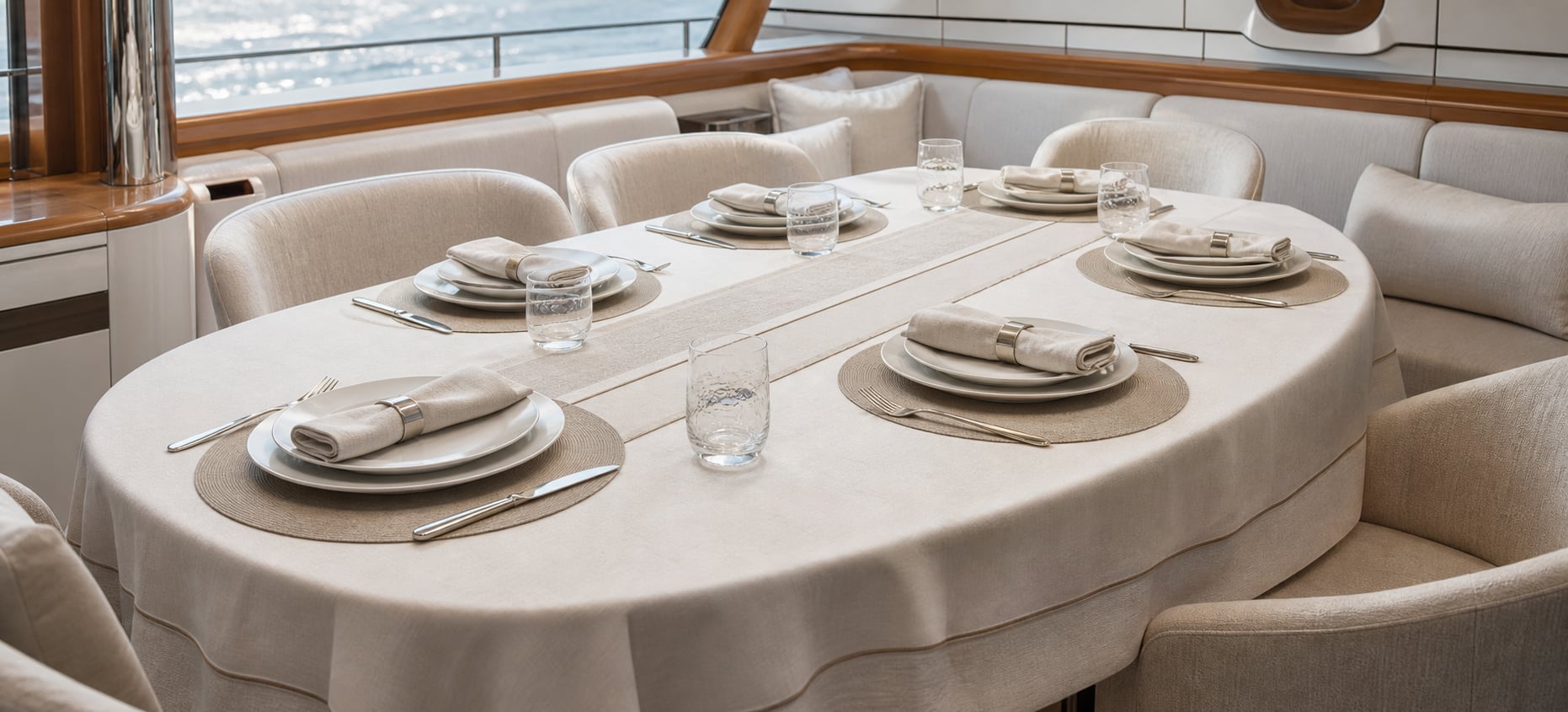
First drape a development sample on every relevant table family. Centre it using a repeatable reference, then check all four sides, corners and floor clearances. Add chairs, covers, undercloths, clips and any normal table accessories. Ask service and housekeeping teams to set, clear, replace and fold it rather than judging a still photograph alone.
Next process the sample through the intended stain-treatment, wash, dry and finishing route. Measure it again after cooling, repeat the table trial and compare it with the target. Confirm seam position, edge shape, colour, surface, press quality, dimensional stability and how it folds for carts and shelves. Retain the approved processed sample and its measurement record for replenishment.
The arithmetic should make ordering easier, not give a false sense of precision. Measure the furniture, choose the service drop, calculate the target, then let a processed table trial decide. That sequence produces a cloth that is proportioned for the room and repeatable for the team.
Explore restaurant tablecloth formats, connect the dimensions to the wider Dine textile programme, and use the on-site measurement guide when shaped furniture or custom development requires a more detailed record.
Product catalogue
Request the Dine catalogue
Share your business email and, if useful, your company or property name. We will carry these details into the secure catalogue-request form with the relevant category already selected.
Journal
Continue reading
Why Table Linen Still Matters in Modern Hospitality
How proportion, texture, drape, and care influence the experience of a restaurant or hotel dining room.
Read Why Table Linen Still Matters in Modern HospitalityTablecloths and Commercial Laundry: Inputs to Confirm
A working handover between restaurant, procurement, and laundry teams before tablecloth approval.
Read Tablecloths and Commercial Laundry: Inputs to ConfirmCustom Sizing: What Should Be Measured on Site?
A practical field checklist for recording objects, clearances, use conditions, storage, and reference information.
Read Custom Sizing: What Should Be Measured on Site?