





Percale vs Sateen Sheets: Which Is Better for Hotels?
Percale generally gives a crisper matte surface, while sateen gives a smoother, more lustrous face. The better choice depends on the room and care process.
Published by Gencer Textiles
Percale is usually the better starting point when a hotel wants a crisp, matte and relatively structured sheet; sateen is the better starting point when it wants a smoother face, more drape and visible lustre. Neither weave is universally better. Yarn, fibre, density, weight, finish, bed build and laundry conditions can make a well-balanced example of either weave more suitable than a poorly specified alternative.
The decision should be made with processed samples, not swatches alone. Place both constructions on the actual beds, ask housekeeping to make and strip them, and send marked pieces through the intended wash, dry and finishing route. Comparing new hand only misses the surface change, dimensional movement and handling that determine whether the choice remains convincing in operation.
The weaves create different surfaces
Percale belongs to the plain-weave family, with yarns interlacing frequently in an over-and-under pattern. This tends to produce an even, matte surface with a clean, slightly crisp hand. Sateen is woven with longer floats and fewer interlacings on the face. The floats create a smoother surface, greater lustre and more fluid drape. Sateen is a weave, not a fibre; it may be made from cotton or another specified composition.
Structure creates trade-offs. More interlacing can support a firm, stable surface, while longer floats can feel smooth but present more exposed yarn length. Textile weaving guidance identifies picking, snagging, skew and seam slippage as possible concerns in satin-type structures. That does not make every sateen fragile. It means the proposed construction should be tested against jewellery, luggage, housekeeping tools, finishing equipment and the hotel’s rejection standard.
| Question | Percale starting point | Sateen starting point |
|---|---|---|
| Visual character | Matte and restrained | Smoother with more lustre |
| Initial hand | Crisp and structured | Fluid and smooth |
| Surface structure | Frequent interlacings | Longer face floats |
| Risk to investigate | Harshness or excessive rustle in an unsuitable build | Snagging, picking or surface change |
| Finishing review | Flatness, creasing and desired crispness | Lustre, tracking, pressure marks and drape |
| Decision evidence | Processed full-size sheet on the real bed | Processed full-size sheet on the real bed |
Match the hand to the room promise
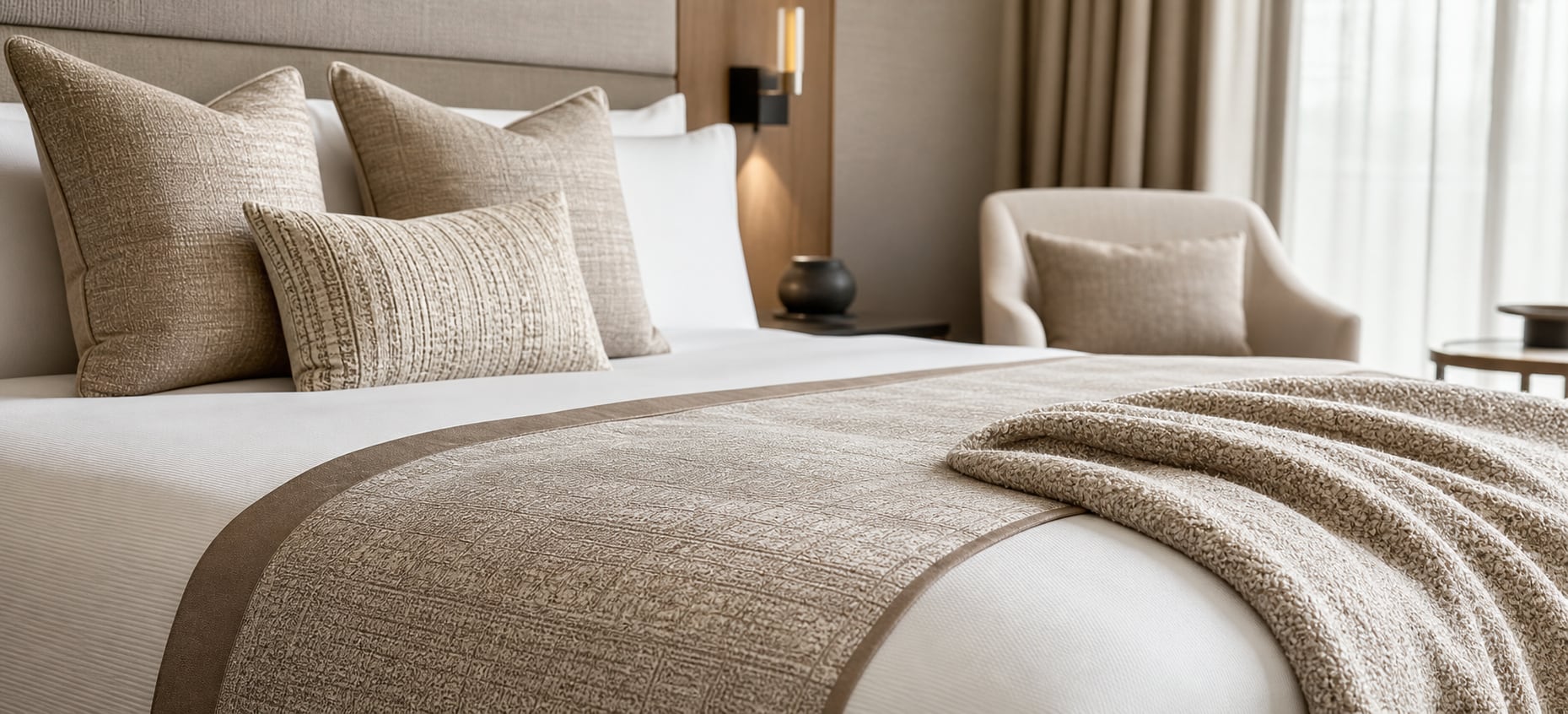
A contemporary city hotel may prefer the visual discipline of matte percale; a formal suite may seek the flowing surface of sateen. Those associations are useful briefing language, not rigid market rules. Room lighting, colour, duvet loft, pillow arrangement and bed styling change how the fabric reads. A sateen with restrained lustre may look quieter than expected, while a heavily finished percale may feel smoother than the word “crisp” suggests.
Assess sound as well as touch. Some crisp constructions make more audible movement, particularly when new or combined with certain protectors and duvets. A smoother fabric may reduce that impression, but it can also feel warmer depending on density, fibre, finish and the whole bed microclimate. A short in-room sleep trial can reveal interactions that a hand test at a meeting table cannot.
Climate does not decide the weave alone
Percale is often described as a cooler choice because its characteristic hand and many commercial constructions feel fresh and less close to the body. Sateen is often described as warmer or more enveloping. These are reasonable starting perceptions, but weave labels do not measure thermal comfort. Yarn density, fabric weight, fibre moisture behaviour, finishing, night-time temperature, humidity and the duvet system all influence the result.
A resort should test the full bed during representative warm and humid conditions rather than assuming that every percale will solve heat. A mountain property should not assume every sateen will feel appropriately warm. Sheets are a thin part of a layered system. The protector, topper, duvet, blanket, sleepwear and air-conditioning strategy can have a larger influence than the difference between two specific samples.
Thread-count numbers are not transferable between the weaves
Do not select a 400-count sateen over a 250-count percale merely because the number is larger. Thread count describes yarn density under a stated method, while weave determines how those yarns interlace. Sateen and percale can therefore reach different balances of cover, hand and drape at different counts. Yarn size, weight and finishing are necessary to understand the comparison.
Read what thread count is best for hotel sheets before setting a density requirement. The article explains why ply, counting method and cover must be recorded alongside the number.
Review snagging, abrasion and repair rules
Longer sateen floats provide the smooth face that many guests appreciate, yet they also expose yarn over a greater distance. Test contact points such as bed frames, luggage benches, service trays, uniform fasteners and laundry equipment. Record whether pulls can be trimmed or repaired under the hotel’s policy and when a visible defect removes a sheet from guest service. Avoid promising that one weave will always last longer.
Percale also needs an abrasion review. A firm or light construction may show wear at folds, hems and high-friction zones, and harsh processing can damage any fabric. Examine surface fuzzing, pilling, thinning, yarn breaks, seam opening and hem distortion after representative cycles. The cause may be the sheet construction, the laundry process, physical handling or an interaction among them.
Include the flatwork finishing team
Both weaves must feed, dry and finish within the available process. Percale may support the clean, crisp result a hotel wants, but that appearance can demand controlled finishing and prompt handling. Sateen may show pressure marks, tracking or changes in lustre under some conditions. These are matters for an actual ironer or finishing trial, not fixed claims about every fabric.
Ask operators to record feeding behaviour, tangling, edge alignment, moisture at entry, speed, temperature or pressure settings, folding quality and manual correction. The correct settings belong to the laundry and equipment guidance. If a candidate needs a dedicated route, procurement should understand the effect on sorting and throughput before approval.
The commercial-laundry guide for hotel sheets provides a process-based review. Product context is available in the hotel bed-sheets range and the wider Stay collection.
Housekeeping sees fit and control
A fluid sateen may drape attractively but move differently during tucking and corner formation. A crisp percale can hold a line yet resist smoothing if the finished dimensions or crease condition are wrong. Have several room attendants make the same representative beds, including the deepest mattress and any topper variation. Observe how much correction is needed to achieve the approved presentation.
For fitted sheets, compare elastic recovery, pocket depth and the effort required to install and remove each construction. For flat sheets, compare grip, tuck security, corner bulk and alignment. The weave should not be blamed for a sizing problem. Measure every sample after care and separate fit observations from surface preferences in the trial record.
Run a fair side-by-side trial
- Choose percale and sateen candidates with documented fibre, yarn, weight, density, finish and dimensions.
- Keep colour and finished size consistent so visual or fit differences do not dominate the weave comparison.
- Mark full-size sheets and retain unused controls from each construction.
- Use the same agreed wash, dry, finishing and conditioning method for both candidates.
- Review the made bed under normal room lighting and during a representative sleep test.
- Collect separate notes from guests or testers, housekeeping, laundry and procurement.
- Record defects and processing time without converting a short trial into a universal lifetime promise.
Where possible, use more than one sheet from each candidate. A single damaged piece may reflect an isolated fault, while a single good piece may hide variation. The project team should define sample size and trial length according to risk and order scale. If the purchase is substantial, a controlled pilot in a small room group can provide better operational evidence before rollout.
Choose by scenario rather than status
Percale is a sensible shortlist choice for properties seeking a restrained matte bed, a fresh crisp hand and a relatively structured sheet. Sateen is sensible for properties prioritising smoothness, drape and a refined lustre. Either may work across hotel positions if the complete construction and care process are appropriate. Neither term should be used as a synonym for quality level.
If different room categories genuinely need different sensations, the hotel may specify both, but it should account for sorting, labelling, storage and replenishment. Variation should have a clear guest or design purpose. Otherwise one well-tested construction often gives housekeeping and laundry a simpler standard. The broader guide to choosing hotel sheets can help the team document that decision without allowing weave preference to obscure dimensions and operations.
Use how to choose bed sheets for a hotel to complete the room, sizing and approval brief. The better weave is the one whose processed sample gives the intended room character without creating unresolved handling or care problems.
Product catalogue
Request the Stay catalogue
Share your business email and, if useful, your company or property name. We will carry these details into the secure catalogue-request form with the relevant category already selected.
Journal
Continue reading
How to Choose Bed Sheets for a Hotel
A practical method for specifying hotel sheets around the room, the laundry process, housekeeping and repeat supply.
Read How to Choose Bed Sheets for a HotelWhat Thread Count Is Best for Hotel Sheets?
Why thread count is a useful construction input but an unreliable quality ranking when considered alone.
Read What Thread Count Is Best for Hotel Sheets?100% Cotton vs Polycotton Sheets for Hotels
A fibre comparison that connects guest feel with drying, finishing, stain response and operational control.
Read 100% Cotton vs Polycotton Sheets for Hotels