




















Should a Restaurant Rent or Buy Its Table Linen?
A restaurant should usually rent standard, high-volume table linen when managed supply and laundry capacity matter more than ownership. Buying is stronger when the exact cloth is part of the concept and the restaurant can control stock, processing and replacement. A third option—owning linen but outsourcing its laundry—often deserves a separate quote.
Published by Gencer Textiles
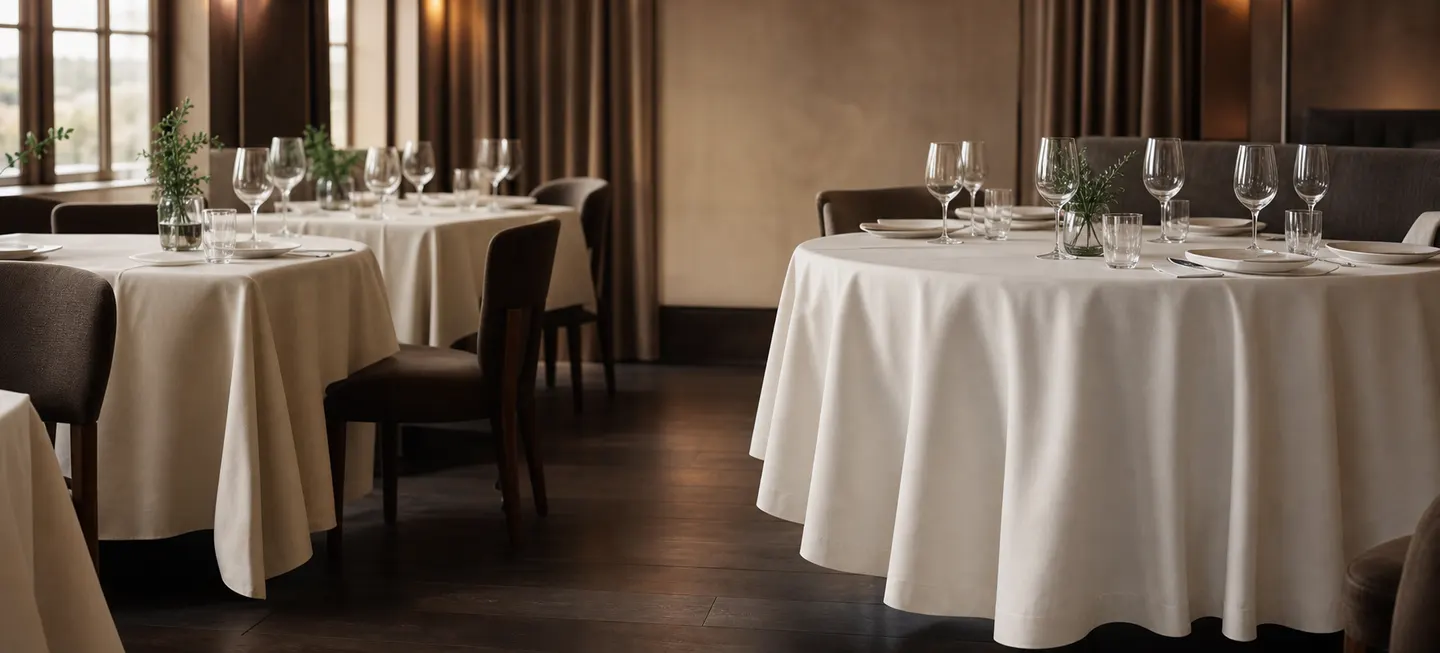
Renting is often the practical answer for a restaurant that wants standard white or solid-colour linen in reliable rotation without owning a laundry system. Buying becomes more attractive when the cloth itself is part of the dining identity—an exact shade, texture, size, border or custom detail—and the restaurant can manage enough stock through a proven care route.
Neither choice is automatically cheaper or cleaner. A rental price may bundle linen, collection, processing, finishing, replacement and delivery. A purchase price covers only the cloth. Compare both models at the point where a correct, clean, finished piece is ready for the table, including what happens when volume changes or stock fails.
Start with three models, not two
“Buy” and “wash in-house” are not the same decision. A restaurant can own its tablecloths and napkins while paying a commercial laundry to process and return those specific goods. This customer-owned-goods model separates textile ownership from laundry operation.
| Model | Restaurant controls | Restaurant depends on |
|---|---|---|
| Managed rental or hire | Approved range, service levels and on-site handling | Provider inventory, route, processing, availability and contract |
| Owned linen, outsourced laundry | Exact specification, stock and replacement decisions | Restaurant inventory plus laundry quality, tracking and turnaround |
| Owned linen, on-site laundry | Specification, inventory and complete process | Equipment, utilities, space, labour, maintenance and process control |
Get a separate quotation for each realistic model. A provider that supplies rental linen may also process customer-owned stock, but the tracking, liability and pricing can differ. Do not assume that outsourcing requires a shared rental pool or that ownership requires buying laundry equipment.
Match the model to the operational bottleneck
Rental is strongest where recurring volume is high, the specification fits an available range, clean storage is limited and the restaurant values one managed replenishment route. A provider can pool processing and inventory across customers, but the restaurant still needs receiving checks, clean and soiled storage, par review and a response plan for shortages.
Ownership is strongest where the table presentation cannot be reproduced from a standard pool, the restaurant wants to retain the same finished specification, or the operation already has a capable laundry route and inventory discipline. It also makes replacement decisions visible: the owner can set the reference sample and decide which pieces remain guest-facing.
| Operating condition | Rental may fit better when… | Ownership may fit better when… |
|---|---|---|
| Design | A standard provider size, colour and finish supports the concept | Exact custom size, fabric, shade or branding is essential |
| Volume | Regular high throughput suits scheduled exchange | Demand is stable enough to size and rotate owned stock |
| Seasonality | The agreement can flex without punitive minimums | Owned reserve can cover predictable peaks economically |
| Laundry | The restaurant lacks suitable processing and finishing capacity | A validated on-site or customer-owned-goods route exists |
| Control | Consistent service matters more than receiving the same individual pieces | Lot, appearance, repair and retirement must stay under direct control |
| Change | The range lets the restaurant alter quantities or standard colours easily | The concept needs continuity beyond a provider catalogue |
These are prompts, not verdicts. A sophisticated rental provider may support dedicated custom stock; an owned programme can still fail through weak processing or counts. Ask what is actually available in the restaurant’s service area and put the answer in the proposal.
Compare the full-cycle cost
Choose one representative period that includes real covers, table turns, private dining, rejects and peak or quiet variation. Count by item code: a 180 cm round cloth is not interchangeable with a 140 × 180 cm rectangular cloth, and a dinner napkin is not simply “one linen”. For each model, divide the total period cost by the number of usable finished items delivered to service—or by served covers if the item mix per cover is fixed and recorded.
| Cost group | Rental or hire | Owned linen |
|---|---|---|
| Textile | Included rental, preparation or allocation charges | Purchase, freight, sampling and financing or capital cost |
| Processing | Included or separately itemised wash and finish | In-house labour, chemistry, water, energy, equipment and maintenance, or outside laundry fee |
| Inventory | Agreed stock level, emergency additions and minimum billing | Full rotation stock, reserve, storage, counts and working capital |
| Logistics | Pickup, delivery, route and off-cycle charges | Internal movement or outside collection and delivery |
| Loss and damage | Contractual loss, misuse and replacement charges | Missing pieces, rejects, repairs and replenishment purchases |
| Change and exit | Rate adjustments, volume changes, term and termination | Specification obsolescence, residual stock and supplier continuity |
For owned stock, do not divide purchase cost by a hoped-for lifespan. Use a documented service history from an equivalent tested product, or model several plausible usable-turn outcomes and show the sensitivity. For rental, reconcile the all-in invoice against actual delivered and accepted quantities. A low unit rate can be outweighed by minimums or recurring fees; a cheap purchase can be outweighed by finishing labour, loss or premature rejection.
Read the rental agreement as an operating specification
A managed service transfers tasks, not accountability. Current providers describe models that combine supply, scheduled collection, laundering, inspection, replacement and restocking, but inclusions vary. Attach the approved product schedule and service levels to the commercial terms.
- List every item, finished size, colour, construction and acceptable substitute.
- State normal stock levels, delivery and collection windows, peak requests and emergency response.
- Define how delivered quantities, rejects, shortages and returns are counted and reconciled.
- Separate normal wear from chargeable loss, staining, wax, tears, burns or misuse.
- List minimum charges, preparation, delivery, fuel or environmental fees, taxes and rate-adjustment rules.
- Read the initial term, renewal window, notice method, service-failure remedy and early-exit calculation.
- Confirm what happens to dedicated or branded stock when volume falls, the design changes or the contract ends.
- Record processing evidence, local compliance, complaint handling and recall or continuity arrangements.
Public textile-rental agreements and linen policies show why this reading matters: some contain loss or damage charges, price-change mechanisms, pickup responsibilities or substantial early-termination provisions. Those examples do not predict a particular restaurant’s contract. They show which clauses need an actual number and responsibility beside them before signature.
Make owned linen a controlled system
Ownership works only when each piece remains identifiable as part of a managed stock. Fix the product codes, finished dimensions, shade or dye lot, construction and approved post-laundry appearance. Count clean, in-use, soiled, at-laundry, repair, reject and unopened reserve stock separately. Otherwise a large nominal inventory can still produce a shortage in one crucial size.
Measure the complete table set before ordering. The restaurant tablecloth size and drop guide explains why table shape, top dimensions and required drop must become finished item codes rather than broad size names.
If processing on site, cost and validate sorting, stain treatment, washing, extraction, drying, ironing or pressing, folding, internal transport and storage. Include staff coverage, equipment downtime and the space occupied by both clean and soiled flows. If an outside laundry processes restaurant-owned linen, agree how pieces are counted, kept separate, rejected, compensated if lost or damaged, and returned during a service disruption.
Hygiene is a process outcome, not an ownership benefit. Ask either laundry route for the evidence relevant to the jurisdiction and risk profile. Industry certification can support due diligence where available, but it does not remove the restaurant’s responsibility to check applicable requirements and the delivered condition.
Consider a hybrid table-linen programme
A restaurant does not have to choose one model for every dining occasion. Standard white tablecloths and everyday napkins can sit in a managed rental rotation, while owned runners, private-dining cloths or signature napkins preserve the concept. Another hybrid owns the complete guest-facing range but rents back-of-house utility textiles.
Hybrid systems reduce one compromise but add sorting risk. Give owned and rented pieces visibly distinct labels or codes, separate their return routes and assign responsibility at clearing, dispatch and receipt. Confirm that the laundry accepts the owned pieces and that rental items placed in the wrong stream can be recovered and reconciled.
Run a decision trial before committing
Shortlist the actual cloth and the actual service, not an abstract rental category. Process an owned sample through its proposed route and obtain representative rental pieces after normal commercial processing. Dress the same table formats and compare dimensions, opacity, drape, shade, touch, finish, folding, stain acceptance and staff handling.
Then model a quiet period, a normal period and a peak or event period. Ask what happens when the restaurant closes temporarily, changes opening days, adds a terrace, hosts a banquet or redesigns the table. The best model is the one that still supplies the correct usable pieces under those changes at an understood full-cycle cost.
Review restaurant tablecloths as a finished specification before comparing ownership models, and give the proposed laundry the same tablecloth processing brief. Once product, finish, quantities, responsibilities and contingencies are common to both bids, rent versus buy becomes a decision the restaurant can audit rather than a contest between two headline prices.
Product catalogue
Request the Dine catalogue
Share your business email and, if useful, your company or property name. We will carry these details into the secure catalogue-request form with the relevant category already selected.
Journal
Continue reading
Tablecloths and Commercial Laundry: Inputs to Confirm
A working handover between restaurant, procurement, and laundry teams before tablecloth approval.
Read Tablecloths and Commercial Laundry: Inputs to ConfirmHow to Calculate Tablecloth Size and Drop for Restaurant Tables
Add the drop twice to every tabletop dimension: a 120 cm round table with a 25 cm drop needs a 170 cm round cloth. The calculation is only the starting point for a processed-size specification.
Read How to Calculate Tablecloth Size and Drop for Restaurant TablesWhy Table Linen Still Matters in Modern Hospitality
How proportion, texture, drape, and care influence the experience of a restaurant or hotel dining room.
Read Why Table Linen Still Matters in Modern Hospitality