









Triple Sheeting vs Duvet Covers for Hotels: Which Works Better?
Triple sheeting can remove duvet-cover loading and suit a sheet-based laundry flow. Duvet covers can fully enclose the insert and create a different guest experience. The better system is the one a hotel proves across labour, linen weight, hygiene, comfort and control.
Published by Gencer Textiles
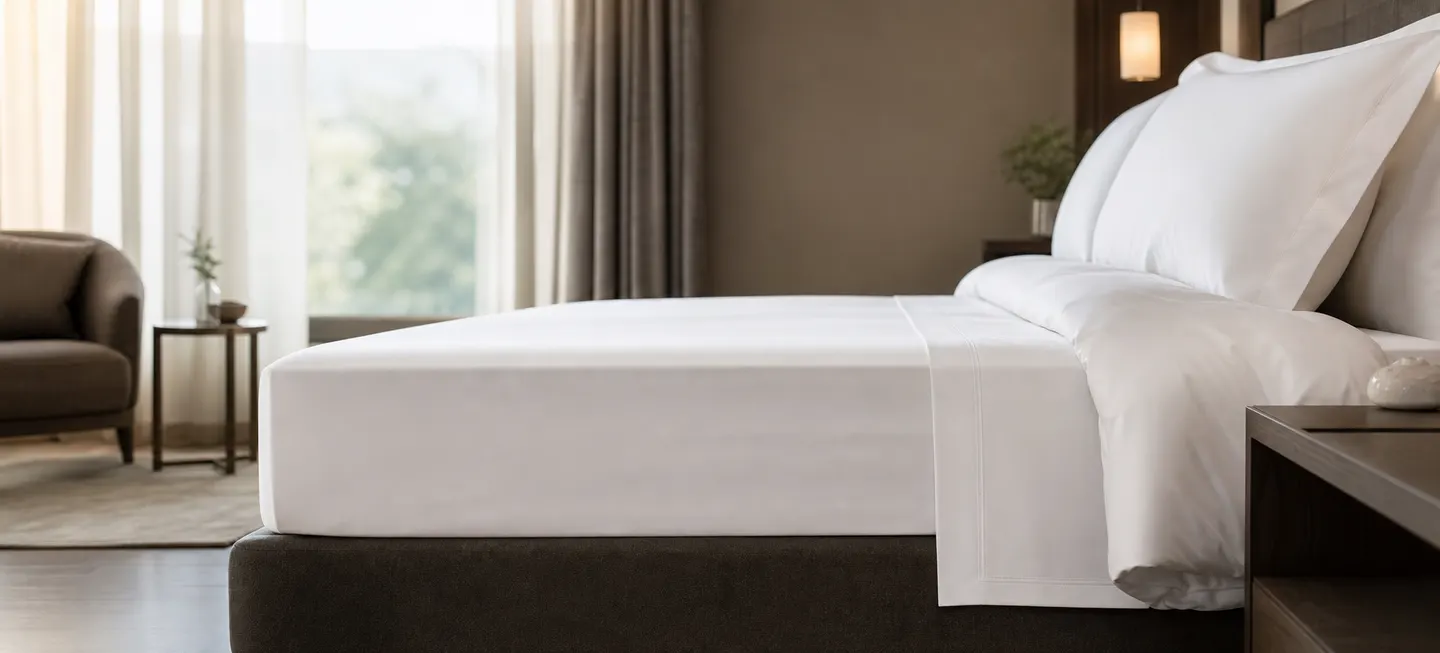
Neither triple sheeting nor a duvet cover works better for every hotel. Triple sheeting often suits properties that want to process the guest-facing top layers as flat sheets and avoid loading an insert into a cover. A duvet cover suits properties that want the insert fully enclosed and can support the stripping, loading, alignment and finishing work. The answer changes when either method includes extra layers, deep tucks or a poorly matched insert.
Choose after measuring the complete route: clean linen issue, bed-making, guest use, stripping, collection, sorting, washing, finishing, folding, storage and reissue. A method that saves time in the room can move work into the laundry; a low piece count can still produce more kilograms or more manual handling. The useful comparison is per serviced bed and by room group, not by the name of the system.
Define the two systems before comparing them
“Triple sheeting” is not used consistently. A common hotel arrangement starts with a bottom sheet, then places a blanket or duvet insert between two flat sheets. Some properties count the bottom sheet as one of the three; others use the phrase for three top-of-bed sheets or add a decorative presentation sheet. Write the actual layers in order so procurement, housekeeping and laundry are comparing the same bed.
| System | Typical component order | Important variation |
|---|---|---|
| Triple sheeting | Bottom sheet; guest-facing flat sheet; blanket or insert; outer flat sheet | The hotel may add a cuff, turn-down sheet, runner or additional presentation layer |
| Duvet cover | Bottom sheet; duvet insert inside a removable cover | A separate top sheet may still be used, and closure, flap and tuck rules vary |
The bottom-sheet choice is separate. Either top-of-bed method can begin with a fitted or flat bottom sheet. Keep that decision explicit because mattress lifting, laundry finishing, stock pooling and processed fit may be affected by the bottom sheet rather than by triple sheeting or the duvet cover itself.
Use the separate comparison of flat and fitted hotel sheets to settle the mattress layer without confusing it with the top-of-bed decision.
Set the change and cleaning standard first
List every surface a guest can touch in normal use. Under triple sheeting, the outer sheet may loosen or be pulled back far enough to expose the blanket or insert. With a duvet cover, the guest touches the cover, but an open end, missing fastening or poor fit can expose the insert. Neither name guarantees a protected filling throughout the stay.
Write separate checkout, stayover, visible-soil and incident rules for sheets, covers, blankets and inserts. Define how a removed filling is inspected, where clean and used pieces are held, and what happens after a spill, body-fluid contamination, pest concern or damaged seam. Follow the textile maker’s care instructions, the laundry’s validated process, the property standard and applicable local requirements rather than importing one universal wash interval or temperature.
Compare complete room-turn work
Triple sheeting removes the need to feed an insert into a sewn cover. Housekeepers instead centre the inner sheet, position the filling, centre the outer sheet, form the approved fold and apply the required tucks. A duvet-cover method removes some layered alignment but adds cover loading, corner placement, closure and any final tuck. An open-end bag cover, a buttoned cover and a cover used with a top sheet are three different workflows.
Time the work from collecting the correct clean pieces to the final inspection, including corrections. Record stripping and separation too: a fast-looking bed may be awkward to dismantle or may send an insert accidentally into the soiled-linen stream. Observe several trained attendants and representative bed sizes. One quick demonstration does not establish a hotel standard.
| Observe in the room | Triple sheeting question | Duvet-cover question |
|---|---|---|
| Placement | How many sheets must be centred, folded and tucked? | How is the insert loaded, aligned and closed? |
| Correction | Do layers creep or produce uneven folds? | Do corners empty, twist or bunch? |
| Stripping | Can staff separate sheets from the filling without dropping or mis-sorting it? | Can the cover be removed without forceful pulling or trapping other linen? |
| Inspection | Can the protected filling and both sheet faces be checked? | Can the cover seams, closure and insert be checked efficiently? |
Include ergonomics, not only seconds
Bed-making exposes staff to repeated reaching, bending, pulling, mattress lifting and tucking. OSHA identifies mattress lifting, awkward postures and repeated exertion as housekeeping hazards. California’s hotel-housekeeping rule requires covered employers to evaluate musculoskeletal hazards and involve and train housekeepers when work practices change. A bedding-system pilot should therefore be part of the property’s safety process, not only a productivity exercise.
Triple sheeting may add mattress-edge tucks and repeated centring. Duvet covers may add lifting, spreading, shaking, reaching into a large cover or forceful pulling when the fit is tight. Neither method should be approved by assuming the other is harder. Record reaches, lifts, tucks, shakes, corrections, working clearance and whether two-person handling is required under the property’s safe method.
Ask attendants what causes strain or rework, then test the proposed correction. A lighter insert, better cover allowance, a different opening, reduced tuck, fitted bottom sheet or changed bed access may matter more than the headline system. Do not trade a small room-time gain for a more forceful or less controllable task.
Count laundry by mass and process
Compare the dry weight of every component changed for the same service event. Triple sheeting may send two top sheets to the laundry while the protected filling follows a separate schedule. A duvet-cover system sends one larger sewn cover, plus a top sheet if the hotel retains one. Piece count alone cannot show wash load, drying demand, flatwork capacity or manual finishing.
| Laundry measure | What to record |
|---|---|
| Changed dry mass per serviced bed | All sheets, cover and other layers removed under the same policy |
| Finishing route | Feeding, ironing or drying, folding, stacking and manual touch-up for each component |
| Sorting and identification | Sizes, room groups, bottom/top roles, closures and filling references that can be confused |
| Rejects and rework | Stains, seam or closure damage, shrinkage, twisting, incomplete drying and remakes caused by fit |
| Filling care | Inspection, cleaning, drying, storage and temporary out-of-service quantity for blankets or inserts |
Run both systems through the intended in-house or contracted laundry. Flat sheets may suit a flatwork line, while a large duvet cover can behave differently during sorting, washing, untangling, drying and finishing. Equipment and contractor capability vary, so confirm the real route. Compare processed dimensions as well as time: a cover that shrinks around its insert or a sheet that loses the approved tuck changes housekeeping work on the next cycle.
The wider guide to commercial-laundry suitability for hotel sheets explains how to evaluate the complete construction after processing rather than relying on fibre or thread count alone.
Evaluate the bed from the guest’s side
A duvet cover creates one enclosed top layer and can give a full, relaxed drape. Triple sheeting can create a crisp layered presentation and a defined turn-down. Those are design directions, not quality levels. Either can look unfinished when dimensions, fold depth, insert loft and bed width do not agree.
Make the guest-use test more demanding than a release photograph. Turn down the bed, get in, move, pull the top layer up, leave and remake it. Check whether the blanket becomes exposed, sheets separate, the insert migrates to empty corners, a closure is felt, or tight tucks restrict normal use. Ask whether the guest can understand and control the layers without dismantling the bed.
Thermal comfort comes mainly from the complete assembly: filling type and weight, air held by the construction, sheet and cover fabrics, room climate and the guest. Switching from triple sheeting to a duvet cover does not by itself solve a bed that is too warm or too cool. Compare like-for-like fillings and room conditions before crediting the outer method.
Plan stock by component and room group
Triple sheeting can sometimes use a controlled pool of identical flat sheets for more than one position. That is useful only when the processed dimensions, hems, appearance and identification genuinely support interchangeability. If attendants quietly reserve one reference for the inner layer and another for the visible outer fold, the stock is not truly pooled.
A duvet-cover system needs covers matched to each insert size and construction, together with a plan for closures and spare fillings. Triple sheeting needs the correct count of inner and outer sheets plus blankets or inserts that may be out for cleaning. Calculate each component from beds in use, change frequency, full laundry turnaround, unavailable pieces and the reserve needed for credible disruption.
Use the component method in how many hotel bed-sheet sets are needed, but name every layer instead of hiding the result inside a generic “bed set”.
A mixed system can be sensible—for example, one method in standard rooms and another in suites—but it adds training, cart, storage and inspection rules. Keep it only when the room-group benefit is larger than that operating complexity. Label shelves and packs by component and size rather than relying on a visually similar fold.
Run a controlled hotel pilot
Build complete, processed samples for representative room groups. Use the same approved mattress, protector, filling and presentation target where the comparison allows. If several variables change at once, record them: the hotel may still select the preferred system, but it should not attribute the result to the cover method alone.
- Draw the exact component order and state which pieces change at checkout and stayover.
- Process every candidate through the intended laundry route before checking fit and appearance.
- Observe full clean issue, bed-making, inspection, guest-use simulation, stripping and soiled sorting.
- Record time together with reaches, mattress lifts, tucks, shakes, forceful pulls, corrections and remakes.
- Weigh the changed dry linen and record finishing, folding, storage and manual rework.
- Inspect blanket or insert exposure, cover alignment, closures, folds and ease of guest adjustment.
- Calculate component stock and temporary shortages for every room and bed size in the pilot.
- Gather structured feedback from housekeepers, laundry staff, room inspectors and the safety lead.
Repeat the comparison across enough attendants, shifts and service events to reveal variation. Do not turn the trial into a race or reward unsafe technique. Review room quality, workload and laundry data together. The winning system is the one the hotel can reproduce at its required standard without hidden work or uncontrolled exceptions.
Write the approved system as a specification
Record the layer order, component names, finished dimensions, fabric construction, hems, cover opening and closure, insert reference, fold and tuck method, change rules, laundry route, room groups, stock identifiers and rejection points. Keep photographs of the released bed and the layers during assembly. The next order must reproduce the tested system, not merely request “triple sheets” or “king duvet covers”.
Use the guide to choosing hotel duvet covers when the cover system wins. If triple sheeting is approved, define the inner and outer hotel bed sheets as separate operating roles even when one construction serves both.
Review hotel duvet covers alongside the sheet programme so cover allowance, closure, processed fit and insert size can be tested against the same room and laundry evidence.
The practical answer is not that one tradition defeats the other. Triple sheeting is stronger when its flat layers move cleanly through the property and stay controlled in guest use. Duvet covers are stronger when enclosure, presentation and a well-designed loading process justify their handling. Measure the whole system, then standardise the version the hotel can execute consistently.
Product catalogue
Request the Stay catalogue
Share your business email and, if useful, your company or property name. We will carry these details into the secure catalogue-request form with the relevant category already selected.
Journal
Continue reading
Flat vs Fitted Sheets for Hotels: Which Is Better for Housekeeping and Laundry?
Flat sheets usually simplify flatwork finishing and stock pooling; fitted sheets can support a quick, consistent bottom-sheet fit, but only when processed dimensions, mattress depth and laundry equipment agree.
Read Flat vs Fitted Sheets for Hotels: Which Is Better for Housekeeping and Laundry?How to Choose Duvet Covers for Hotels
A practical route from the actual bed and laundry process to a duvet cover that housekeeping can use consistently.
Read How to Choose Duvet Covers for HotelsWhat Makes Hotel Sheets Suitable for Commercial Laundry?
A process-based guide to testing sheets through sorting, washing, drying, flatwork finishing, folding and return to the room.
Read What Makes Hotel Sheets Suitable for Commercial Laundry?