






















Flat vs Fitted Sheets for Hotels: Which Is Better for Housekeeping and Laundry?
There is no universal winner. A hotel should compare the complete route from clean-linen issue to bed-making, stripping, sorting, finishing and return—not judge the sheet only by how quickly one corner goes onto a new mattress.
Published by Gencer Textiles
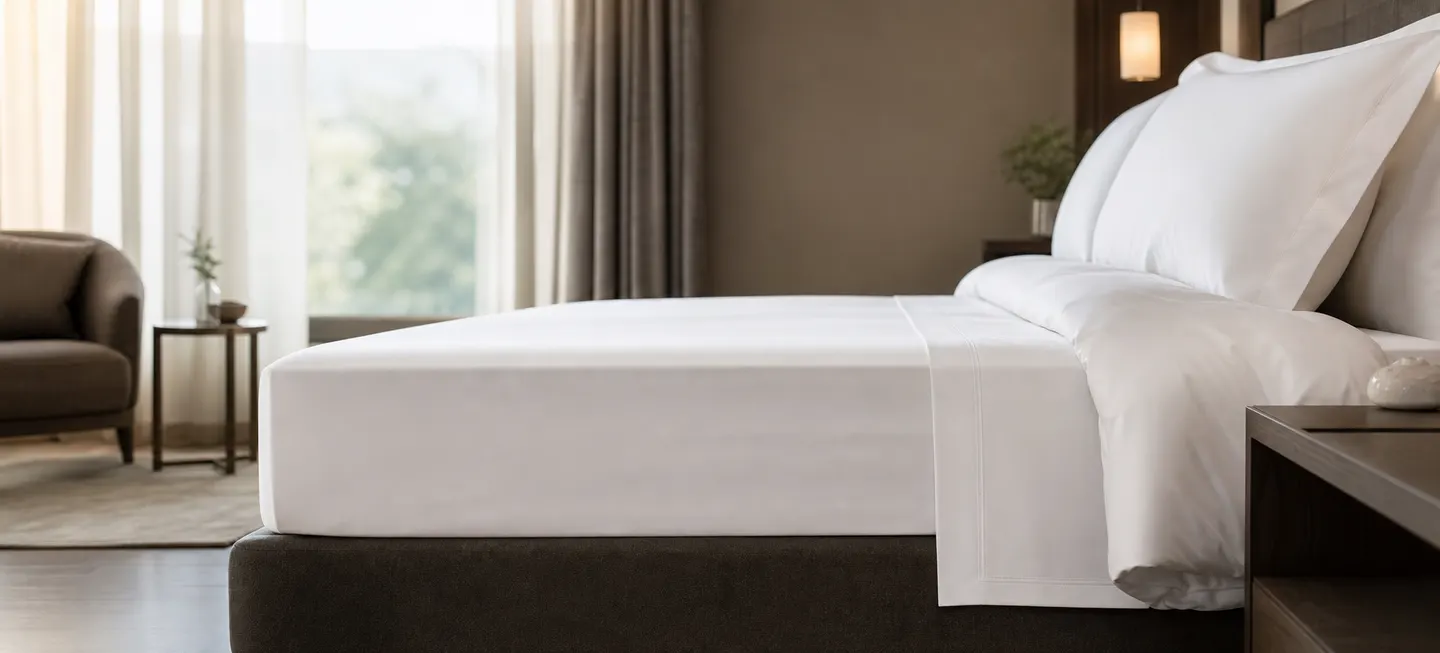
Flat sheets are usually easier to pool, feed, iron and fold as flatwork. Fitted sheets can make the bottom-sheet position more obvious and may reduce some bed-making effort when the pocket fits after laundering. Neither advantage survives a poor specification: an undersized fitted sheet forces mattress lifting, while an oversized flat sheet adds unnecessary tucking and handling.
The practical choice is therefore not “flat or fitted” in isolation. It is the format that performs best with the hotel’s mattress assemblies, housekeeping method, finishing line and stock system. Some hotels will choose one format throughout; others will reach a better answer by room group or by using a fitted bottom sheet with a separate decision about the top sheet.
Compare the operational trade-offs
| Operating question | Flat bottom sheet | Fitted bottom sheet |
|---|---|---|
| Bed fit | Tuck allowance can adapt to a controlled range of mattress depths | Corners and pocket define the fit, so the processed dimensions must match closely |
| Bed-making | Requires an approved tuck pattern and enough access around the mattress | Can locate quickly, but tight pockets may require repeated corner lifting |
| Laundry finishing | Naturally suited to conventional flatwork feeding, ironing and folding | Needs a route and equipment proven to handle elasticated, three-dimensional pieces |
| Stock flexibility | One reference may serve several compatible depths or bottom/top roles | Different mattress depths may need separate pocket references |
| Condition checks | Check dimensions, hems, stains and distortion | Also inspect elastic recovery, corners and pocket shape |
| Main failure mode | Too much or too little tuck allowance | Shrunk pocket, tired elastic or the wrong mattress depth |
This table shows tendencies, not guaranteed outcomes. Modern commercial equipment can process some fitted sheets, and a well-designed flat-sheet method can be fast. The hotel must confirm what its own laundry or contractor can finish reliably rather than assuming every line behaves alike.
Where fitted sheets can help housekeeping
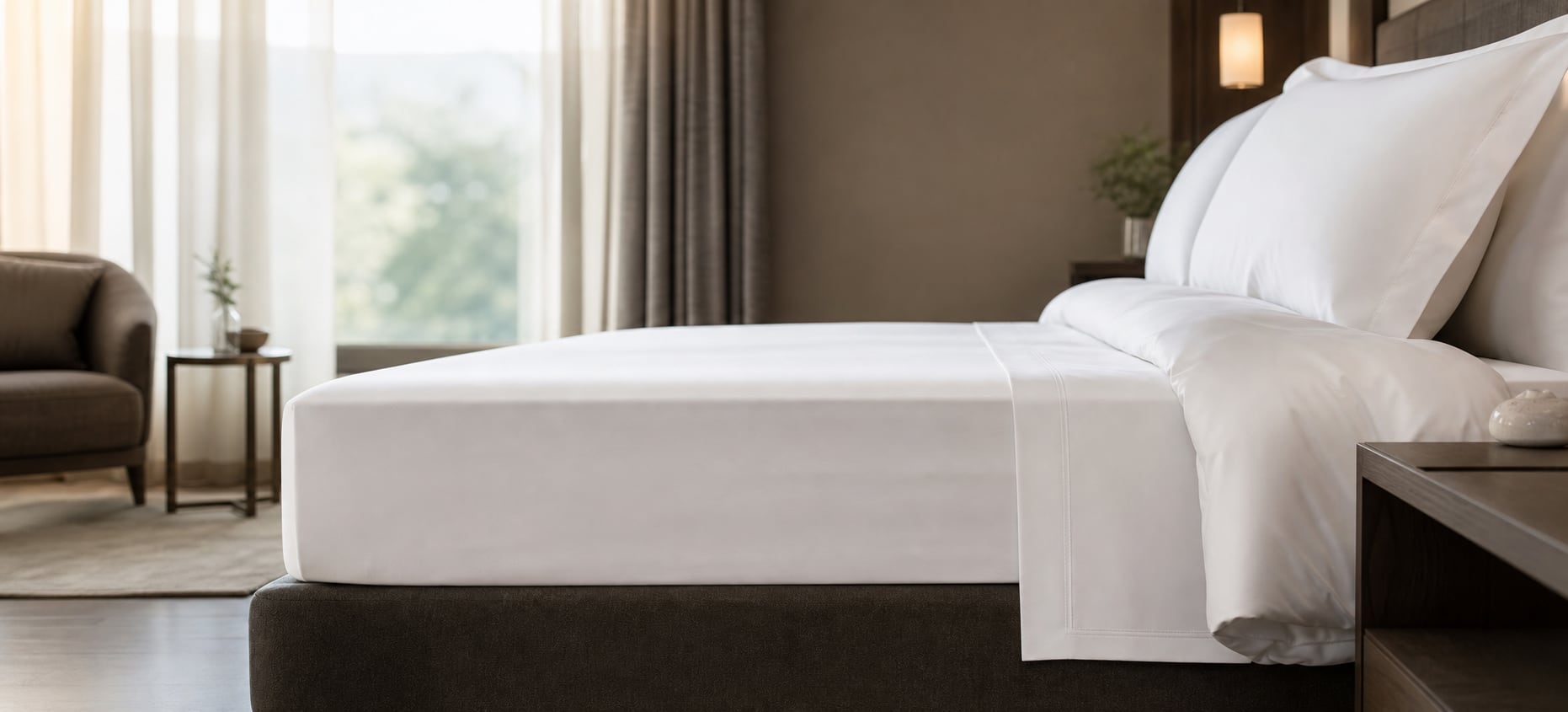
A correctly fitted bottom sheet gives the housekeeper clear corner positions and reduces the need to judge equal tuck on each side. On a consistent mattress fleet, it can produce a repeatable appearance with less loose fabric to manage. Ergonomic studies of hotel bed-making have also found reductions in some workload measures when fitted sheets were combined with an appropriate method or a mattress-lifting aid.
That evidence does not make fitted sheets a complete ergonomic solution. Mattresses still have to be accessed, and low reaches, awkward postures and repeated lifts can remain. The gain is most plausible when staff can place the corners without wrestling with the mattress and when the bed frame leaves safe working access.
When fitted fit removes the advantage
A fitted sheet is only fast while it fits. Laundering can change dimensions, and the working mattress is more than its nominal label: topper, protector and mattress pad all add depth and can alter the corner profile. If the pocket is too shallow or the under-mattress return is inadequate, a housekeeper may have to lift each corner higher, pull harder and repeat the work when the sheet releases.
Elastic introduces another service component. It must retain recovery through the approved care process without becoming slack, brittle or uneven. A loose corner may look acceptable when the room is released yet move during use; an over-tensioned corner can distort the sheet or make fitting unnecessarily difficult. Inspect elastic and processed fit as part of linen quality control, not only when guests report a problem.
Why flat sheets suit many laundry lines
Commercial flatwork systems are built to feed, dry or iron, fold and stack large flat pieces. A flat sheet presents straight edges and no elasticated pocket, making it a natural match for that route. This can reduce manual handling between finishing stages and support consistent packs when the laundry line, operators and sheet dimensions are coordinated.
Fitted sheets are not automatically excluded from automation. Specialist feeders and folders exist for difficult three-dimensional pieces, but capability varies. Ask whether the actual plant can sort, untangle, feed, finish and fold the proposed construction at the required throughput. The answer may differ between an in-house laundry and an external contractor, or after a supplier changes equipment.
Where flat sheets add housekeeping work
A flat bottom sheet transfers more of the fit decision to the room. Staff need an agreed orientation, centred placement and a defined tuck. Too little under-mattress fabric releases; too much adds bulk, time and material. A generous universal size may simplify purchasing while making every bed harder to handle, so standardisation should not mean uncontrolled oversizing.
The method matters as much as the rectangle. Observe whether staff can work around the bed without deep overreach, excessive mattress lifting or repeated corrections. If the approved presentation requires tight hospital corners or a particularly deep tuck, include that work in the comparison rather than timing only the first placement of the sheet.
Keep the top-sheet decision separate
“Flat versus fitted” normally describes the bottom sheet. Whether the hotel also uses a flat top sheet is a separate presentation and service decision. A fitted bottom sheet does not require the removal of the top sheet, and choosing flat sheets for the bottom does not mean the same piece should be used interchangeably without identification and a controlled size plan.
This distinction matters in laundry and stock counts. Record bottom sheets, top sheets and any dual-use flat reference explicitly. Otherwise a theoretical pool of identical sheets can split into informal room practices, and the shortage becomes visible only during a busy turnaround.
Choose by room group, not necessarily the whole hotel
A single format is easiest to govern when mattresses and bed frames are genuinely consistent. Mixed estates are different. Rollaway beds, sofa beds, extra-deep toppers, accessible rooms and legacy mattress sizes may not share the same answer as the main room inventory. Forcing one fitted pocket across all of them can multiply exceptions; forcing one large flat sheet can create surplus fabric everywhere.
Group beds by complete dressed dimensions and working access. A hotel may use fitted bottoms in a stable room group, flat bottoms for variable or occasional beds, and a common top-sheet programme where dimensions permit. The aim is not variety for its own sake, but the fewest references that work without unsafe effort or hidden rework.
Run a processed room-and-laundry trial
Trial both candidates after the intended laundry process, not straight from the supplier’s package. Use representative mattresses, protectors and bed frames, and include the staff who actually make the rooms and finish the linen. A small controlled trial is more useful than a theoretical seconds-per-bed claim imported from another hotel.
- Record mattress length, width and full dressed depth by room group.
- Process samples through the intended wash, dry and finishing route several times before judging fit.
- Observe complete bed-making and stripping, including lifts, overreaches, corrections and remakes.
- Time representative work without turning one fast operator into a universal standard.
- Track sorting, feeding, finishing, folding, stacking and any manual rework in the laundry.
- Check fitted-sheet elastic and corner retention; check flat-sheet centring and tuck allowance.
- Count the stock references, genuine interchangeability and space needed for clean issue.
- Repeat the check when mattresses, protectors, care processes or laundry equipment change.
One California hotel-housekeeping evaluation found a modest average bed-making time reduction with fitted sheets in a small preliminary sample, but individual methods varied and shrunken fitted sheets required mattress-corner lifting. Other ergonomic research found useful reductions in some exposures, especially with a lifting aid, without eliminating high-risk work. These results support a site trial; they do not justify a universal productivity figure.
Write the decision into the specification
For a flat sheet, state the processed length and width, orientation or identification, hem construction and the approved tuck on the real mattress assembly. For a fitted sheet, add top-panel dimensions, processed pocket depth, corner construction, elastic position and extent, and the required return beneath the mattress. In both cases, define fabric, seam quality, dimensional tolerances, care route and acceptance after processing.
Also document the operating decision: which room groups use the reference, whether it is bottom-only or dual-use, how laundry will finish it and what condition removes it from service. This prevents a sensible trial result from being lost when the next order is described only as “king flat” or “deep fitted”.
Use the hotel bed-sheet size guide to record the dimensions, then compare the sample through the commercial-laundry requirements for hotel sheets. Review hotel bed sheets and carry the approved construction, processed fit and room-group rules into the repeat-order specification.
Product catalogue
Request the Stay catalogue
Share your business email and, if useful, your company or property name. We will carry these details into the secure catalogue-request form with the relevant category already selected.
Journal
Continue reading
Hotel Bed Sheet Size Guide
A measurement-led guide to flat sheets, fitted sheets, mattress depth, finished dimensions and room-type records.
Read Hotel Bed Sheet Size GuideWhat Makes Hotel Sheets Suitable for Commercial Laundry?
A process-based guide to testing sheets through sorting, washing, drying, flatwork finishing, folding and return to the room.
Read What Makes Hotel Sheets Suitable for Commercial Laundry?How to Compare Hotel Bed Sheet Specifications
A like-for-like comparison framework that exposes missing data and connects textile construction to operational results.
Read How to Compare Hotel Bed Sheet Specifications