


What GSM Is Best for Hotel Bathrobes?
GSM becomes useful only after the robe construction and intended use are clear. Compare nearby weights within the same type of robe, then judge the complete garment rather than the number alone.
Published by Gencer Textiles
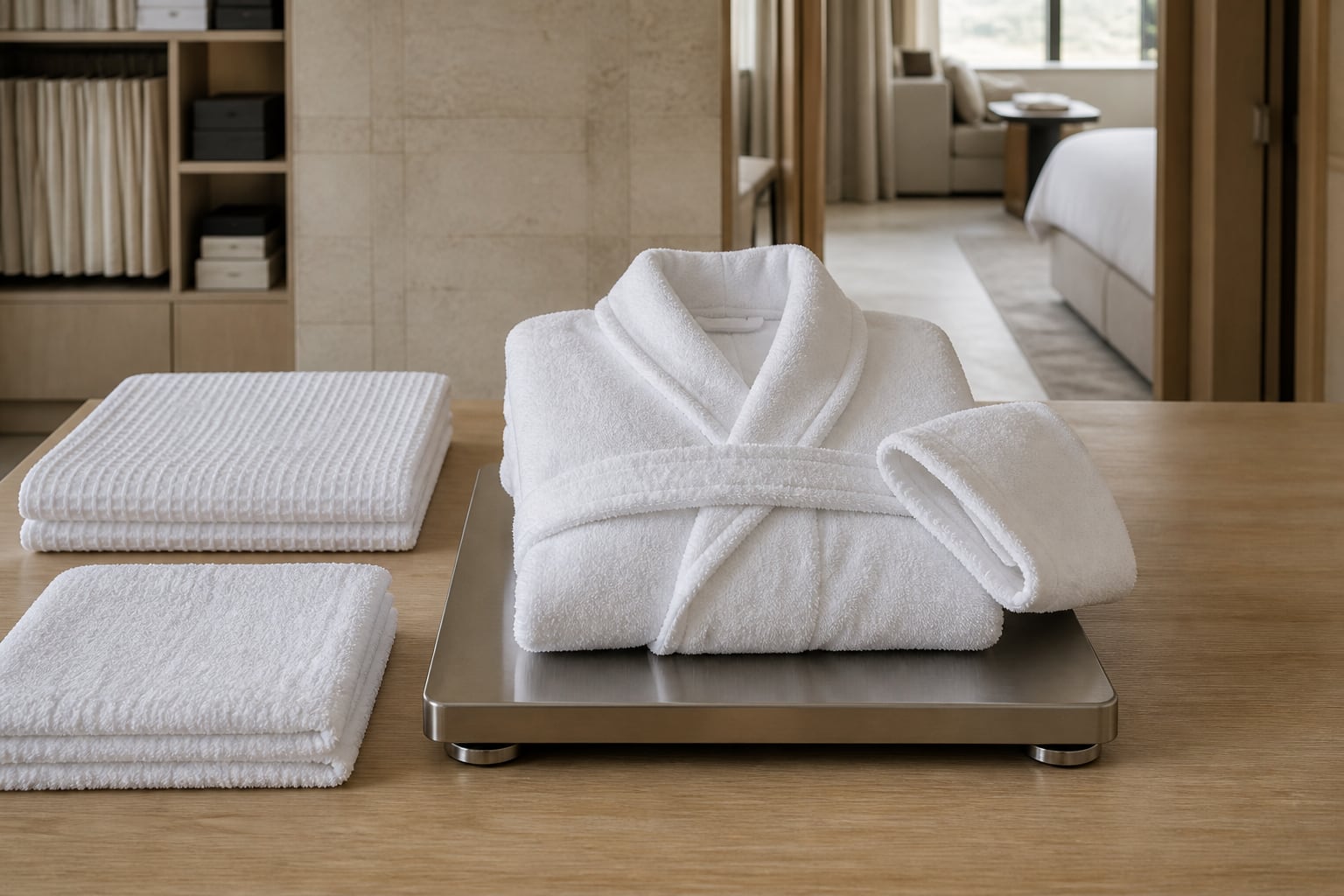
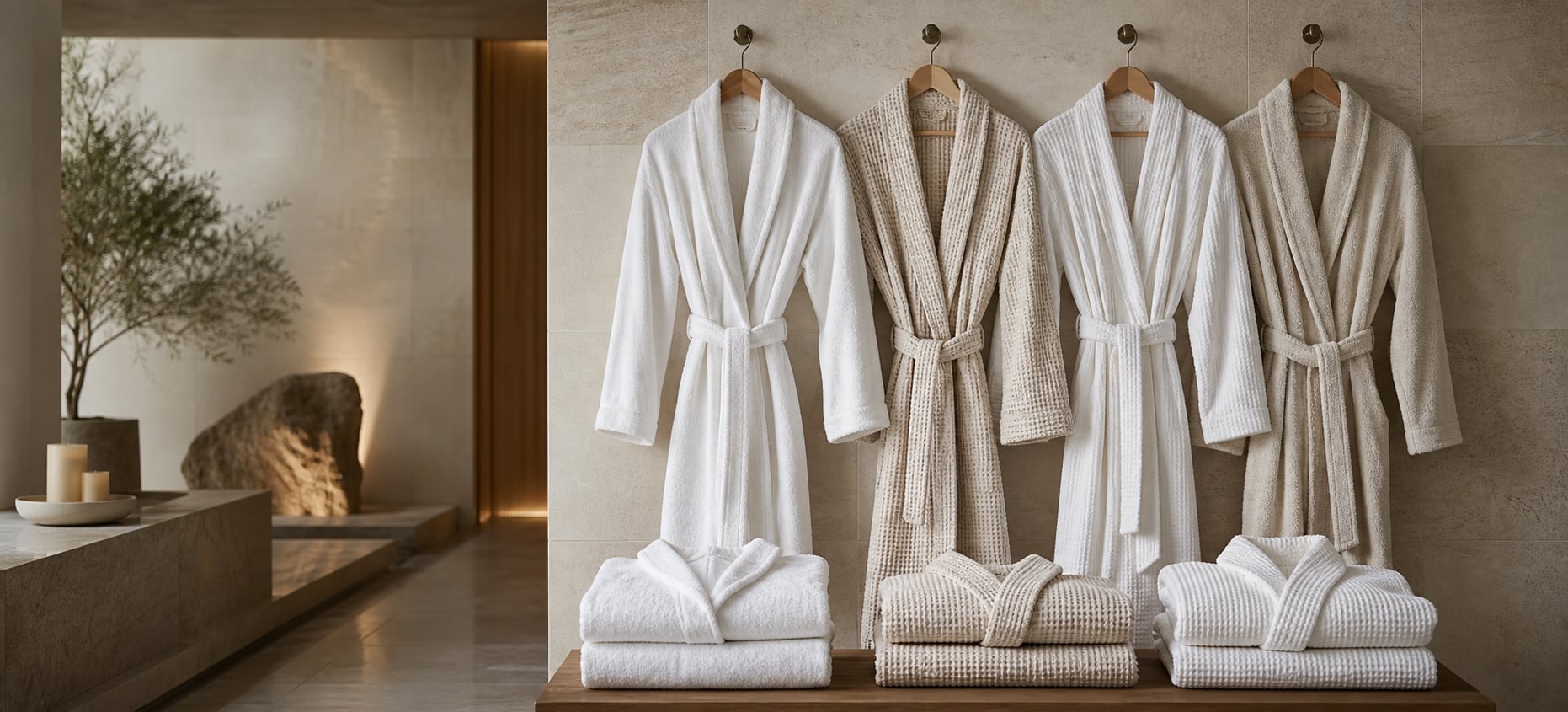
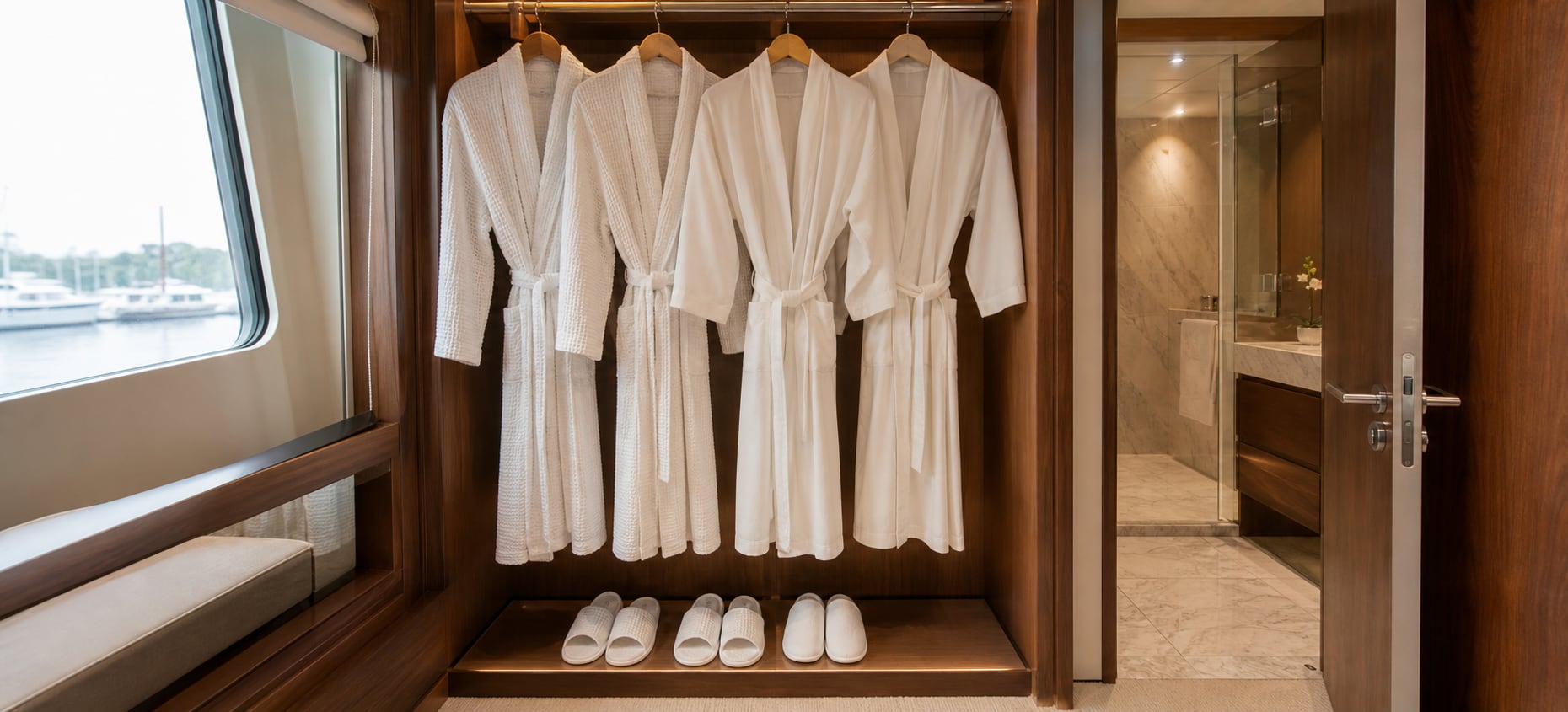
For a cotton terry bathrobe used in hotel guest rooms, 350–450 GSM is a sensible starting range. It usually gives the robe enough body and post-shower absorbency without moving automatically into the bulk of very dense terry. For a lightweight waffle robe, a range around 200–300 GSM is more typical because the construction is meant to feel lighter and less bulky. These are useful comparison ranges, not quality grades.
Choose the construction before the GSM. A 250 GSM waffle robe and a 400 GSM terry robe are designed to feel and behave differently, so the lower figure does not make the waffle robe inferior. Once the construction is fixed, GSM helps you choose how light or full that particular robe should be.
Move above about 450–500 GSM only when a noticeably full, warm terry or terry-velour robe is part of the intended experience and the finished sample remains comfortable. In a warm room, for dry lounging or where robes need to circulate quickly, a lighter garment usually makes more sense.
Practical starting ranges by robe type
There is no official hotel star rating attached to a GSM number. The ranges below are places to begin a sample comparison. Fibre, yarn, loop or waffle construction, finish, dimensions and collar style can all change the result.
| Robe type | Starting GSM range | What that range is likely to suit |
|---|---|---|
| Lightweight waffle | About 200–300 GSM | Warm rooms, dry relaxation and a robe that folds and handles with less bulk |
| Cotton terry | About 350–450 GSM | General guest-room use where body, warmth and post-shower absorbency need balancing |
| Full terry or terry-velour | About 450–500 GSM and above | A deliberately heavier, warmer feel after the complete robe has been tested |
| Flat woven or other lightweight construction | Compare within that construction | Uses where drape and lightness matter more than towel-like absorption |
The ranges overlap because GSM is only one description of the fabric. A compact 400 GSM terry can feel firmer than a more open construction at the same weight. A velour face can feel smooth while the looped reverse handles moisture. The number narrows the comparison, but the sample tells you how the robe actually feels.
If the construction itself is still undecided, begin with the broader guide to choosing bathrobes for a hotel. It separates guest-room, pool and spa uses before weight is considered.
GSM measures fabric, not the finished robe
GSM means grams per square metre. It describes how much a square metre of fabric weighs under the agreed measuring conditions. It does not tell you the total weight of the garment, because a complete robe contains several square metres of fabric as well as a belt, pockets, labels, seams and sometimes embroidery or piping.
Length and cut can therefore outweigh a small GSM difference. A long robe with a generous front overlap, deep cuffs and a shawl collar may weigh more than a shorter robe made from fabric with a higher GSM. This is why the finished piece weight belongs beside GSM when two samples have different dimensions or details.
The arithmetic is useful when everything else stays equal. At the same fabric area, 450 GSM contains about 29% more fabric mass than 350 GSM. That difference appears across the body, sleeves, collar and belt. If the two robes are different sizes, however, the ratio no longer predicts which complete garment will be heavier.
Moisture also changes textile mass. When a quoted GSM needs verification, the supplier and buyer should use the same sampling, conditioning and test method. A casual swatch measurement taken in different room conditions is not a reliable basis for rejecting a delivery.
Compare weight within the same construction
GSM is most useful when the other important variables are held steady. Compare two looped cotton terry robes with the same dimensions and collar style, or two waffle robes made to the same pattern. The weight difference can then be felt without construction or fit disguising it.
Avoid treating the ranges as one ladder from basic to premium. A light waffle robe may be exactly right for a warm guest room, while a dense terry robe may be uncomfortable there. In a cool suite where the robe is worn after bathing, the same dense terry may feel reassuring. The lower number is not automatically a compromise and the higher one is not automatically an upgrade.
Towels are not a shortcut either. A bath towel and a robe can share a GSM while feeling completely different because the robe wraps around the body and adds sleeves, overlap, a collar and a belt.
The guide to GSM for hotel towels explains towel weight in its own context. Use those figures for towels, not as a bathrobe scale.
What a higher GSM changes for the guest
Within the same terry construction, a higher GSM normally gives the robe more substance. It can feel warmer, hold more moisture and create a fuller layer around the body. That may be welcome when someone steps out of a shower into a cool bathroom.
The same mass is carried on the shoulders and becomes more noticeable once the robe is damp. A heavy shawl collar can stay wet near the neck, and generous sleeves can feel cumbersome around a basin or breakfast tray. Guests experience the complete garment, not a square metre of fabric.
Absorbency does not rise in a simple quality line with GSM. More fabric can provide more capacity, but fibre, loop structure, yarn and finish affect how readily water reaches the material. A lower-GSM sample that wets easily may dry the skin more pleasantly than a dense sample whose finish initially resists water. Compare the robes in the condition in which a guest will use them.
What extra weight changes after use
More fabric mass also moves through every laundry load. When robe dimensions and construction are comparable, the heavier option generally leaves fewer pieces per weight-limited load and gives the dryer more textile and moisture to handle. The exact effect depends on extraction, load size, equipment and drying endpoint, so a GSM number cannot predict a universal cycle time.
The difference continues in storage. A full terry robe takes more shelf or trolley space than a light waffle robe and is heavier to move in quantity. These points should not automatically defeat the heavier choice. They simply need to be worth the guest-facing difference.
A robe shared between guest rooms and a spa needs particular care because the use may change. Time spent in damp changing areas, movement between facilities and the laundry return required by a spa can favour a different weight from a robe that stays in a cool suite.
The article on avoiding spa bathrobe specification errors covers those conditions in more depth.
Choose between nearby weights with complete samples
Ask for complete robes in the same construction, size and style at two nearby weights. Wear each one dry, then after a shower if it is meant to absorb water. Notice the weight at the shoulders, the warmth around the neck, the way the front overlaps and whether damp sleeves or cuffs become awkward.
Then send both samples through the intended washing and drying process. Compare the dry finished weight, time to reach the normal drying endpoint, feel, dimensions and appearance. Decide whether the extra fabric produces a difference that guests will value enough to justify its effect on handling.
Keep the comparison narrow. If one sample changes the fibre, collar, length and GSM at the same time, it cannot tell you which difference produced the result. First choose the robe construction and pattern, then compare weight within that design.
Record GSM with the complete specification
Record the approved GSM together with its tolerance, fibre composition, construction, finished measurements, collar and cuff design, belt, pockets, finished piece weight and care method. Keep a washed reference sample. This prevents a later order from matching the headline number while changing the garment around it.
For most guest-room terry robes, begin the comparison at 350–450 GSM. For lightweight waffle, begin around 200–300 GSM. Choose a heavier option only when the complete washed robe gives a clearly better result for the intended use.
Compare shortlisted weights in complete garments from the Gencer hotel bathrobe collection, and approve the sample that still feels appropriate after real use and care.
Product catalogue
Request the Stay catalogue
Share your business email and, if useful, your company or property name. We will carry these details into the secure catalogue-request form with the relevant category already selected.
Journal
Continue reading
How to Choose Bathrobes for a Hotel
Choose the robe for how guests will use it, then approve its fit, construction and appearance after the hotel’s actual care process.
Read How to Choose Bathrobes for a HotelWhat GSM Is Best for Hotel Towels?
How to interpret grams per square metre without treating towel weight as a standalone quality score.
Read What GSM Is Best for Hotel Towels?500 GSM vs 600 GSM Hotel Towels
A focused comparison of two common towel weights without treating either as universally superior.
Read 500 GSM vs 600 GSM Hotel Towels