






























How Often Should Hotels Replace Pillowcases?
Retire a hotel pillowcase when normal laundering can no longer return it to the property’s guest-ready standard. Use the reasons and rate of retirement—not a borrowed lifespan—to time replenishment.
Published by Gencer Textiles
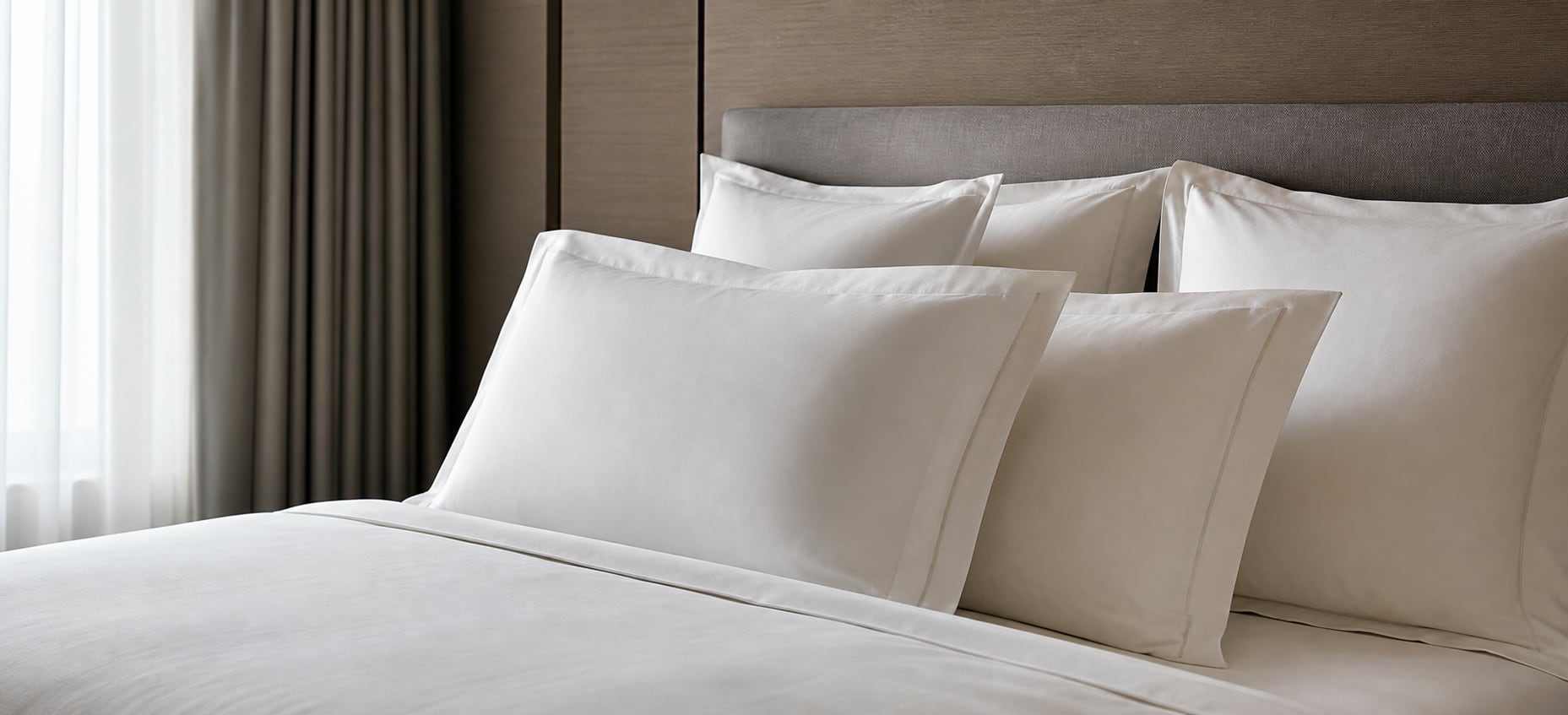
Hotels should not replace pillowcases on a fixed calendar. Retire an individual case when the normal laundry process can no longer return it to the property’s guest-ready standard—for example, because a mark remains, the surface feels rough beside the face, the opening is damaged, the shape has distorted or the colour no longer belongs on the bed. Then use the rate and causes of those retirements to decide when to buy more.
This is a different question from how often a pillowcase should be changed and laundered. Change frequency follows the hotel’s service and hygiene policy, including the reset between guests. Replacement means permanently removing a case from the guest-linen inventory. Confusing the two produces neat-sounding answers such as “every year” that say very little about whether a particular case is fit for tonight’s room.
A replacement date answers the wrong question
Pillowcases bought on the same day do not share the same working life. Some circulate continuously in high-demand room types. Others remain in reserve, move through a slower room category or disappear into the wrong stack. A new case can be lost to an irrecoverable stain or torn seam; an older one can remain fully serviceable. Purchase age is useful batch history, not an expiry date.
A promised number of washes is not much better unless each case is tracked and every cycle is genuinely comparable. Soil level, load, water, chemistry, mechanical action, drying and finishing all affect the result. Cycle estimates can help compare batches under one controlled operation, but they should not overrule what the processed case actually looks and feels like.
Judge the case after the process
The useful inspection moment is after laundering and finishing, when temporary creasing and removable soil should already have been dealt with. Open the case under good light and check both faces, the corners, seams, hem, opening and internal flap where present. The question is not whether the piece looks used. It is whether it can return to the bed without an apology or extra work.
| What the finished case shows | Decision | What the evidence may reveal |
|---|---|---|
| Clean, stable in shape, sound at seams and consistent on the bed | Return to guest-ready stock | Normal serviceable condition |
| A mark or odour that may be recoverable under the approved process | Hold outside clean stock for review | A stain-treatment or process question, not yet a retirement |
| Permanent facial-oil shadowing, yellowing or greying outside the room standard | Retire from guest use | Soil, chemistry, sorting or batch behaviour worth tracking |
| Roughness, pilling, thinning or a weakened corner near the face | Retire when it fails the approved hand or appearance | Surface wear or processing stress |
| Frayed opening, failed hem, open seam or distorted flap | Repair only if the result will be sound and unobtrusive; otherwise retire | Construction, handling or finishing damage |
| Changed dimensions or skew that prevents a clean fit | Remove from that room reference and investigate | Dimensional change, mixed specification or process variation |
Keep a doubtful case out of the clean stack while it is assessed. Otherwise the same piece can circulate repeatedly through rewash, folding and room rejection without anyone making a final decision. A simple hold location and a named decision owner are more valuable than a detailed form nobody uses.
The face side deserves a higher standard
A pillowcase occupies a small area of the bed, but the guest sees it at close range and rests directly against it. A faint shadow, coarse patch or raised repair that might be inconspicuous elsewhere can be obvious here. Inspect the sleeping surface by touch as well as sight, and judge embroidery, borders and repairs where the face may meet them.
Cleanliness and condition are separate tests. Correct laundering is the hygiene process; replacement is the serviceability decision after that process. A case can be hygienically processed yet still fail the room standard because it is permanently discoloured, rough, misshapen or visibly repaired. Equally, a sound-looking case should not bypass the approved laundering route.
Read the made bed, not only the folded stack
Small pillowcases often look acceptable one by one and inconsistent when several meet on the bed. Compare shade, lustre, border shape and apparent size in the room’s actual light. White cases from different lots may process to noticeably different tones; an Oxford border can lose its geometry; a stretched opening can expose the protector even though the folded case appears square.
This is why individual retirement and batch replacement are not opposites. Most defects justify removing only the affected piece. A phased batch decision becomes sensible when sound individual cases no longer combine into a coherent presentation, when a construction no longer fits the approved pillows, or when one lot shows a common fault that is accelerating. Replace the smallest group that restores a stable room standard, rather than discarding every case because one failed.
One defect is a decision; a pattern is a diagnosis
Retiring a permanently marked case solves tonight’s release decision. Ten similar marks in one week ask a different question. The cause may sit in room use, delayed stain handling, sorting, wash chemistry, loading, drying, finishing, a trolley edge or the textile itself. Replacing the cases without examining the cluster allows new stock to meet the same damage.
Use a short, stable set of retirement reasons: permanent mark or discolouration; surface or hand; seam, hem or opening; dimensional fit; shade mismatch; loss; and other reviewed cause. Record the product reference and lot where available. The point is not to score the prose of an inspection report. It is to make repeated failures visible enough for housekeeping, laundry and procurement to act on them.
Pillowcases can also expose a circulation problem. Their small format makes them easy to mix between sizes, styles and room groups or to become enclosed within larger linen during handling. If one reference appears to wear unusually fast, confirm that the count, sorting and rotation are real before concluding that the fabric has reached its natural limit.
Let the retirement rate set the buying moment
The reorder trigger is reached before serviceable stock falls below the quantity required on beds, in the laundry circuit and in the property’s justified reserve. Count usable cases by exact size and style; held, rejected, missing and retired pieces are not available inventory. A surplus of one reference cannot dress a pillow assigned to another.
Start with the operating quantity in How Many Pillowcases Does a Hotel Need?, then compare it with the serviceable count and the recent retirement pace. This turns replacement evidence into a purchasing lead signal without pretending that every hotel needs the same annual allowance.
When replenishment is needed, compare a processed sample with the stock it will join. Match finished dimensions, construction, shade and hand—not only fibre composition or a nominal thread count. If the current pool has drifted too far for a new delivery to integrate cleanly, introduce the new lot by floor or room group and keep the references distinct through laundry and storage.
Replace on evidence, not an anniversary
A credible pillowcase policy can fit in one sentence: change and launder according to the hotel’s service and hygiene rules; retire after processing when the case fails the guest-ready standard; replenish before the serviceable pool reaches its operating minimum. Dates, cycle counts and supplier estimates can inform that policy, but none should release a poor case or discard a good one automatically.
The discipline lies in noticing the finished result, deciding once, and learning from recurrence. That protects the guest-facing standard while keeping purchasing tied to the hotel’s own rooms, laundry and loss pattern.
When the evidence points to a specification change rather than simple replenishment, revisit how to choose hotel pillowcases and compare processed options in the hotel pillowcase range.
Frequently asked questions
Is replacing a hotel pillowcase the same as changing it between guests?
No. Changing means removing a used case for the approved laundry process and fitting a clean one according to the hotel’s service and hygiene policy. Replacing means retiring a case permanently because it can no longer meet the guest-ready condition standard.
How many washes should a hotel pillowcase last?
There is no universal wash count. Construction, use, soil, laundry chemistry, mechanical action, drying, finishing and accidental damage vary. Track cycles if the operation can do so reliably, but make the release or retirement decision from the processed case’s condition.
Should a hotel replace all matching pillowcases at once?
Usually not. Retire individual failures and keep sound cases in service. Replace or phase a wider group when shade, hand, fit or construction has become inconsistent on the made bed, or when evidence shows a common batch fault. Test replenishment stock after laundering before mixing it with the existing pool.
Product catalogue
Request the Stay catalogue
Share your business email and, if useful, your company or property name. We will carry these details into the secure catalogue-request form with the relevant category already selected.
Journal
Continue reading
How Many Pillowcases Does a Hotel Need?
A component-level method for calculating pillowcases through the hotel’s real room and laundry circulation.
Read How Many Pillowcases Does a Hotel Need?What Fabric Is Best for Hotel Pillowcases?
There is no universal best fabric. Compare complete pillowcases for face feel, laundering, finishing and fit.
Read What Fabric Is Best for Hotel Pillowcases?How to Choose Pillowcases for Hotels
A practical way to match pillowcase fit, fabric and construction to the room, laundry and housekeeping routine.
Read How to Choose Pillowcases for Hotels